








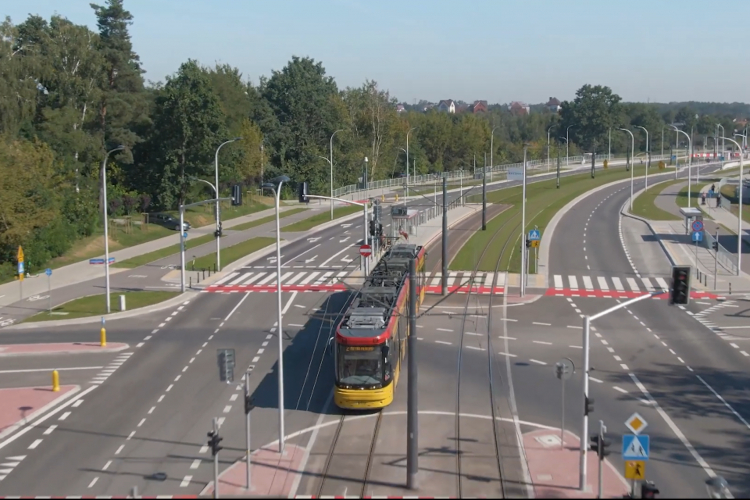
Tramwaje Warszawskie is an example of innovative urban transport in Europe. Modern, eco-friendly rolling stock, fast transit, punctual journeys, and numerous amenities for the benefit of passengers and city residents – these are just some elements of smart city development at the level of tram infrastructure in the capital. Added to this are energy savings, higher road safety levels, and a clean environment. All these innovations would not be possible without technology. Tramwaje Warszawskie is building a so-called green wave solution, a system of priorities for trams, using GPS data and cloud data processing.
Every day, over 400 trams take to the capital’s tracks, covering 4 million kilometers in a month. Together with other public transport modes, they are the most frequently chosen way to travel around Warsaw. This is confirmed by the Microsoft Smart Mobility Index, prepared based on European data, according to which the share of public transport in passenger travel is almost half as high as in other European cities. In this respect, Warsaw ranks first, tied with Brussels.
It is no wonder, then, that transport operators set the modernization of services provided to passengers as their goal. In 2010, the modernization of trams in Warsaw accelerated. At that time, 186 modern carriages were purchased. It was one of the largest such one-time purchases in the world. Additionally, an innovative Passenger Information System was launched – interactive boards at stops that show travelers when their tram will arrive.
However, behind this simple and highly appreciated solution by Warsaw residents lies complex technology. Initially, the entire system of collecting, analyzing, and sharing data from vehicles moving around the city in a way that was readable for passengers relied entirely on a local server room. As long as the system operated only on one short section of Aleje Jerozolimskie, this solution was fully sufficient. However, when the operator, following many positive reactions from Warsaw residents, decided to expand the system to include more stops and parts of the city, it turned out that the physical infrastructure could not provide the quality of service that was expected.
– Providing Warsaw residents with a reliable Passenger Information System that they could rely on during their travels was not an easy task. While the very idea of providing accurate information regarding tram arrival times was a great concept, the implementation of the project in terms of the infrastructure behind the system required some improvements. The local server room was unable to handle such an extensive system. – said Maciej Dutkiewicz, spokesperson for the board.
The physical infrastructure also had many other drawbacks. A significant factor negatively affecting the work of those responsible for maintaining the system was the short, only 3-hour, maintenance windows.
– Any changes to the system or updates had to be carried out at night, during the three hours when trams are not running. Only in this way could we ensure that maintenance work would not be disruptive to passengers – added Maciej Dutkiewicz. – At a certain stage, we matured to the decision that if we want to provide the highest quality services to residents, we must offer them from the cloud. This decision coincided with the migration of the office environment to Microsoft 365, along with email and tools for remote communication and collaboration, such as Microsoft Teams. The success of this project made us look more favorably at the cloud – he continues.
One change, many benefits
Migrating the IT environment to the cloud also opened the door to other projects improving public transport mobility in Warsaw. Placing data collected from the rolling stock on virtual servers enabled Tramwaje Warszawskie to use it in other projects as well. One of them is the flagship green wave system, thanks to which trams passing through an intersection do not have to wait at a red light. The “green wave” directs traffic lights through information sent by vehicles approaching the intersection, so that they do not have to stop. All this takes place under the supervision of city road authorities and is monitored by them, ensuring that the transport needs of other road users – pedestrians and drivers – are also taken into account.
Migrating Tramwaje Warszawskie’s IT systems to the cloud significantly accelerated the implementation work of a system so important to Warsaw residents. Until recently, introducing the “green wave” required installing sensors that detected approaching trams from a distance of even several hundred meters. This involved the necessity of laying underground installations and digging up streets. Not only could this be done on average once every 40 years when the tracks were being renovated, but the cost of building such an installation at one intersection amounted to several hundred thousand zlotys. The new system based on virtual tram detection allows for saving these amounts, as well as faster implementation of innovations at intersections.
– We used to be able to implement priority at 10 intersections a year using conventional methods. After moving to the cloud, we launched priorities at 80 intersections in just two years – said Maciej Dutkiewicz.
Using the “green wave” system, Tramwaje Warszawskie shortened the travel time of rolling stock on the north-south line by several minutes. If we multiply this by the number of trips per day, as well as the number of days in a month, we get real savings, especially in the working time of tram drivers. In turn, a passenger traveling this route every day saved a whole day that they would otherwise have spent traveling around the city.
The “green wave” not only shortens travel time, especially on the longest routes in the capital, but also brings savings to the city budget. Every priority given to a tram at an intersection means electricity bills lower by as much as 10,000 zlotys.
– Starting a 40-ton vehicle generates very high electricity consumption. Thanks to the priority, the tram is able to pass through the intersection without stopping. The green wave means real savings. With full priority, we are able to save up to 13 percent of energy – said Anna Górka from the Tram System Development Strategy Department at Tramwaje Warszawskie.
Cloud computing has additionally allowed Tramwaje Warszawskie to improve the rolling stock diagnostics process, which can now be carried out remotely. The implemented systems monitor vehicle conditions and collect data about them. Thanks to this, those responsible for fleet maintenance can prepare for the repair of components that have failed even before the tram returns to the depot.
Additionally, a remote monitoring system has been implemented, which allows for increasing passenger safety and responding faster to incidents that occur on the tram route.
Plans for the future
– Despite the fact that we are not a technology company, we are very advanced in this respect compared to other companies in the industry. We have something to boast about in this field – argues Maciej Dutkiewicz, talking about the implemented projects.
However, the ingenuity of Tramwaje Warszawskie does not end there. The company plans to continue using the opportunities offered by the cloud.
– In the near future, we want to expand the existing implementations to include more stops and intersections, and we are also planning further projects that will use advanced cloud tools. Ultimately, we assume that more than half of our infrastructure will operate based on this technology – said Mariusz Grochowski, Director of the IT Office at Tramwaje Warszawskie.
However, the use of cloud-based technologies in public transport is not just about faster travel. As the Microsoft Smart Mobility Index points out, such solutions positively affect 35 key aspects of life, including air quality, resident satisfaction with life, and road and transport safety. Simply put, smarter mobility solutions and services positively affect societies and their well-being. Cities that perform well in this regard have not only more satisfied residents. Innovations implemented for residents also attract investment and talented employees.
– The Passenger Information System, the green wave, or remote diagnostics are examples of innovative projects that realistically improve the work of tram drivers and employees responsible for maintaining infrastructure and the fleet, but above all, they improve the quality of life of the city’s residents. Projects like these prove how innovative Polish technological thought is and how much ingenuity and readiness to implement the latest solutions lies within Polish society. That is why I am extremely pleased that it is Microsoft’s cloud that is the foundation of all these solutions, and thanks to it, companies like Tramwaje Warszawskie can implement innovations that serve people – said Ilona Tomaszewska, Public Sector Director at Microsoft Poland.
Source: Microsoft/Paulina Bochen