











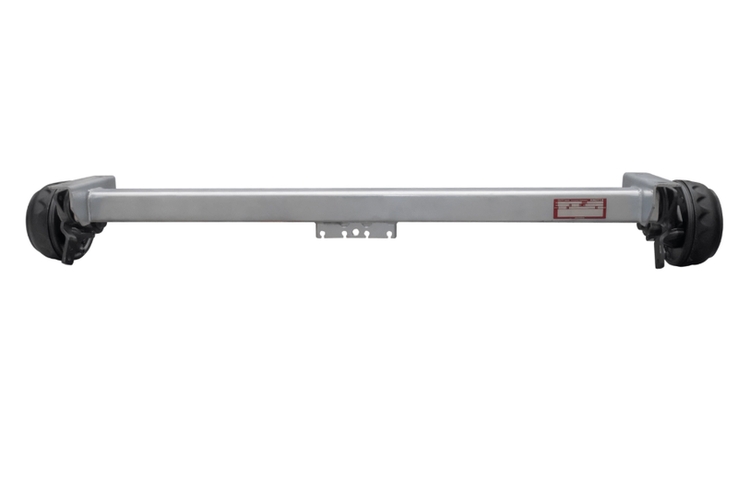
A trailer axle is a component responsible for the safety, load capacity, and stability of a vehicle combination on the road. Its selection should not be accidental but rather thoroughly considered. You will encounter various types of trailer axles on the market – if you do not know what to look for when making a purchasing decision, be sure to read this text.
Trailer axle – what is it and what is it responsible for?
A trailer axle is a structural element that connects the trailer wheels and enables it to move stably on the road. It transfers the weight of the load to the running gear, influences vehicle handling, and largely determines safety during transport. Depending on the design and equipment, it can also perform additional functions – such as vibration damping, steering assistance, or braking.
Types of trailer axles
A well-chosen axle is a guarantee of a smooth ride, both with an empty and a loaded trailer. It minimizes tire wear, dampens vibrations, and, when using appropriate technologies, protects the transported cargo. Depending on the design and purpose, you will find several types of axles on the market:
The simplest in construction and the cheapest is the rigid axle. It consists of a single beam connecting both wheels and is mainly used in light trailers (GVW up to 750 kg). It works well on short distances and even terrain, but it may handle uneven surfaces worse and contribute to faster tire wear.
A torsion (swinging) axle is a solution that facilitates maneuvering, allowing for independent wheel movement and better adaptation to the surface. It increases driving comfort in narrow streets or on winding roads. It is often used in cargo and utility trailers that require greater maneuverability.
The most advanced variant is the damped axle – with suspension that is cushioned or pneumatic. It dampens vibrations better, maximizing stability and driving comfort. However, it requires regular maintenance and is the most expensive, as it is a top-class choice.
When is a braked axle needed?
Another popular variant is the braked axle – integrated with a braking mechanism that most often works with an overrun brake. This means that the trailer brakes on its own when the car starts to slow down. The force of the overrun on the hitch activates the system and mechanically presses the brake shoes in the hub.
Having a braked axle is mandatory for trailers whose Gross Vehicle Weight (GVW) exceeds 750 kg. Without this component, the trailer cannot be registered or admitted to traffic. Why is this important and required?
The primary issue here is safety. A braked axle shortens the braking distance of the entire combination, increases stability when driving with a load, and proves invaluable especially on steep descents and during sudden braking. Furthermore, it relieves the car’s braking system, minimizing the wear of individual components of that system.
What should guide you when choosing a trailer axle?
There are at least several criteria regarding the selection. They determine durability, driving comfort, and safety on the road. It is worth considering primarily the weight of the load, the type of terrain, the type of trailer (e.g., cargo, construction, specialized – agricultural, motorcycle, etc.), as well as the type of suspension and the method of use. If you want to be sure that you choose a proven and durable product for many years – reach for high-quality components from renowned manufacturers, e.g., AL-KO, KNOTT. In case of doubt, seek professional advice.