









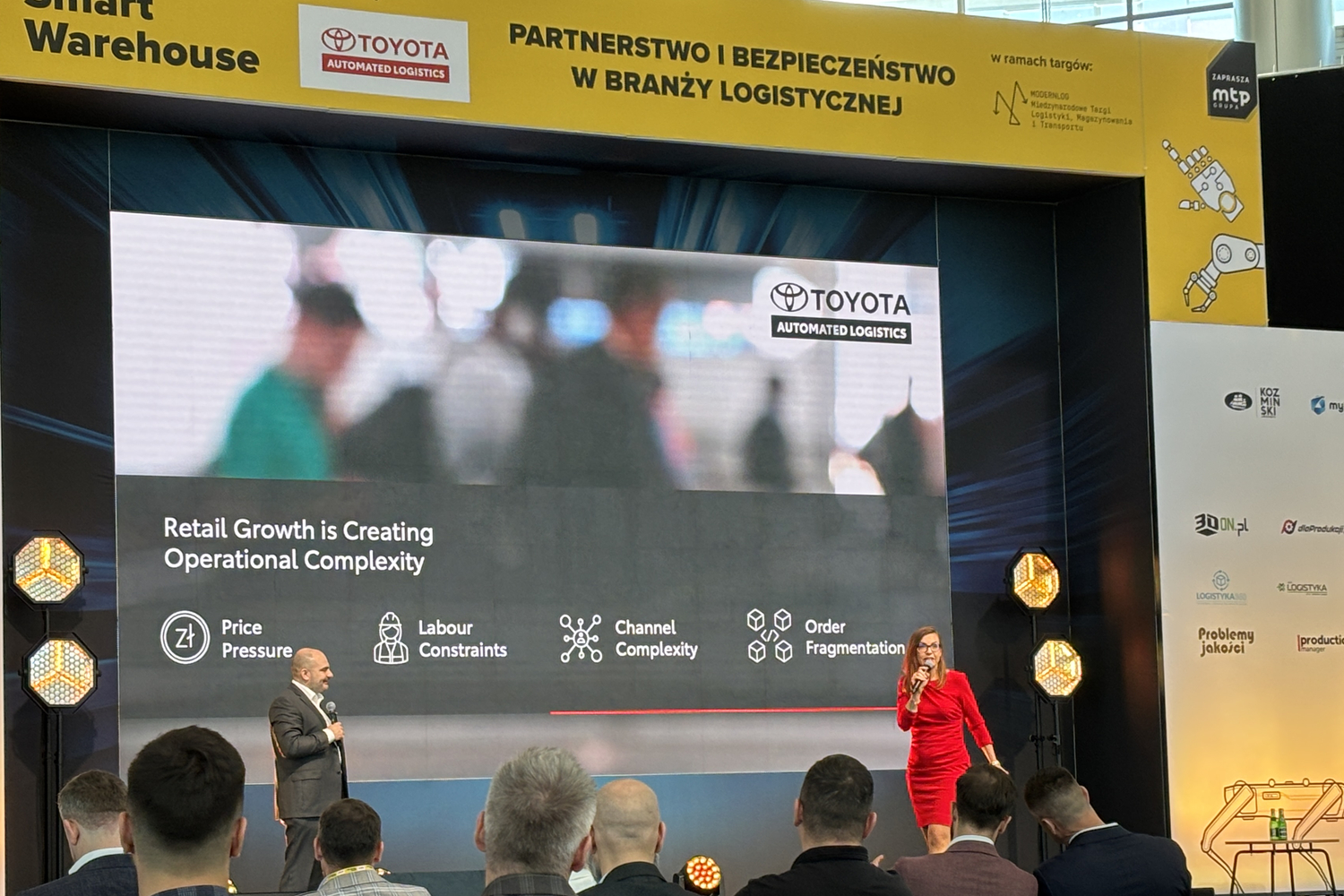
Poland is currently the fifth-largest e-commerce market in Europe. It is characterized by an unprecedented growth rate and unique challenges. How do global players navigate this dynamic environment? Representatives of Toyota Automated Logistics argue that the key to success is flexibility, local commitment, and the Japanese philosophy of continuous improvement.
Although almost everyone recognizes the Toyota brand, the intralogistics market is still evolving in its perception of the company’s full portfolio. Toyota Automated Logistics (TAL), part of the powerful Toyota Industries Corporation group, is a separate entity focusing on advanced automation. This organization is built on solid pillars and the experience of companies such as Vanderlande, Bastian Solutions, and viastore.
With over 550 active installations in nearly 100 countries worldwide, TAL is one of the largest global providers of intralogistics solutions. However, it is Poland that emerges in the company’s strategy as a market of particular importance.
Global DNA, local commitment
We have already completed over 47 projects here and support many installations. We assist our clients through after-sales care, but also through the continuous development of projects over time – emphasizes Katarzyna Błaszkiewicz, Business Development Manager (CEE region) at Toyota Automated Logistics. – The installed technology is not a ‘forever’ solution. That is why, even though we are a global organization, we are very deeply rooted locally.
Lack of ‘legacy burdens’ as a Polish advantage
Unlike Western European markets (e.g., Germany, the Netherlands, or the UK), where automation has been implemented gradually over the last 20-30 years, the Polish market is not burdened by older technologies. Companies in Poland do not have to integrate innovations with obsolete systems, which gives them enormous flexibility and allows for a ‘fresher’ approach to investment.
On the other hand, Polish logistics faces a unique challenge: the simultaneous and extremely dynamic development of traditional retail store chains and the online channel.
Older markets first developed physical supply chains and only later layered online volumes on top of them. In Poland, there is no such luxury. Everything is developing simultaneously, which creates a unique challenge: an advanced omnichannel model and the necessity to handle, among other things, returns or click-and-collect orders, often from a single warehouse – notes James Osborn, representing Toyota’s global structures.
What does Poland teach Toyota?
The Polish market operates under immense cost pressure and struggles with labor shortages, which necessitates smart automation. In response to these local conditions, TAL has defined four main investor expectations that are currently shaping the company’s strategy across the entire EMEA and APAC regions:
1. Incremental investments: Clients want to start with smaller systems and scale them as needed, avoiding over-investment (fast ROI).
2. Compactness: Installations often take place in already operating facilities, without the possibility of halting warehouse operations.
3. Hybridity: Systems must handle complex omnichannel flows.
4. Scalability and flexibility: Solutions must adapt to unpredictable market changes (a strategy including, among others, dense AS/RS storage with a very wide SKU profile).
In implementing these strategies, Toyota collaborates with a network of technologically advanced partners, such as Geek+ Robotics, which allows for the selection of optimal and agile solutions tailored to a specific distribution center.
Japanese long-term planning
Clients are no longer just looking for a manufacturer or a supplier of individual technologies. They are looking for a partner who will design, implement, and then take full responsibility for the project and its maintenance according to agreed standards – points out Katarzyna Błaszkiewicz.
Such a role as a general integrator fits perfectly into the Japanese organizational culture, in which Kaizen is of fundamental importance – a philosophy of continuous improvement based on humility and the conviction that every process can be improved.
This is also linked to an extraordinary planning perspective. Although 3- or 5-year strategies are the standard in Europe, Toyota operates in 20-year horizons. How is this possible in such a volatile and unpredictable industry, exposed to dynamic geopolitical and market turmoil?
The key is building resilience and flexibility at the planning stage. Our long-term transformation plans for Poland are linked to its development into a true Central European logistics hub. We know there will be moments of extreme pressure. The key is to anticipate these extremes and have a system that can adapt to them – explains James Osborn.
See for yourself
Flexibility and safety also mean resilience to modern crises, such as rising energy costs or the risk of blackouts. Toyota representatives emphasize that the basis for reducing energy consumption is full transparency and profiling of its consumption. In turn, in the face of power failure risks, the Japanese response is not limited to simple countermeasures, such as diesel generators.
The answer is the Japanese concept of Genchi Genbutsu (‘go and see for yourself’). This means creating individual contingency plans based on a deep, local understanding of the impact of a potential problem on the client’s logistics system.
Combining Japanese work methodology with a deep understanding of Polish dynamics creates a new quality on the market. Toyota Automated Logistics proves that implementing automation in e-commerce and omnichannel logistics does not have to mean painful compromises. Instead, it can be a thoughtful, constantly improved journey with a trusted partner, ready for the challenges of not just tomorrow, but the coming decades.
The article was based on a keynote speech delivered during the Smart Warehouse conference.