











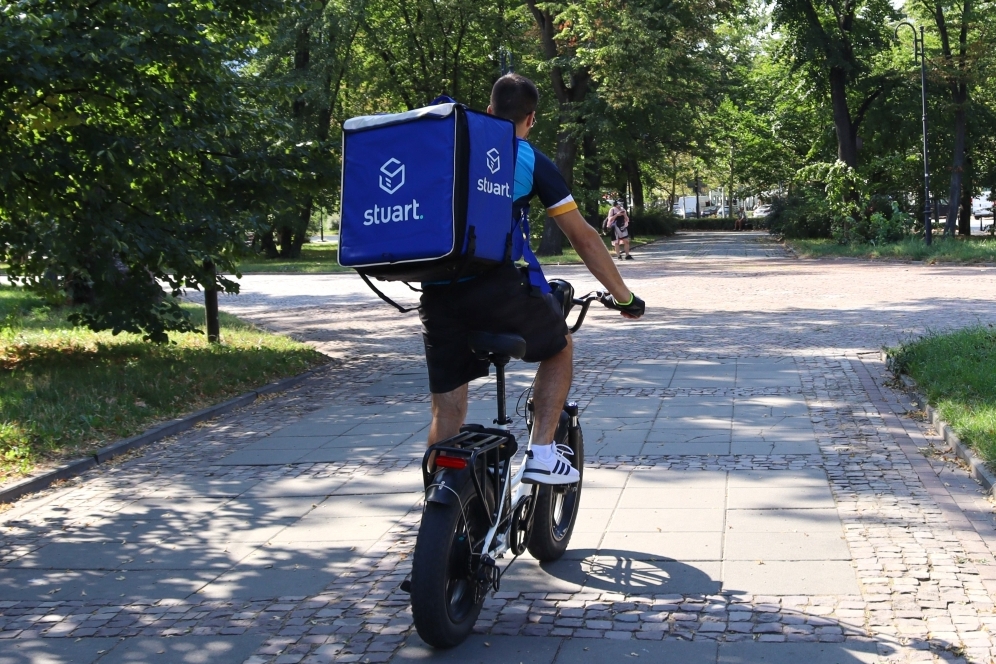
Stuart, a company responsible for fast deliveries for clients such as AmRest and Leclerc, is getting closer to its goal of achieving net-zero emissions by 2035, according to this year’s Sustainability report. Over the last twelve months, the number of eco-friendly deliveries it has completed has increased by more than half, and CO₂ emissions per parcel have decreased by 1/4.
As shown by the Stuart study “(Un)Delivered Trust. When logistics runs out of breath,” as many as every second Polish retailer declares that ecology in deliveries is an important aspect for them. At the same time, one in five openly admits that the environmental impact of last-mile services poses a certain challenge for them. Alongside delivery speed and costs, this aspect remains quite high on the development strategy agenda for retailers. Does the instant delivery model have a solution for this?
Ecological optimization shows the difference
A step towards green logistics is enabled by an appropriate fleet assigned to parcel transport – including electric cars, scooters, or bicycles, which are part of low-emission vehicles. The 2024 Sustainability report shows that it is thanks to these that the number of deliveries carried out by Stuart in an environmentally friendly way has increased by 61 percent year-on-year. Supporting the process was also the use of smart parcel consolidation technology and route optimization based on AI. The result is not only faster delivery but also a real reduction in emissions, which fell by as much as 24 percent per parcel.
Striving for climate neutrality is a clearly defined goal that we face every day, and annual reports help us not only track progress but also transparently communicate where we are in the process.
– says Agnieszka Majewska, General Manager of Stuart in Poland.
The results show that concrete actions towards zero emissions can gradually transform urban logistics. Although the availability of infrastructure supporting investments in a sustainable fleet remains limited at the moment, the fast delivery model uses solutions that support this path in many industries, also outside of gastronomy and e-grocery. For example, some modern cargo bikes are designed to carry parcels with a total weight of 600 kg to 1000 kg per day.
Monoprix, a French chain offering food, clothing, and cosmetics, among other things, serves customers both in-store and online. Together, we carry out deliveries in Paris in less than an hour, using only an eco-friendly fleet. This is proof that even a large retail chain in a metropolis can operate in a sustainable and cost-effective way.
– adds Agnieszka Majewska.
The issue of green last-mile logistics remains worth analyzing, especially in the context of future ESG reporting, growing interest in shopping, and customer expectations – both in terms of delivery speed and transparency. The complex layout of urban fabric, the increasing number of returns, or deliveries during peak hours remain a challenge for the retail sector, which can look for answers in modern, environmentally friendly services in the spirit of q-commerce.
About the study
The study was conducted on the Ariadna National Research Panel on a sample of N=109 people. Quotas were selected according to the representation in the population of people aged 18 and over – for gender, age, and size of place of residence. A purposive sample was selected according to the representation in the population of people managing a company / business owners in the trade and service sectors in Poland. Implementation date: March 19–24, 2025; method: CAWI.
Source: Stuart