









The year 2019 proved to be a record-breaking one for passenger transport. Over 335 million passengers were transported by rail – 25 million more than in 2018. Freight transport fell by about 5% compared to 2018. 236 million tons of goods were transported by rail.
Przewozy Regionalne – POLREGIO enjoyed the greatest popularity in 2019. Almost 88.9 million passengers used their services. The company implemented a concept of mutual ticket recognition with public transport operators and expanded the possibility of purchasing tickets through various channels. A new brand of superREGIO trains was created, which are intended to ensure greater availability of connections between individual cities in selected voivodeships. The top three also included Koleje Mazowieckie, which transported 62.1 million passengers, and PKP Intercity – 48.9 million passengers.
– The total length of journeys made by rail passengers is over 22 billion kilometers. A significant part of these trips could probably have been made by private cars. However, these cars did not appear on the roads, they did not travel billions of kilometers. It is thanks to the railway that traveling was safer and more ecological. The railway currently serves as an excellent, daily-used metropolitan and urban transport system and is eagerly chosen for long-distance tourist or business trips – says Dr. Eng. Ignacy Góra, President of the Office of Rail Transport.
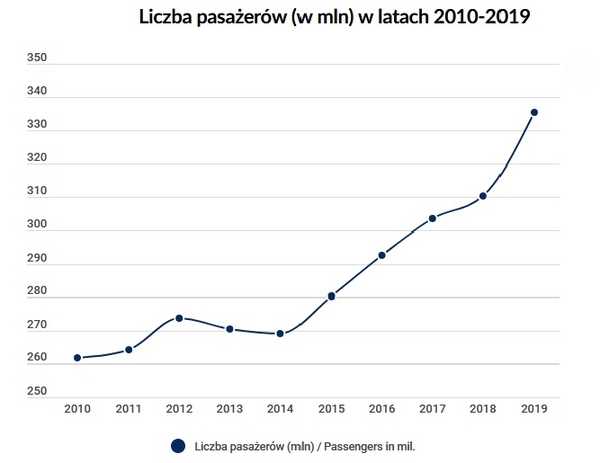
Almost all carriers operating regular services recorded an increase in the number of passengers compared to the previous year. In terms of the percentage increase in the number of travelers, the leader was Łódzka Kolej Aglomeracyjna, which can boast a 27% increase. Koleje Śląskie and Koleje Dolnośląskie achieved a 20% increase.
The increase in the number of travelers last year is not a coincidence, but the result of significant investments. Carriers carried out modernizations and purchased rolling stock. These investments significantly increased travel comfort. PKP Intercity, for example, upgraded the standard of 90 carriages in 2019. The availability of many distribution channels, the creation of joint offers integrated with public transport, the possibility of paying for tickets with payment cards, the increasing accessibility of the railway for people with reduced mobility, or the launch of more trains during periods of peak demand – all this influenced the competitiveness of rail transport. The year 2019 also brought the adoption by the Council of Ministers of a resolution on the establishment of the Program for Supplementing Local and Regional Railway Infrastructure Kolej Plus until 2028. This should increase the availability of railways in the regions. The number of international connections, which were launched by both regional and long-distance carriers, also increased.
In freight transport, PKP Cargo leads with a share of over 40% by mass and almost 44% by transport work. However, the share of smaller carriers is growing. Entrepreneurs whose market share did not exceed 1% transported a total of 13% of the cargo mass.
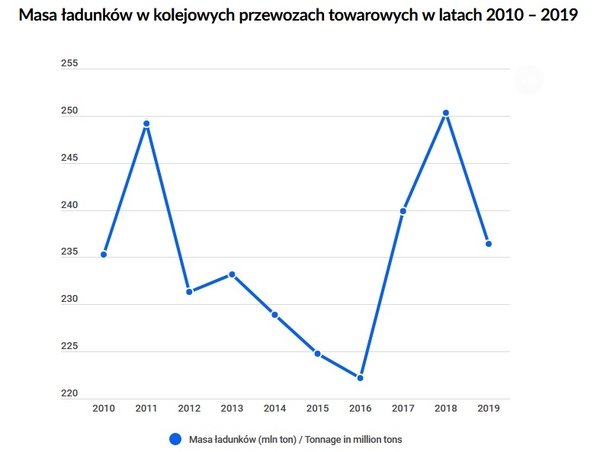
A precise analysis of the structure of freight transport will be possible after collecting data from the last quarter of 2019. However, it can already be stated that the transport of bulk goods had the greatest impact on transport results. Due to lower demand for aggregates or coal, an increase in the share of intermodal transport is noticeable.
– The mass of intermodal transport is growing year by year. This type of transport has a future and should be developed – informs Dr. Eng. Ignacy Góra. – Thanks to intermodal transport, road, rail, and sea transport can be used optimally.
Thanks to support from EU funds dedicated to projects related to intermodal transport, one can notice large investments by carriers in rolling stock adapted for container transport. The results of the UTK report for 2019 are very optimistic and show that the railway is striving to improve quality.
Report “Year 2019 in passenger and freight transport”
Source: Office of Rail Transport