












Microchips are a component that can be crucial for economic and technological security. In recent years, many projects have been launched around the world aimed at changing the existing order, in which critical components were manufactured in only a few places globally. DSV – Global Transport and Logistics has already begun building logistics solutions that will become the foundation for new silicon supply chains.
The global race for autonomy
The Covid-19 pandemic highlighted the enormous impact that semiconductors have on the entire economic ecosystem. Disruptions in the supply of integrated circuits from factories located in South Korea or Taiwan led to the limitation or complete suspension of operations for companies around the world. In Europe, the most vivid example was the problems of the automotive sector – and hundreds of thousands of vehicles waiting in lots around factories or dealerships. All this because cars lacked small components that enable the proper functioning of complex comfort or safety systems.
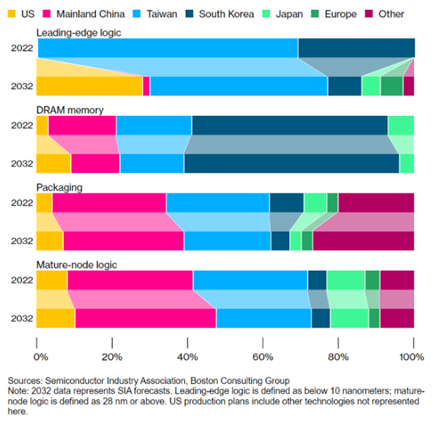
In response to these events, regulations were created in Europe (European Chips Act) and the United States (CHIPS Act) aimed at supporting – through various types of facilities, preferences, or subsidies – the construction of local semiconductor production centers. As an analysis by the Semiconductor Industry Association and the Boston Consulting Group shows, public investments will transform the global chip production market in the coming years.
Silicon trade routes
Although analysts at the Boston Consulting Group do not predict that Asian manufacturers will lose their leading position among integrated circuit suppliers, they forecast a significant increase in production capacity in Western countries by 2032, particularly in the United States. Along with the reshoring of factories to new locations, it will be necessary to create new logistics chains capable of handling both the supply of necessary raw materials and semi-finished products, as well as the transport of finished products to customers.
In the world of semiconductor logistics, every stage of the value chain involves a series of challenges. Before a chip is created, very delicate, technologically advanced machines or chemical substances used in production processes must reach the factory. Finished products, which are crucial to the economy, also require special attention – shipments must be properly protected against physical factors such as temperature and humidity. Vibrations or pressure can also lead to their damage.
– says Krzysztof Osik, Air Freight Director, DSV – Global Transport and Logistics.
Due to the properties of semiconductors, air transport plays a key role in the global architecture of the supply system for these products – based on the principle that the shorter the transit time, the lower the chance of risks materializing.
DSV strengthens its presence in the USA
With the future needs of companies on both sides of the Atlantic in mind, DSV – Global Transport and Logistics has been strengthening its operations in the US state of Arizona since 2023. The operator has added new capabilities for handling shipments from the local Phoenix-Mesa airport as part of its global air consolidation network.
Service quality is absolutely crucial for companies in the advanced electronics manufacturing sector. Even the smallest error can lead to serious consequences in later stages of production processes, including even their stoppage. This can involve incurring costs in the amount of millions of dollars. As DSV, we meet these expectations and develop our teams of specialists who can directly supervise the handling of goods at the port of origin and destination.
– points out Krzysztof Osik, Air Freight Director at DSV.
The choice of investment location is not accidental, as the state is one of the largest beneficiaries of the US CHIPS Act. Since 2020, 40 new projects related to chip production with a total value of USD 102 billion have been launched there. These ventures include, among others, the construction of the first factory outside Taiwan for TSMC – the largest semiconductor manufacturer in the world.
Source: DSV