








Jesper Sonne Thimsen, Sales Director for Central and Eastern Europe at Mobile Industrial Robots (MiR), summarized the key trends affecting the AMR market during a press briefing. Increased adoption of robots for primary production will be combined with the emergence of larger AMR fleets, which in turn will result in the need to manage the interaction of different robots within a fleet, interoperability, more advanced cooperation with IT systems, easier maintenance, and the development of AI functions.
45% growth, and that’s not the end. Robotization from a market perspective
According to data from the IFR report, mobile robot solutions are already firmly rooted in transport and logistics, with over 49,500 units sold in 2021 alone. This is a significant 45 percent increase over the previous year. Sales results also reflect the demand for automated mobile transport in manufacturing – more than 80% of the units sold were mobile robots for transport and internal logistics without public traffic. In 2021, unit sales grew by 47% to over 40,400 units.
“The need to automate material transport is accelerated by the difficult situation in the labor market and the need to ensure production and services are resilient to disruptions. Recent years have proven that robotization is the answer to these problems. MiR robots operate 24/7, coping with changing work environments and needs, allowing manufacturers to shift employees to tasks related to creating the value chain, rather than those that are merely a cost to the company,” says Jesper Sonne Thimsen, Sales Director for Central and Eastern Europe at Mobile Industrial Robots (MiR).
Eaton and Forvia – a look at successful implementations
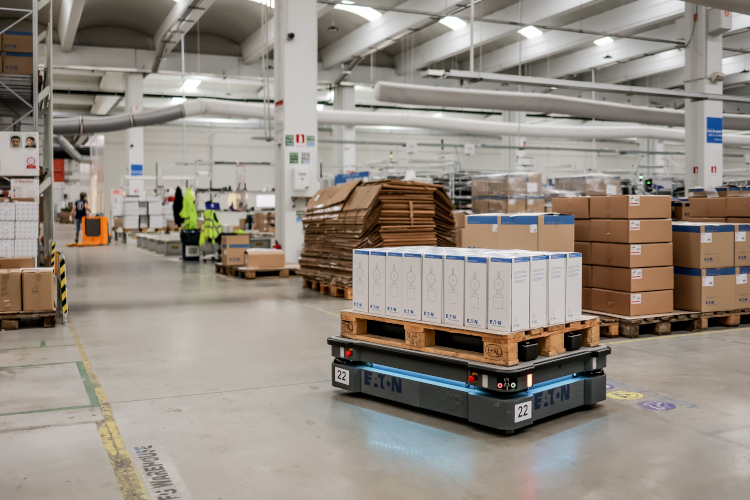
The Romanian Eaton is a global power management company. The Arad plant manufactures products for the Life Safety business unit. MiR robots were implemented there to optimize intralogistics processes and safety. The main reason was to relieve employees and move them to higher value-added tasks, such as working in multi-tasking teams. MiR robots work at Eaton six days a week, operating on two shifts. Every day they transport over 100 pallets.
Before the AMR system was implemented, materials were transported by employees using manual forklifts. This took up unnecessary time, especially between shifts when assembly lines had to be prepared for incoming employees. The entire fleet consists of 5 MiR robots. The company plans to use new MiR250s to pick electronic components from the controlled environment of the SMT area.
There are 14 MiR robots working at the Forvia plant in Písek (CZ). 7 of them are large robots, mainly MiR600s, which work in the finished goods area, bringing empty pallets to the assembly lines and picking up full pallets for the logistics area. The second area where MiR250 robots operate is delivering components from the warehouse to the assembly lines. The robots at the plant work 24 hours a day, seven days a week, covering all three shifts. MiR robots were chosen as the best fit for the manufacturer’s needs: they are a globally available, complete, autonomous solution using Wi-Fi connectivity, independent mapping, and customized fleet software. The final factor was the level of service and maintenance provided by Mobile Industrial Robots, which was rated as very high.
In all the above cases, users carefully calculated the total cost of ownership, which proved useful, especially in the face of rising electricity costs. “We are proud to say that our products, in addition to other features, are distinguished by low energy consumption. A full day of MiR work costs just 2.58 EUR. By implementing our AMRs, customers get excellent performance and low energy bills in a package,” said Jesper Sonne Thimsen.
AMR robots in the future – what can we expect
During the meeting, Jesper Sonne Thimsen presented key trends that will shape the future of robotics and automation. These are related to demographic changes (labor shortages), the need for cost optimization, and technological development.
The rapid growth of the presence of AMRs and other robots in industry and new communication standards will increase the demand for tools to manage fleets consisting of units from different suppliers. Wider use of the 5G communication standard will bring new possibilities for faster data exchange and faster robot response times. This trend is reinforced by the development of AI, enabling AMRs to communicate directly and, for example, relieve the operator from prioritizing missions. Also, the blurring of boundaries between different “classic” robot applications and the combination of different devices from different suppliers into one solution is noticeable and will intensify over time.
“Seeing how our customers use the solutions we provide, we know that the possibilities are endless – they depend only on the willingness to solve a problem,” concluded Jesper Sonne from MiR.