











Five years ago, Deutsche Post DHL, the world’s leading mail and logistics group, officially launched the GoGreen program, becoming the first logistics company in the world to set a measurable climate protection target.
By 2020, the Group aims to reduce CO2 emissions by 30% compared to the 2007 baseline. The GoGreen environmental program is a permanent element of the company’s strategy, and the results of related activities are reflected in areas such as reduced energy, paper, and fuel consumption, as well as investments in innovative technologies. At the same time, Deutsche Post DHL provides customers with a wide range of environmentally friendly shipping options and opportunities to obtain advice on energy efficiency. In turn, customers can use CO2 savings to reduce their own carbon footprint. Demand for green products and services has been growing steadily for years: in 2012, more than 2.4 billion GOGREEN shipments were sent, and approximately 180,000 tons of CO2 were offset for customers – this is about 30% more than in 2011 and more than three times as much as in 2009, when a total of 704 million shipments were sent.
– GoGreen is a real success – says Christof Ehrhart, Director of Corporate Communications and Corporate Responsibility at Deutsche Post DHL. – Since its implementation, we have been steadily reducing our carbon footprint and are halfway to achieving our goal of reducing emissions by 30% by 2020. Environmental protection has a permanent place in our strategy and is reflected in Group-wide guidelines regarding issues such as paper, purchasing, and investments. Our employees also act sustainably throughout the year. As a result, 20,000 of our employees worldwide have taken part in the “GoGreen” e-learning training.
As part of World Environment Day, which is celebrated under the auspices of the UN every year on June 5, Deutsche Post DHL employees are participating in many projects again this year. In China, Guatemala, and the United States, they are planting trees. In Germany, some have made a conscious decision to stop using cars. In England, employees have started a “Green Week,” during which colleagues will be informed daily about ways to save energy, recycle, and use food wisely. In Asia, lights will be turned off in department stores, and employees in Latin America will turn off air conditioning to save energy.
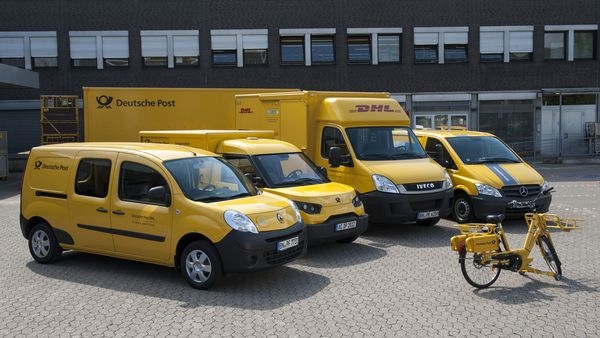
The Group has linked all environmental and climate protection activities to the GoGreen program, which began in 2008. At that time, the company started using biofuels and hybrid-powered trucks. In 2010, the first electric cars were introduced for delivery operations. Currently, about 8,500 vehicles in the Deutsche Post DHL fleet use alternative drives or have undergone aerodynamic or electric engine modifications. Since 2011, a total of 80 hybrid and electric vehicles have been operating in Manhattan, New York, and the company has just announced, together with the German Ministry of the Environment, a plan to offer carbon-neutral deliveries in Bonn, the company’s headquarters. As part of this unique project, 140 electric vehicles will provide zero-emission, quiet, and fuel-efficient delivery of letters and parcels in Bonn and the surrounding area.
The company has also committed to saving resources in its buildings and other facilities: about 42% of the total energy demand of individual buildings is covered by renewable sources. For example, the temperature in the Group’s headquarters is regulated using groundwater from the nearby Rhine, and the energy consumption of the Post Tower is about one-third lower than that of a conventionally built high-rise building. The company’s branches also use environmentally friendly building technology, for example, the European transport hub in Leipzig. Here, solar panels and a combined heat and power plant generate green energy.
Deutsche Post DHL is moving quickly toward its goal of reducing CO2 emissions across the entire Group – including transport services provided by subcontractors – by 30% by 2020. By 2012, efficiency had improved by 16% compared to 2007 levels. However, achieving this ambitious environmental goal by 2020 will require lower CO2 emissions from subcontractors who provide transport services – these emissions account for the largest part of the Group’s measured emissions. For this reason, in 2012, Deutsche Post DHL partnered with other leading transport and logistics companies to implement an initiative called Green Freight Europe, which was created to increase the sustainability of road transport in Europe.
The mail and logistics company has been offering green products to its customers since 2006, when the GOGREEN Pluspäckchen was introduced in Germany. Since 2011, all parcels sent by private customers in Germany have been shipped in a climate-neutral way at no extra cost. Today, many companies also send letters and parcels in an environmentally friendly way using Deutsche Post services. Globally, DHL Express customers in more than 60 countries use carbon-neutral services. In 2010, DHL Global Forwarding introduced CO2 reports, which now also include specific solutions to optimize customers’ supply chains.
Deutsche Post DHL has been calculating its carbon footprint for seven years. In 2009, it also introduced a Group-wide carbon accounting and controlling system, which has been integrated with the accounting department. This allows for the creation of precise CO2 emission reports, which in turn allows for improvements in driver behavior and route planning – which in turn helps achieve the 2020 goal.