










Half of Poles shopping on non-EU e-commerce platforms have no idea that a fundamental change is coming to the way their orders are delivered and settled. However, sellers and contract operators are preparing for the new reality in cross-border online trade, as the revolution in the import model means that the locations through which shipments enter the European market will change. The way packages are processed on their way to the end customer will also change, and purchase prices will certainly change as well. Many myths have grown up around the imposition of customs duties on cheap packages from China, so it is worth clarifying at least a few of them.
From Wednesday, July 1, 2026, e-commerce consumers ordering products from outside the European Union will no longer be able to benefit from the de minimis exemption, which until now allowed both them and sales platforms to avoid customs duties as long as the total value of the shipment did not exceed 150 euros. Under the new regulations, which will be in force for the next two years, a flat-rate customs duty of 3 euros has been introduced, but studies show that Poles shopping on foreign platforms do not have much knowledge about either the change itself or the new rules regarding cross-border e-commerce.
More than half of Poles know nothing about the abolition of the de minimis exemption
The latest analysis conducted in Q2 2026 by ID Logistics Poland among consumers shopping in online stores outside the EU shows that more than half of them (51%) have not heard at all about the changes introducing the 3-euro fee. Another 29% know about them but do not know the reasons for their introduction, and only one-fifth are aware of what caused the reform. The latter most often mention limiting the influx of cheap goods (29%), the need to seal the system (25%), and protecting the EU market (23%). Even among those who have heard about the changes, as many as 38% do not know what they concern at all. Only 27% are aware that it is about customs duties, and another 20% point to some tax, including VAT, which is unfortunately an incorrect indication. It is worth adding that out of a representative group of 1,039 surveyed Poles who made foreign online purchases in the last 12 months, as many as 87% declared that the goods were ordered in Asia.
Target: sales platforms from China
It is Asian platforms that the change in law is aimed at, and during the work on the regulations, EU officials did not hide the fact that China was primarily in their sights. It is precisely the services from the Middle Kingdom that, by using the de minimis exemption, not only in the EU but also in other parts of the globe, have for years been conducting an exceptionally intensive and effective expansion, eventually becoming some of the most popular shopping platforms in the world. This is perfectly visible in the May Mediapanel list of the most visited shopping sites in Poland. At the top of the ranking is Allegro with over 18.5 million real users and a reach of 62.36%, followed by Temu, with almost 17.4 million visitors and a reach of 58.38%. AliExpress (5th place) and Shein (6th place) are also high on the TOP 10 list.
The most important changes and facts in the area of cross-border e-commerce from July 1, 2026
It should be remembered that the change in customs duties applies not only to platforms associated with China, but to all services sending orders to consumers in the European Union. In the course of work on the regulations, many myths appeared in the public space about the first proposed and then approved solutions, so it is worth clarifying the most important issues.
- The simplified, temporary customs tariff of 3 euros is applied only to items in shipments with a real total value not exceeding 150 euros.
- The 3-euro customs duty applies to each item in the shipment, but an item in a shipment is not the same as a piece of goods. In a large simplification, an item in a shipment is a declaration line or a row in a customs declaration with a product with a specific code from the commodity classification (HS, CN, TARIC), description, and indicated country of origin, if required. The 3-euro amount is therefore generally charged for each code from the commodity classification, and not per piece of goods. For example, if there are 7 cotton t-shirts from China in a package with different sizes, colors, and patterns, but the same code and description, and the total value of these t-shirts does not exceed 150 euros, the customs debt is charged only once (3 euros), and not seven times (21 euros). If there are also 2 USB cables from China in the same package, they have a different code, so another 3 euros are added. If there are 6 t-shirts from China and 1 from Vietnam in the package, and the declaration requires entering the country of origin, the customs duty due will be 6 euros, precisely because of the different country of origin, etc.
- It is not the consumer who has to settle the customs duty, but the declarant of the import, i.e., the platform, the seller, or the designated indirect representative. The customs debt will be settled based on the customs declaration, but information about the use of IOSS (Import One-Stop Shop), i.e., the system for VAT settlement, also has some significance. The involvement of IOSS takes place only in terms of determining the declarant, the competent office, and the place where the debt arises. The VAT procedure does not change. According to the latest data, goods whose non-EU sellers are registered in IOSS account for 93% of low-value e-commerce flows to the EU, i.e., up to 150 euros. There is, of course, a very small probability that the consumer will pay the customs duty, but only if they are able to provide all the required documents and the collection of the customs duty turns out to be impossible at several intermediate stages. Such a scenario is, however, extremely rare, because a hierarchical approach is used here, i.e., prioritizing IOSS holders through users of special procedures or their intermediaries, down to the consumer.
- The 3-euro customs duty is also collected on postal shipments. Postal operators operating within the Universal Postal Union (UPU) rely on data needed to settle customs duties obtained from partners in the country of dispatch.
- The main debtor of the customs duty is the declarant and they are responsible for all financial obligations.
- Under the adopted regulations, the 3-euro customs duty is not subject to automatic refund or remission, even if the products from the order have been returned.
- If IOSS has been used, the customs debt arises in the Member State where the declaration for release for free circulation is submitted. If IOSS was not used, the customs debt arises in the country where the delivery ends.
- From November 1, 2026, it will be mandatory to provide a PID, i.e., a product identifier, to customs authorities. This can be done voluntarily as early as July 1, 2026.
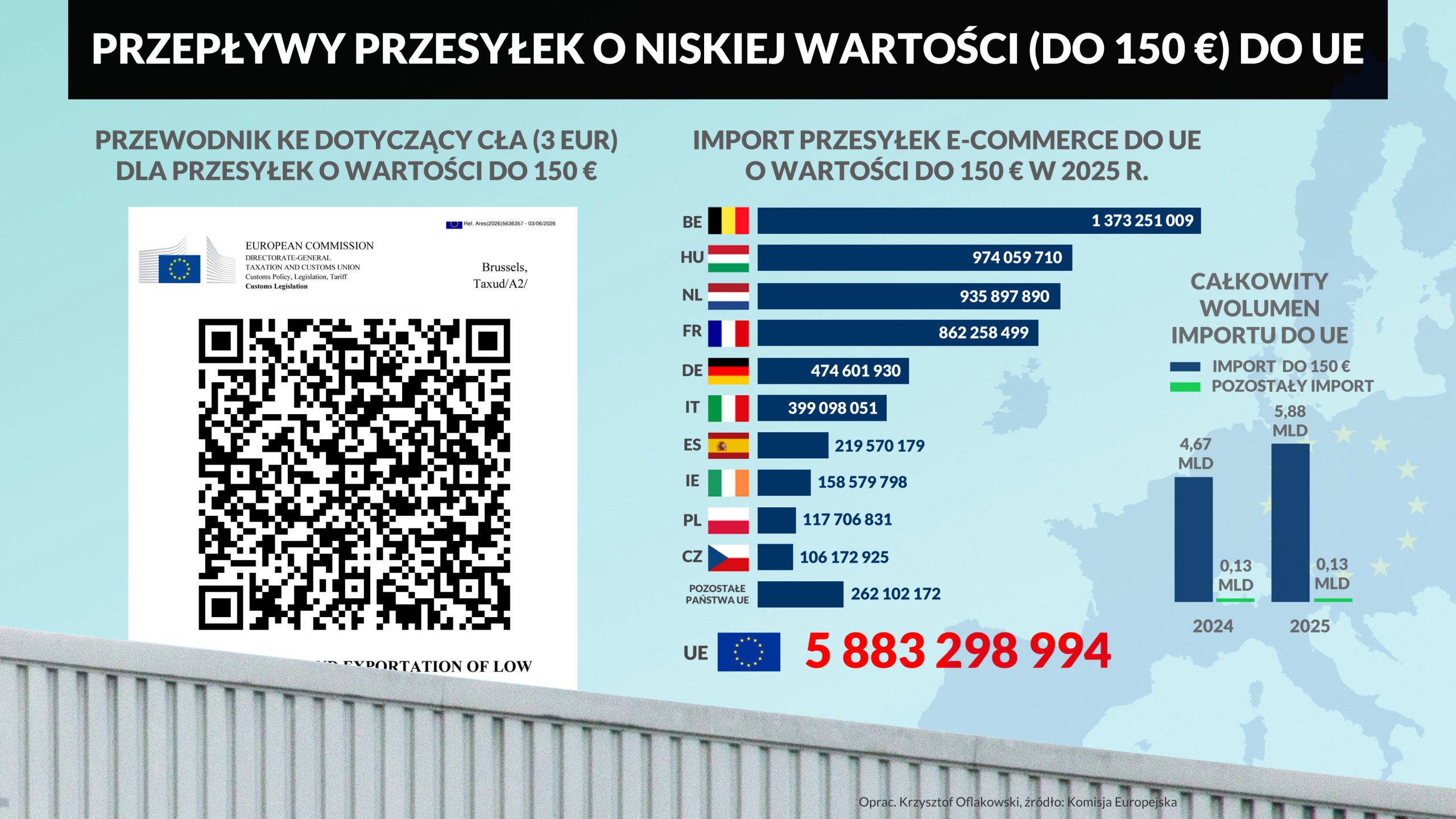
These are, of course, not all the significant changes regarding the 3-euro customs duty, which is why the EC has published detailed guidelines in the form of a guide (Customs Guidance on EUR 3 customs duty) with rules and examples regarding the calculation of the new levy. The English-language version of the guide is available on the European Commission’s website or via the QR code in the graphic below.
Why did the European Union decide to make changes?
In the official justification, one can read that the current digital environment containing data on all imported goods simply allows for the abolition of the exemption introduced to avoid a disproportionate burden on the administration, companies, and individuals. Due to the significant volume of low-value imports, more effective protection of the finances of the EU and individual Member States is also required.
What does this significant volume of imports look like in practice?
In 2024, approximately 4.67 billion shipments of up to 150 euros purchased remotely flowed into the Union, and 91% of them came from China. That is over 12.6 million packages per day, of which almost 11.5 million were from the Middle Kingdom. This is also twice as much as in 2023 and three times as much as in 2022. The EC warned last year that e-commerce import products already account for over 97% of all EU customs declarations.
In 2025, there was another significant increase in the import of cheap e-commerce shipments, by 26% year-on-year. According to the EC, there were nearly 5.9 billion of them and they already accounted for 97.9% of the EU import volume. The EC even provides an exact number, which was 5,883,298,994 units, i.e., approximately 16.1 million units per day. However, such a gigantic volume accounted for only 2.1% of the value of all imported goods, and the average cost of a cheap package was only 8.82 euros. Traditionally, most of them came from China. In terms of volume, it was 5.47 billion, i.e., 93%, and in terms of value, 78%.
What will happen now with the import of cheap e-commerce purchases?
Certain effects of the abolition of the de minimis exemption in the EU will likely be similar to those that occurred in the USA. There was a sharp collapse in the import of individual shipments there after the application of regulations allowing packages worth up to $800 to avoid customs duties was ended on August 29, 2025. In the last full year of the exemption’s application, i.e., in 2024, the local Customs and Border Protection (CBP) cleared 1.36 billion such packages, which is an average of 113.3 million per month. At the end of 2025, the total volume fell to 942.5 million, i.e., by 30.5%.
There was also a decrease in the value of cheap e-commerce imports, from $64.6 billion to $48.1 billion at the end of 2025. Air transport, in particular, recorded a significant year-on-year loss. The total number of bills of lading (BOL) there fell from 1.1 billion to 794.8 million (-27.75%). Shipping gained, however, whose result at the end of 2025 was 5.9 million BOL compared to 3.7 million in 2024. Express services recorded a decrease from 189 million to 130 million, while postal services fell from 74.8 to 68.6 million shipments. CBP boasts, however, that from May 2, i.e., from the first attempts to withdraw de minimis and collect customs duties, to December 17, 2025, it collected over $1 billion in due customs duties.
The first period was, however, very painful, especially for the American post office. Data from the Universal Postal Union (UPU), i.e., a specialized UN agency bringing together operators from 192 countries, shows that after the withdrawal of the de minimis exemption (August 29, 2025), as many as 88 postal operators reported a partial or total suspension of services to the USA. Data collected on the UPU electronic platform also showed that on Friday, August 29, postal flows from countries belonging to the organization fell by 81% compared to Friday, August 22.
Will such a scenario repeat itself in the EU?
European services are theoretically better prepared, at least in terms of IT infrastructure. The existing IOSS system will be helpful in settling customs duties. Besides, a much larger volume of cheap packages is processed in the Union than in the USA. For some time, purchases and visits to foreign platforms will likely fall. According to analysts from Sensor Tower, the number of daily users on the American version of Temu dived by 48% in May compared to March. It was in May that the first attempts were made to collect customs duties on cheap online orders, but the system collapsed and the exemption was reactivated, finally abolishing it at the end of August 2025.
The platform reacted like most big players, i.e., it focused on changing the order fulfillment model. It switched from shipping individual packages directly to customers to a consolidation and fulfillment model and deliveries from local warehouses. The result of this strategy is, among other things, a clear increase in e-commerce flows in maritime transport visible in CBP data. The same will happen in Europe and there are already signs of it.
For a long time, we have been observing increased interest in the market in contract services regarding the handling of online orders originating from outside the EU. Platforms are preparing for the abolition of de minimis and we are witnessing a significant change in the business model in the e-commerce market and the way orders are fulfilled in one of the fastest-growing branches of the logistics sector. New regulations will force sellers from Asia to consolidate their assortment in Europe, because the current method of delivery, i.e., from a continent on the other side of the world to a consumer in Europe, is losing its economic justification. With a low order value, additional fees will discourage many internet users from purchasing. Although the platform’s client will not have to handle customs formalities, at some point the service will compensate itself for the flat rate of 3 euros or the customs duty according to the standard procedure for mass imports. However, all participants in this market want to maintain the lowest possible prices, which is why a natural step is outsourcing logistics services to local operators, which, with the appropriate scale effect, will allow minimizing additional burdens. The operators themselves, foreign stores, and the ultimate interested parties, i.e., digital consumers, are counting on this – says Marek Kaniera, e-commerce operations director at ID Logistics Poland, which provides comprehensive logistics and transport solutions, e-commerce handling, and supply chain management in 18 countries.
Our research shows that more expensive purchases will influence a greater willingness of as many as 25% of consumers to choose goods shipped from warehouses in Poland or other EU countries, precisely to avoid additional fees. Another 12% will order exclusively from Poland or another EU country. Internet users who place orders on services outside the Union are very price-sensitive. To such an extent that 35% of them declare that they will give up the purchase if it turns out that any additional cost must be covered. The analysis also shows that 15% will abandon the cart if its value increases by 3 euros. That is half of those shopping online outside the Community. Sellers cannot afford to lose such a large share of customers, hence their preparations for the new regulations. We expect, however, that the volume of low-value transactions, i.e., up to 150 euros, may decrease, just as it happened in the USA, where orders fell by about 30%, but only until the platforms build appropriate logistics capabilities in Europe. This may cause a series of positive consequences in Poland, because a revolution in the import model taking place at such a pace means that the locations where shipments enter the European market will change rapidly. Aviation will lose out on the changes, but ports will gain, perhaps rail, but contract operators will certainly gain, and alongside them the warehouse market – adds Marek Kaniera from ID Logistics.
Preparations for the abolition of de minimis are visible in the warehouse market in Europe
The summary of Q1 2026 for Europe, published by JLL, shows that the beginning of the year was exceptionally good for the logistics sector, which recorded the best first quarter since 2023. Demand increased by 9% year-on-year and by as much as 16% compared to the five-year average for Q1 from the pre-pandemic period. The broad-based recovery meant that growth was recorded in 9 out of 13 markets. During this period, it was contract operators (3PL) that had the largest market share in leasing, which amounted to as much as 46%, which corresponds to 2.7 million sqm and an 18% year-on-year increase. Behind logistics were retailers and manufacturing (16% each) and directly online sellers (7%), among whom entities from China dominated. According to JLL, the driving force behind this growth is active outsourcing of logistics capabilities by manufacturing and the e-commerce industry itself, for which the goal is to optimize the network and increase capabilities in terms of deliveries.
Such a strong position of contract logistics driven by e-commerce is visible not only in the Union but also in the United Kingdom, which has the most developed online trade sector in Europe. According to data from the British Office for National Statistics (ONS), online sales reached 27.9% of total retail sales in March 2026, remaining at a stable level of about 27.5% throughout 2025. Work on changes regarding de minimis and the import of cheap e-commerce is also progressing there, which, of course, Chinese platforms are closely watching, and this is visible in the warehouse market. A JLL representative from Shanghai claims that even now, Chinese sellers rely heavily on external logistics capabilities to reach their customers, and recent changes in Europe make local warehousing more economically attractive. Requirements regarding operational efficiency and the need to strengthen competitive advantage, e.g., in terms of deliveries and processing returns, also encourage the expansion of infrastructure on-site.