








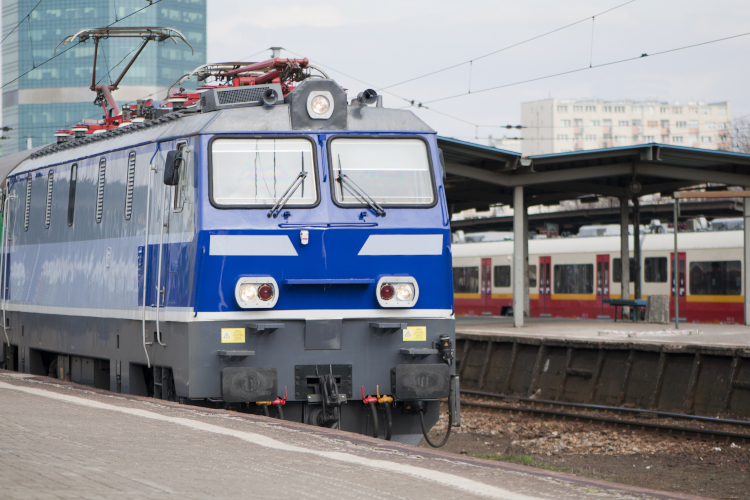
Safety, system performance in various weather conditions, and the level of savings – these are among the parameters being verified in the currently ongoing second phase of SENSUM tests. The innovative system supporting economical and ecological driving has so far been tested by train drivers from Koleje Mazowieckie and Łódzka Kolej Aglomeracyjna. Now, Koleje Śląskie, Koleje Wielkopolskie, and Koleje Małopolskie have joined them. The project is being carried out as part of the Railway Energy Efficiency Centre (CEEK).
When traveling by train in one of the five voivodeships: Masovian, Łódź, Silesian, Greater Poland, or Lesser Poland, we might encounter a train that runs more smoothly and generates a significantly lower carbon footprint. This is thanks to SENSUM – an application that significantly improves vehicle operation and enables energy savings. In the first phase, drivers spent a total of over 200 hours using SENSUM. The system is being developed by PKP Energetyka in cooperation with engineers from the company REDS.
Eco-driving is conscious, skillful, and economical driving that allows for the lowest possible consumption of energy or fuel. SENSUM is the first such innovative solution for the Polish railway, prepared for drivers and by drivers in a co-creation model.
During the first phase of testing, the quality of communication between tablets and the central system, the precision of location and displayed recommendations, and the interface design were rated positively. According to the conclusions from this first phase, the system improves work comfort and situational awareness, and additionally increases the motivation and engagement of vehicle operators. Based on feedback provided by drivers using SENSUM, a package of corrections and improvements was introduced, and the latest version of the application has returned to the cabs for final verification.
We are pleased that even at the testing stage, more and more carriers are joining the group of SENSUM users, thereby having a direct influence on the final shape of the system. We strive to develop the application in dialogue with its direct users so that it is fully tailored to the needs of every driver. We believe that soon, thanks to our joint efforts, eco-driving on the railway will become a standard, and SENSUM tablets will be available in every vehicle, which will significantly impact the energy efficiency of the sector – said Leszek Hołda, member of the board of PKP Energetyka and vice-chairman of the Presidium of the CEEK Program Council.
This time, the verification will include, among other things, the level of energy savings generated by drivers using the system, the transmission of safety warnings along the route between tablets, and the effectiveness of the system in various track and weather conditions, etc.
– The experience of foreign carriers, as well as numerous scientific studies, show that implementing eco-driving based on dynamic recommendations sent to the driver’s cab allows for significant energy savings, reaching 15% in the case of agglomeration transport. The SENSUM system, designed and executed by REDS, constitutes a Polish implementation of this concept and is based on state-of-the-art technologies. The system is currently undergoing the second phase of operational tests, and I am sure that as a result, we will demonstrate a significant reduction in traction energy consumption by drivers using SENSUM – said Dr. Eng. Witold Bartnik, CEO of REDS.
As part of the joint work on SENSUM, workshops organized by CEEK were held in February this year, with the participation of nearly 50 drivers from over a dozen different railway companies. During the event, the capabilities of SENSUM were presented, and participants also had the opportunity to test the system on a specially designed simulator. The second test phase will last until the end of March, and subsequently, in the fourth quarter of this year, the production launch of SENSUM is planned.
Implementing SENSUM on a sector-wide scale will enable the generation of electricity savings at the level of 400 GWh, which is enough to power 20,000 households for 10 years, and a reduction in CO2 emissions by 320,000 tons – the amount absorbed annually by the Białowieża Forest.