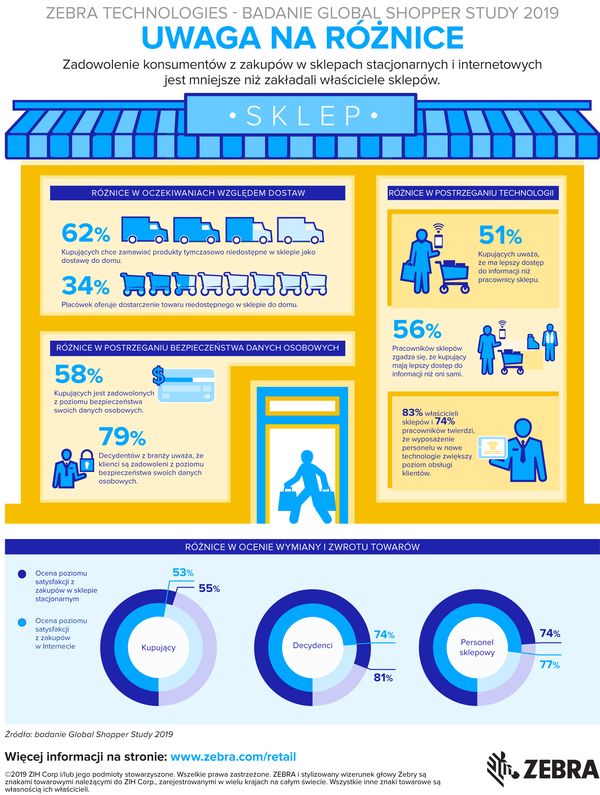
Zebra Technologies, a company offering mobile computers, scanners, barcode printers, and software and services that provide real-time visibility into company assets, has announced the results of the eleventh annual Global Shopper Study. The survey is an analysis of the opinions and expectations of shoppers, store associates, and retail industry owners and decision-makers.
More than half (55 percent) of those surveyed admit that their companies are experiencing staffing shortages, and 49 percent complain of being overworked. Store staff express dissatisfaction with the fact that they are not always able to help customers. According to 42 percent of the store associates participating in the study, they do not have much time to support shoppers, which is due to the pressure to complete other tasks. In turn, 28 percent point to difficulties in obtaining information helpful to shoppers. Interestingly, the majority of retail decision-makers (83 percent) and store associates (74 percent) believe that stores with the right technology can improve the standard of customer service. Two-thirds (66 percent) of store staff believe that with the help of tablets, they could improve customer service and raise the level of their support.
At the same time, only 13 percent of shoppers declare complete trust in retail companies regarding the protection of personal data, which translates into the lowest level of trust among 10 different industries. The results of the Global Shopper Study show that as many as 73 percent of respondents from the shopper group want flexible control over how their personal data is used by stores.
– Our research reveals the growing expectations of shoppers – said Jeff Schmitz, Senior Vice President and Chief Marketing Officer at Zebra Technologies. – Stores are focused on challenges related to order fulfillment, but they must remember the need to provide shoppers with personalized, high-level service. The industry should enable customers to purchase the products they want, at a time and place convenient for them, and in a way they prefer.
The study results also showed different expectations between store owners and store staff regarding the benefits of implementing automation solutions. Nearly 80 percent of retail decision-makers – compared to 49 percent of staff – believe that thanks to new technologies that can automate the payment process, the number of checkout counters operated by cashiers can be reduced. Moreover, more than half of decision-makers (52 percent) declare that they are transforming point-of-sale (POS) space into self-checkout zones, and 62 percent are replacing it with pickup zones for goods purchased online.
More than half of customers (51%) believe that thanks to smartphones, they have better access to product information than store staff. Stores are investing in cutting-edge technology to bridge these gaps. Nearly 60 percent of surveyed retail decision-makers plan to increase spending on mobile computers by more than 6 percent, and more than one in five stores (21 percent) plans to allocate 10 percent more funds to rugged tablets over the next three years.
Key findings:
Asia-Pacific
• As many as 62 percent of retail workers view their employers more positively when they provide them with mobile devices to perform tasks in their daily work.
• 49 percent of store staff say that mobile point-of-sale (mPOS) systems help them do their jobs better.
Europe and the Middle East
• Nearly three-quarters (74 percent) of those surveyed confirm that the growth of the e-commerce market is associated with increased interest in solutions that allow meeting customer expectations, as well as warehouse investments.
• More than three-quarters (76 percent) of retail decision-makers believe that accepting returns and managing returns of goods ordered online is a major challenge.
Latin America
• Both shoppers (59 percent) and store associates (67 percent) believe that customers have better access to product information than store employees.
• A vast majority (99 percent) of IT decision-makers believe that more efficient inventory management tools are needed to ensure service accuracy.
North America
• Only 11 percent of shoppers completely trust retailers with the protection of their personal data, which translates into the lowest level of trust among all market sectors, including healthcare, financial institutions, and technology companies.
• Nearly seven out of 10 store associates (68 percent) say that electronic shelf labels could improve service levels, and 54 percent of shoppers want to use them while shopping.
Background and methodology:
The eleventh Global Shopper Study, conducted annually on behalf of Zebra, covered approximately 4,725 shoppers, 1,225 store associates, and 430 decision-makers from North and Latin America, Asia-Pacific, and Europe and the Middle East. Respondent opinions were collected between October and November 2018 by Qualtrics.