








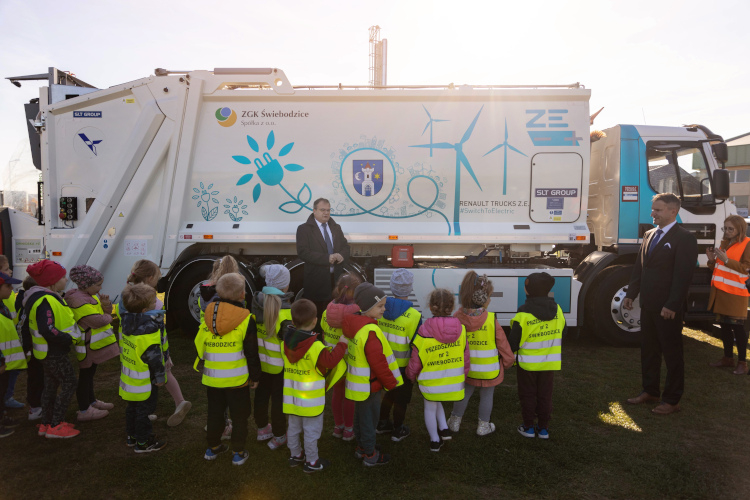
The Municipality of Świebodzice, mindful of the possibility of reducing its carbon footprint, is investing in electric vehicles. At the beginning of November this year, the fleet of the Lower Silesian municipal company ZGK Świebodzice grew by a Renault Trucks D Wide Z.E. electric garbage truck. This 100% electric vehicle is also the first electric truck registered in Poland, and the city of Świebodzice has joined the ranks of Electromobility Pioneers.
In accordance with the assumptions of the Electromobility Development Program, local governments are striving for sustainable development of municipal transport and thus for reducing the number of vehicles with conventional propulsion in urban fleets. The authorities of Świebodzice chose the 100% electric Renault Trucks D Wide Z.E. model with municipal bodywork, which can already be seen in daily operation on the city streets.
– We are receiving four electric units, including a Renault Trucks vehicle, the first garbage truck in Poland handed over to a municipal company, and thus we are showing the young generation, our society, that we are able to take care of our environment, of our future. Electromobility is a future from which there is no turning back. Such equipment should be operating in every municipality. I am glad that I can boast about these investments – said Paweł Ozga, Mayor of Świebodzice, adding that the low-emission vehicles were purchased with funding under the government’s Polish Deal fund.
During the handover of the symbolic key to the all-electric Renault Trucks model, Ireneusz Zyska, Secretary of State and Government Plenipotentiary for Renewable Energy Sources, was also present. In his speech, he emphasized how important this investment is for the city, as the low-emission vehicles will serve the residents by fulfilling their task, but will also contribute to improving air quality in the city.
A step into the future
The transport industry is undergoing a major change, and it is already known that it will change more in the coming years than it has over the last century. The Renault Trucks D Wide Z.E. is the first mass-produced truck to hit public roads in our country.
– Renault Trucks will produce and deliver one thousand electric vehicles similar to this one to European markets this year. However, this one is particularly important for our Polish organization – it is the first electric truck registered in Poland and at the same time the first garbage truck handed over for commercial use – concluded Marcin Majak, Sales Director of Renault Trucks Poland.
The Renault Trucks D Wide Z.E. model with a Terberg garbage truck body was tested for 1.5 years in the fleets of municipal companies in Poland, where it was treated without any special treatment during daily operation. In terms of functionality, this garbage truck does not differ from its conventional counterpart. The vehicle’s maneuvering properties are similar. In every municipal enterprise testing the vehicle, the capacity of the traction batteries was more than sufficient to perform daily tasks.
– The work of a garbage truck, i.e., crushing and loading waste into the body, takes place while stationary. The tests we carried out last year showed that in 80% of cases among municipal companies, the vehicle returned to the base after a full day of work with an average traction battery charge level of 20-24%, which was enough for a full day of work, to return to the base, and still have a little bit left in reserve – added Marcin Majak.
Energy transformation in Świebodzice
In Świebodzice, the vehicle was tested in February this year, for two weeks, on a “full-time” basis. It served the entire city, both single-family housing areas and housing estates, as well as more demanding routes, e.g., in terms of precise maneuvering through narrow downtown streets. There, as the drivers reported, the car performed perfectly, and they appreciated the dynamics and maneuverability of the 3-axle chassis. They also praised the very quiet operation of the vehicle’s drive system and the hydraulic systems operating the loading area and the lifter, as well as the speed of the bodywork’s operation.
– I have very good professional drivers on my team. At first, however, they were a bit shy about the vehicle as new equipment. However, after training by Renault Trucks Poland employees, after just three days of driving, they were arguing about who should drive. The driving comfort in the vehicle and the ease of operation also left a good impression on them. This was also one of the key premises that we want to purchase such a vehicle – says Sławomir Sprawka, President of ZGK Świebodzice.
The garbage truck was well received not only by the employees but also by the city’s residents, who did not even know when the waste was being collected. – Our municipal company received signals that there was no waste collection. Ultimately, it turned out that the container in front of the house was empty because the garbage truck had passed by quietly. So, apart from improving air quality, residents will also appreciate the quiet operation of the vehicle, especially in the morning hours – continues the President of ZGK Świebodzice.
Ecology and economy
The ZGK Świebodzice fleet has four garbage trucks, including the electric D Wide Z.E. model. The President of ZGK Świebodzice also pointed to the time savings in terms of the vehicle’s dynamic operation: The car starts immediately after pressing the accelerator pedal and stops almost immediately after pressing the brake. Analyzing the time required for waste collection, especially from single-family housing where you have to stop dozens or hundreds of times, such dynamics generate a large saving of working time over a month, over a year. And the level of traction battery charge is not insignificant. Without additional charging, the battery status at the end of the day showed about 35-40% charge.
Attention was drawn to the quite large share of electrical energy obtained as a result of recuperation, i.e., during braking, free rolling, or driving down hills.
The garbage truck was charged from a socket in a closed garage.
– The vehicle has a built-in charger. During charging, when it is fully charged, it draws a minimal amount of energy from the grid to maintain temperature and readiness for work. You can then get in, start the vehicle, and set off to work at any time – explains Radosław Kołodziej, Sales Representative of Renault Trucks Poland – Batteries can be recharged even at short intervals – this does not affect their durability and efficiency. The range on a single charge is up to 120 km.
– Electromobility is a path and a direction that must be continued – concluded Sławomir Sprawka, President of ZGK Świebodzice.