








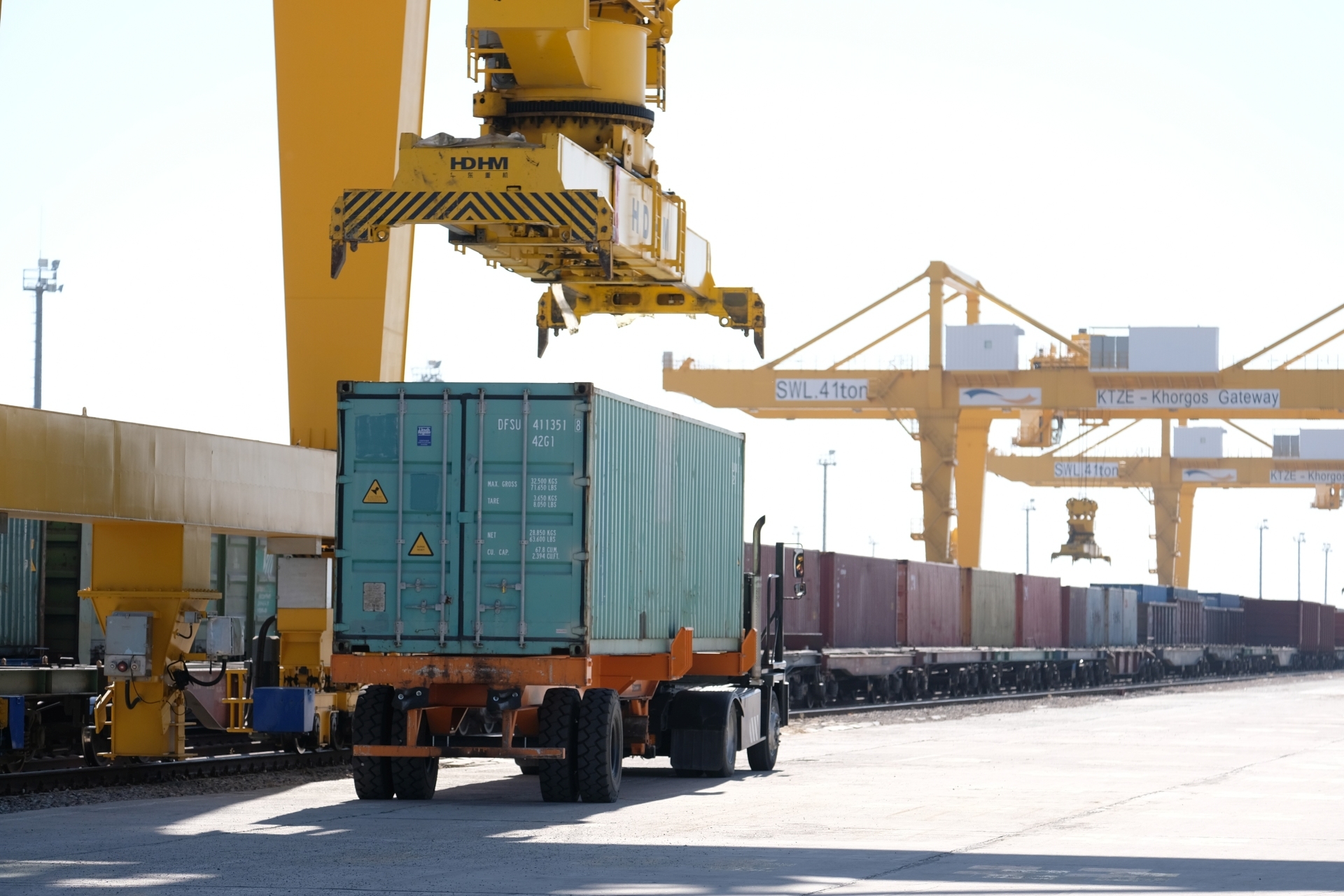
The number of inquiries regarding transport via the Middle Corridor is growing. Consumers from Central Asia are an attractive purchasing power for European manufacturers and distributors. The Red Sea crisis has accelerated rail transport and increased business appetite for air and intermodal solutions.
We have been present in Kazakhstan for a year now. In the autumn of 2023, we launched operations at our branch in Almaty, where we provide a full range of services, including road, air, rail, and intermodal transport, as well as warehouse logistics. What were the reasons for this expansion? Kazakhstan is an excellent hub between Europe and Asia, especially China, as well as a distribution center for goods for the local market and neighboring countries. Almaty and Warsaw are separated by a distance of approximately 4,000–4,500 km, depending on the transport route. Therefore, having a well-functioning logistics center located directly in the Central Asian region provides a competitive advantage for our clients. Looking back at this investment over the past year, I can say that we were One Step Ahead. During this period, Kazakhstan’s position as a significant player in international transport has grown even further. Why?
The Red Sea crisis has accelerated rail transport and increased business appetite for air and intermodal solutions
The main reason is the geopolitical aspect. The crisis in the Red Sea broke out in December last year. As a result of Houthi rebel attacks, the Suez Canal was blocked, and ships on the China-Europe route are taking a much longer maritime route around Africa, which extends transport time by approximately 14 days. Consequently, to maintain production or distribution continuity, companies operating on the European market have been looking for other transport solutions, which mainly lead through Kazakhstan. Rail freight from China to Europe has gained importance. Importantly, despite the recent temporary drop in sea freight rates and the adjustment of business processes to longer sea transport times, interest in rail transport is not waning.
The Red Sea crisis has caused many companies to permanently incorporate this solution into their supply chains, and to build resilience, at least a portion of their volume will be transported by rail. It is also worth noting that transporting products by train through Kazakhstan has its limitations. The difference in track gauge between this country and China necessitates the transshipment of goods at the border, which extends transport time and constitutes one of the logistics bottlenecks. Increasing the number of transshipment terminals would increase capacity, which is particularly important during peak transport periods.
In the face of the Suez Canal blockade, there has also been increased interest among clients in air freight options, not only directly from China but also using Kazakh airports in Almaty or Astana, which has a direct air connection with Poland. It is also worth emphasizing that German investors are planning to build a new cargo airport near the Kazakh-Chinese border in Khorgos, which will significantly increase transport capabilities in this region.
The number of inquiries regarding transport via the Middle Corridor is growing
However, that is not all. Recently, the Middle Corridor, of which Central Asia is a key element, has been gaining importance more and more dynamically. This route runs from China to Kazakhstan, and further through Azerbaijan, Georgia, and Romania or Bulgaria, which in this context act as a logistics gateway to the rest of Europe. In the first half of 2024, cargo transport on the Trans-Caspian International Transport Route – the official name of this route – increased by 65%1. The government of Kazakhstan plans for 500,000 containers to be transported via this route by 2040. Is this a realistic assumption? In my opinion, yes. A few months ago, we spoke about the Middle Corridor more theoretically, as an alternative, but today we are carrying out deliveries for our clients via this route in both full container load (FCL) and less-than-container load (LCL) formulas – transported on our dedicated consolidation from China to Poland and then distributed throughout Europe. We are observing a growing number of such inquiries.
Crucial for the development of this corridor is the intensive development of infrastructure, which will increase its capacity. And importantly, these are concrete projects that are already in the implementation phase. A logistics center with warehouses and an intermodal terminal is being built near Almaty, which is intended to handle cargo transported directly from China to Kazakhstan, as well as transit via the Middle Corridor. Meanwhile, transshipment terminals are being expanded and modernized at the ports of Aktau on the Caspian Sea (Kazakhstan) and Poti on the Black Sea (Georgia).
In my opinion, a litmus test for the success of this project is also the fact that funds for this investment are flowing from many important economic and geopolitical players – including the World Bank, the aforementioned Germany, but also to a significant extent from China. Trade with Europe is crucial for the Middle Kingdom, which is why they are looking for stable routes in the face of geopolitical challenges – the aforementioned Red Sea crisis, bypassing Russia and Belarus in transit, and a potential conflict between China and Taiwan. This would cause a blockade of key Chinese seaports such as Shanghai or Ningbo and the inability to sail through the Taiwan Strait, through which ships to Europe from major ports in China pass. The Middle Corridor is a logistical response to these challenges.
Consumers from Central Asia are an attractive purchasing power for European manufacturers and distributors
Conducting logistics operations in Central Asia, we observe growing interest in transport solutions from Europe to Asia. The growth of trade between Poland and Kazakhstan is developing dynamically. The exchange includes, among others, industrial goods, construction materials, and consumer products such as electronics, home appliances, and fashion. Central Asia is becoming an important recipient of European goods, and the development of e-commerce is accelerating this trend. Kazakhstan is developing as a target market with a GDP of $261.4 billion in 2023 and a growth rate of over 5% per year[1]. Other countries in the region, such as Uzbekistan, Turkmenistan, Tajikistan, and Kyrgyzstan, are also in a growth phase, together creating a huge market of almost 80 million people. It cannot be denied that this region is very promising and attractive for European manufacturers and distributors, including Polish companies. Therefore, the aforementioned development of transport routes, such as the Middle Corridor, is also significant in the area of exports to these markets.
[1]https://data.worldbank.org/country/kazakhstan?view=chart
Source: Rohlig SUUS Logistics