












PSNM summarizes the year 2024 in the new mobility sector in Poland.
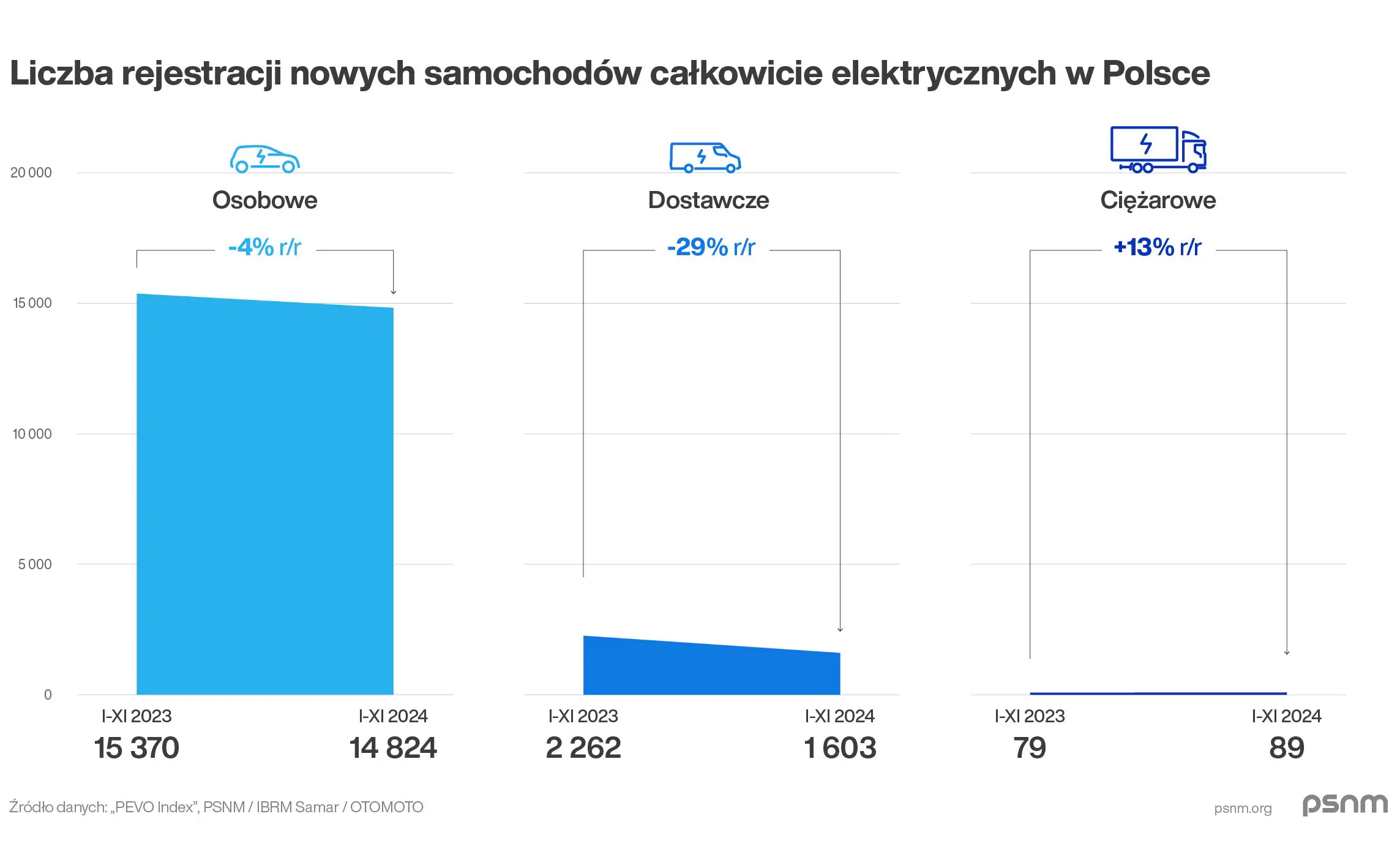
In 2024, for the first time, the number of registrations of new battery electric vehicles (BEVs) in Poland decreased year-on-year. According to data from November, the passenger “electric” segment recorded a 3.5% y/y decline, while the commercial vehicle segment saw a drop of as much as 29% y/y. The share of BEVs in the new passenger car market barely exceeds 3%. This is one of the worst results in the European Union. We are ahead of only Croatia and Slovakia.
– 2024 was a difficult, if not the most difficult year in the short history of Polish new mobility. In many EU countries, after years of subsidies, markets lost some momentum or stabilized, but this occurred at high sales volumes. In Poland, however, any decline should not have taken place at the current, very early stage of the sector’s development. The unexpected decision to first suspend and then prematurely terminate the “My Electrician” program had a negative impact on the pace of market development. Until September, when subsidies still influenced the number of registrations, we recorded year-on-year sales growth. A slight, but still growth. In recent months, it has been a continuous decline. The state of the BEV market in 2024 contrasted sharply with the situation in the area of publicly accessible infrastructure, where there was a significant increase. In the first half of the year alone, the total power of charging points increased by almost 1/3, to approx. 300 MW. This is a record result – says Aleksander Rajch, Member of the PSNM Management Board.
Support for the purchase of an electric car
PSNM points out that replacing the existing support mechanism with the “My Electrician 2.0” program, which has many flaws and was not sufficiently consulted with the social side, may slow down the pace of market development. Above all, there is a risk of wasting the vast majority of the PLN 1.6 billion intended for the implementation of the program. However, some hope for boosting Polish electromobility is provided by the announced subsidy programs for electric trucks, the charging infrastructure intended for them, and energy connections. They have a total budget of PLN 6 billion. Their advanced implementation stage is, according to PSNM, one of the most positive events in the Polish electromobility market in 2024, and the introduction of the programs may bring Poland closer to achieving the goals of the EU AFIR regulation.
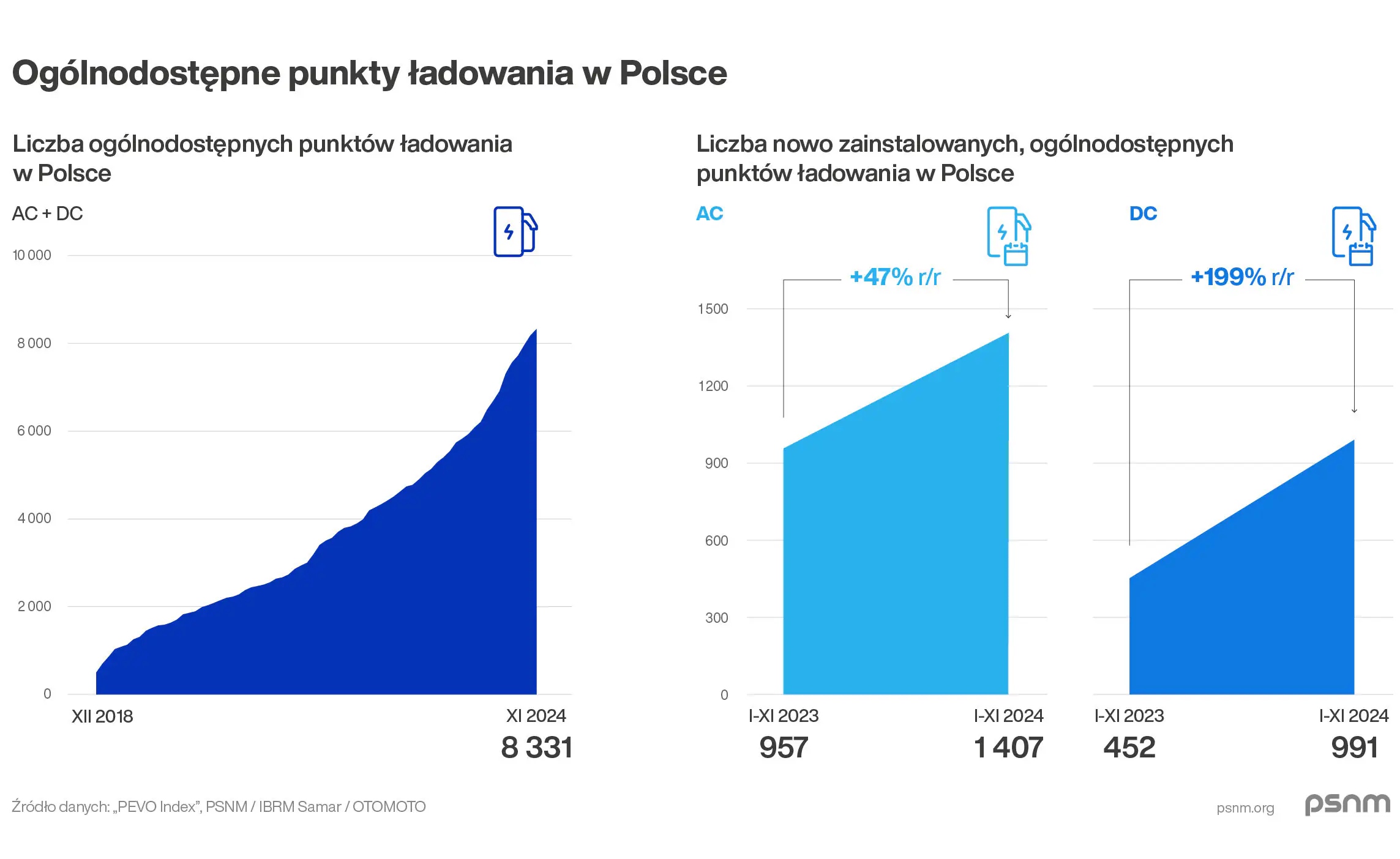
– We already know for sure that 2024 will be a record year in terms of the number of newly installed, publicly accessible charging points, especially in the key DC segment. During the first 11 months of this year, almost 1,000 fast direct current charging points were launched. This is more than 2 times more than in the corresponding period of 2023. The record noted this year is primarily due to the ambitious actions of the industry, which is constantly increasing the scale of investments despite many serious systemic barriers, the lack of adequate support from public administration, and limited demand for charging services resulting from the still low share of EVs in the vehicle fleet. It is worth keeping in mind that the commissioning of subsequent points in 2024 was the finalization of projects started months or even years earlier (and often co-financed from a support program that has already ended). There are approx. 8.3 thousand points operating in our country. This is many times less than, for example, in Belgium (approx. 80 thousand points) or Austria (approx. 30 thousand points), i.e., countries that have an incomparably smaller automotive market than Poland – says Jan Wiśniewski, Director of the PSNM Research and Analysis Center.
EU regulations and expansion barriers
PSNM points out that the consequence of barriers to infrastructure expansion is a very low level of implementation of the obligations of the EU AFIR regulation, which concern the expansion of charging zones along the TEN-T network and at urban nodes. Taking into account the core network and zones for light vehicles, the obligations resulting from AFIR (for 2025 and 2027) are currently implemented at approx. 9% and 3.5%, respectively. In the case of the comprehensive network and zones for heavy-duty vehicles, the level of fulfillment of obligations is even lower – in practice, it is 0%. A problem negatively affecting the pace of infrastructure expansion is also the very unfavorable conditions of GDDKiA tenders.
PSNM notes that in 2024, the government administration in Poland still did not set goals for the development of the electromobility sector in economic terms. This is a necessary condition for a decisive acceleration of development in the production and research and development areas of the e-mobility industry. There is a lack of a coherent strategy, set at the central level, for the transformation of the automotive industry in Poland towards zero-emission. This creates a serious risk in the context of the changes that the automotive sector is undergoing all over the world and in relation to its importance for the entire Polish economy (the industry accounts for 8% of Polish GDP, 13.5% of annual exports, and provides almost half a million jobs).
– The lack of prioritizing the new mobility industry means that not only are we missing an opportunity for development, but we may also lose our current position. This applies in particular to the battery industry. Based on data from the Polish Economic Institute, in the period from January to July 2024, the value of lithium-ion battery exports from Poland amounted to 3.2 billion euros. This means a decrease of 58.2% y/y. In 2024, a manifestation of the difficult market situation of the Polish battery industry was, among others, Northvolt’s decision to end the production of energy storage systems in Gdansk, or the transfer of lithium-ion battery production for Ford electric cars from the LG Energy Solution factory in Biskupice to the USA (due to significantly more attractive financial conditions provided to battery manufacturers in the United States). At the same time, Poland is being bypassed by subsequent, potentially strategic investments that are being located in other European Union member states (also in the CEE region). This is, among other things, a result of the still too low share of RES in the national energy mix – says Aleksander Rajch, Member of the PSNM Management Board.
New mobility and local governments
New mobility also encounters numerous difficulties in local governments. During the first eleven months of 2024, there was a very large decrease in the number of electric bus registrations. Based on data from the end of November, the number of registered e-buses (BEV) was 178, which is as much as 41% less than in the corresponding period of 2023.
– In 2024, however, we also recorded a number of positive events and initiatives in the local government area. First of all, from July 1 of this year, a Clean Transport Zone (SCT) began to apply in Warsaw. As a result, more than six years after the introduction of regulations governing SCT into the Polish legal order, the first such area was created in Poland, not counting the short-term validity of the zone in Krakow in 2019. Soon, more SCTs will begin to apply in Polish cities. This is a consequence of the planned amendment to the Act on Electromobility and Alternative Fuels, introducing the obligation to establish zones in cities with over 100,000 inhabitants where nitrogen oxide standards have been exceeded. The dynamics of the development of city bike systems is also pleasing. The number of such bikes increased to over 27.4 thousand units, which means an increase of 28.2% y/y. This is, among other things, a consequence of the launch of two large and exceptionally successful city bike systems: the Tri-City one – MEVO, which offers 4,000 electric bikes, and the Metrorower – the largest system in Poland and the third in Europe – says Agata Wiśniewska-Mazur, Coordinator of the PSNM Local Government Committee.
A problem in cities, however, remains the low pace of charging infrastructure expansion. Regardless of the connection challenges common to the entire sector, the biggest barriers in this area include, among others, very lengthy coordination procedures, architectural requirements not adapted to market conditions (in practice making it impossible to launch DC stations in some cities), or finally, very diverse lease rent rates. As a result, in as many as 19 out of 37 of the largest cities in Poland, the share of publicly accessible, fast DC charging points is no more than 20%, and in 11 out of 37 of the largest cities in Poland, the number of publicly accessible DC charging points does not exceed 10. PSNM emphasizes that the current scale of challenges at the national and local government level, declines in electric vehicle registrations, barriers to charging infrastructure expansion, protracted legislation, and a leaky financing system may put the Polish market in an even more difficult situation in the next 12 months.
– The year 2025 will welcome us in a completely different regulatory reality. New obligations regarding emission reductions will come into force, which will force automotive concerns to change their strategy implemented in recent months by 180 degrees and once again focus on intensive sales of “electrics”. In a situation where Poland is almost at the very bottom of the European e-mobility ranking in the EU, with a share of electric cars at the level of approx. 3%, there is a significant risk that further sluggishness in supporting the new mobility market will reduce our country to the role of a main sales market for combustion vehicles that no one wants to buy in other parts of Europe. Automotive concerns will ensure the achievement of emission targets in other countries. As a result, the e-mobility market in Poland may remain in a stagnation phase for longer. In the short term, this risk seems to be the biggest challenge currently facing stakeholders in the new mobility sector in Poland, but it is not too late to take preventive measures – says Maciej Mazur, Managing Director of PSNM.
The full summary of the year 2024 in the Polish new mobility sector, prepared by PSNM, is contained in a report available at the link.