










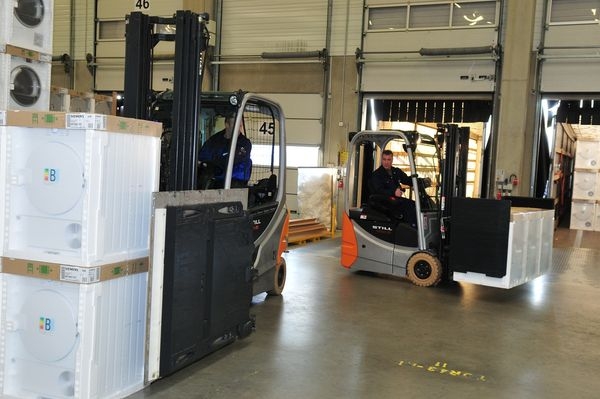
Excessive speed, driving while fatigued, and a lapse in concentration – these are sins committed not only by drivers but also by forklift operators. The so-called human factor is one of the main causes of accidents in warehouses.
In 2011, the National Labour Inspectorate recorded 141 workplace accidents in storage areas, resulting in 158 people being injured. Most dangerous incidents are caused by improper work organization and human error. A lack of appropriate qualifications to identify hazards, recklessness, bravado, inattention, or fatigue among forklift operators can lead to serious consequences. The level of safety in a warehouse depends on proper work organization and supervision, as well as the experience and competence of the operators.
Most common mistakes
There are many examples of reckless operator behavior. Starting from the prohibited practice of lifting other employees on the forks, through leaving an active forklift unattended, to reckless driving. Exceeding speed limits and excessive haste while maneuvering loads are common practices. Improperly placing goods on a rack ends in damage at best, and in the worst case, it falls from a height and crushes a person. Everyone bears the consequences of errors made by operators: the operator themselves, bystanders, and the company. That is why it is so important to conduct periodic health and safety training that includes the principles of complying with forklift operation regulations.
Awareness of danger
The primary duty of operators is to correctly identify hazards and adjust their driving style accordingly. This is why it is so important to provide the employee with knowledge regarding the weight and type of transported loads and the technical condition of the forklift’s driving surface. Possessing information about the maximum lifting capacity of the forklift and the weight of the load, the operator must not decide to transport goods heavier than the equipment’s capabilities allow. The employee must be aware that the pace of work depends on their assessment of the situation. Vehicle speed should be adjusted to conditions – especially if the surface is slippery or wet. Particular caution should be exercised when taking corners, especially in areas with limited visibility. Using sound signals is permissible in such situations.
– When operating a forklift, the most important things are smooth driving and precision in maneuvers. When picking up goods, you should slow down and position the forklift perpendicular to the pallet. Inserting the forks at the wrong angle can damage the pallet or the load on it – says Janusz Cieślak from STILL Polska. It is also forbidden to move with a raised mast. During driving, the forks should be just above the ground. If the load limits visibility, it should be transported by moving in the opposite direction. Loads with non-standard dimensions can only be transported using adapted equipment. However, safety in the warehouse depends not only on the operators themselves but also on other people. Staying near a forklift during operation, and especially walking or standing under raised forks, is unacceptable. It is particularly important that all employees are aware of the existing hazards.
Work organization under scrutiny
One must be aware that the blame for haste and recklessness may lie not only with the operators but also with the management staff. In an effort to increase efficiency, employees are forced to achieve results in too short a time. The consequence of this is a lack of sufficient concentration during tasks, which can lead to an accident. Hitting a person or colliding with another device can result in serious injury or even death. Property damage can also lead to serious risks. Colliding with a rack, or even improperly picking up pallets from it, leads to permanent deformations, which can ultimately lead to weakening the rack structure and its collapse. This can have tragic consequences not only for the company’s infrastructure and stored goods but, above all, for people.
Code of good practice for forklift operators
1. Familiarize yourself with the forklift’s operating manual.
2. Perform the daily maintenance of the forklift diligently.
3. Pay attention to smooth driving while operating the forklift. Avoid sudden maneuvers such as sudden braking, accelerating, and turning.
4. Observe the speed limits, designated routes, and horizontal and vertical signs established for the workplace.
5. Always ensure you have sufficient visibility. When driving between narrow aisles in the warehouse, slow down and use a sound signal.
6. Ensure the goods are properly secured, especially if they have non-standard dimensions. The center of gravity of the load should be as close as possible to the central point of the pallet.
7. Never transport goods heavier than the maximum lifting capacity specified by the manufacturer for the given forklift model.
8. Do not allow bystanders to be in the immediate vicinity of an operating forklift. Before you start work, make sure no one is nearby.
9. Always keep the mast lowered while driving. Extend it only when picking up goods from a rack or a stack of load units.
10. Do not walk away from an active forklift and do not leave the keys in the ignition unattended.
11. Never transport additional people on a forklift in the cabin, on the forks, or on a pallet. Lifting employees is only possible in forklifts equipped with a work platform adapted for this purpose.
12. If warning lights turn on or you notice any irregularity in the forklift’s operation, stop working and immediately inform the service department about the failure.
13. Familiarize yourself with the forklift’s equipment and use it properly: adjust the seat and steering wheel position to your height, turn on the heating and rear window defroster in winter.
14. Perform all maneuvers with due precision and without excessive haste. Remember that safety in the warehouse depends on your concentration and skills.
Developed by: STILL