











For over a dozen years, during various meetings, including those with high school and university students, I have been trying to show how often logistics and logistical thinking accompany us in our daily lives. And it is not even about “big” logistics, carried out by international or national specialized operators, but about that everyday, unnoticed kind, the existence of which we are not even aware of. I once called it “small-scale home logistics,” pointing out that we are all logisticians at the same time.
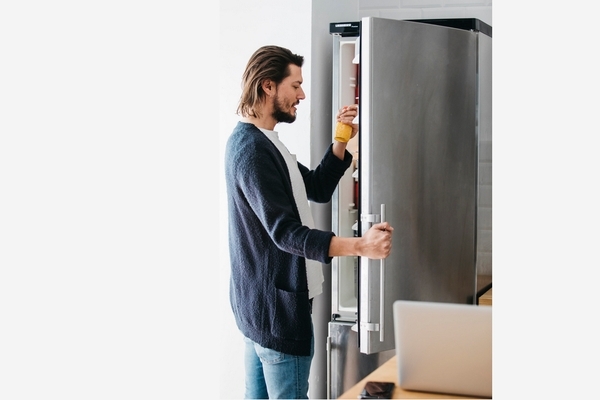
Of course, some will smile with pity at such words, but many a homemaker performs, on the micro-scale of their household, a series of current and pre-planned activities every day to organize the supply of raw materials, their picking, processing, and delivery of final products to recipients (read: household members) according to their needs and orders. Once upon a time – at least in the “food” segment – one had to acquire and do everything themselves, but today one can use outsourcing by ordering basic products or finished goods online. Has anyone wondered what a modern refrigerator is? It is not just a cooling and freezing device, but a modern micro-warehouse (for small children even a “high-bay” one), where individual goods are stored on specific levels, either loose or – after picking and processing – in specialized containers that prevent the loss of their nutritional properties and freshness. Some of the stored products, e.g., dairy, vegetables, and fruit, are subject to the FIFO (First In First Out) principle, while to which ones do we apply the term LIFO (Last In First Out)? Perhaps Saturday shopping for an afternoon barbecue, i.e., pork neck, beer, etc.? When we order products online, their flow is also accompanied by the transmission of information about them and the planned delivery date. So, are we logisticians on a home micro-scale or not? With a big wink, of course.
Meanwhile, the Japanese concern Mitsubishi offers us the next level of organization and resource management on a household scale, namely energy resources at the home-electric car interface. At the foundation lies the reduction of electricity bills and the convenience of emergency power supply in sudden cases. It is about the Dendo Drive House, a package of systems designed for households, consisting of electric vehicles and chargers enabling vehicle-to-home (V2H) power supply, solar panels, and home-use batteries, offered as a comprehensive service (from sales and installation to maintenance and after-sales service). Mitsubishi Dendo Drive House enables the use of energy generated by the house to charge cars, as well as supplying energy from cars back to households. How this will look in practice, we will see in the MI-Garden GINZA complex being prepared in the Tokyo metropolitan area (in its name, the letter “M” stands for Mitsubishi, while “I” symbolizes intelligence, ingenuity, inspiration, and interactivity). The Japanese designers want to show a model of life based on sustainable energy using a vehicle-to-home energy system. It is worth noting that 100% of the energy used at MI-Garden GINZA will come from renewable sources. Could this be the next stage in the development of “small-scale home logistics”?