











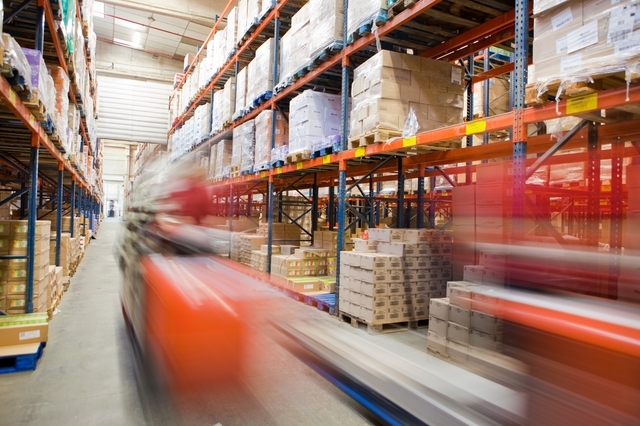
In facilities such as warehouses, distribution centers, production plants, as well as container and transshipment terminals, cargo transport systems and processes play an important role. They constitute an integrating element for other subsystems, and the efficient handling of cargo flows is largely dependent on the efficiency of the transport operations performed. These are among the main components of all logistics processes and systems and require a series of activities to be carried out, such as planning, controlling, and managing both in their external and internal areas.
Transport as a system is a kind of connection between areas, e.g., production and storage or consumption zones, and it integrates separated subsystems and ensures the exchange of cargo between these subsystems. The activities of the transport system should be coordinated with other activities and processes of the enterprise, such as production, warehousing, storage, or order fulfillment. The fundamental criterion used during the design and reconstruction of internal transport systems is the maximization of the efficiency of basic process handling. When defining tasks for these systems, it is necessary to take into account many parameters and the relationships between them. It is important for decision-makers to be aware that changing one of the parameters can have both a positive and a negative impact. Often, the decisions made require taking many factors into account, and the problem can be formulated as a multi-criteria optimization task. In modern logistics and production systems, automated transport systems are increasingly used. Transport tasks in such systems can be carried out, for example, using unmanned vehicles of the AGV type. Such solutions are widely used in many fields: e.g., warehouse systems, flexible manufacturing systems, and container transport in container terminals. In many modern systems where we deal with material flow, solutions based on AGV-type transporters are chosen due to the belief that the efficiency and flexibility of the system will be increased, and thus operating costs will be reduced. The primary goal of the article is to analyze selected aspects of modeling internal transport systems using discrete-event stochastic simulation methods.
The article contains 36,260 characters.
Source: Logistyka Magazine