









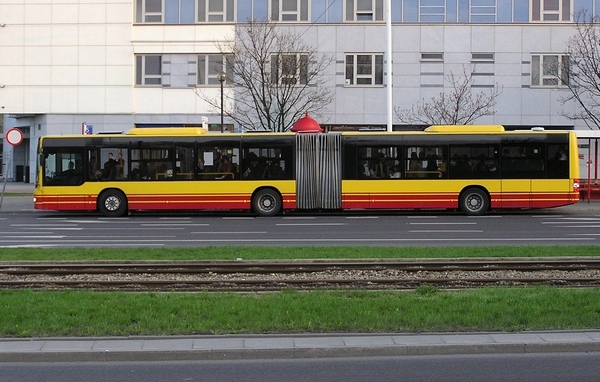
The territorial development of cities has for years been in contradiction with the needs of residents to move quickly from residential areas to places of temporary stay (work, school, offices, etc.). Irreversible trends related to urbanization force a constant increase in the level of development, the degree of branching, and the density of the collective communication network. Expectations are rising regarding the qualitative and quantitative characteristics of public collective transport that affect the travel times that city residents must spend on commuting.
Especially in large urban agglomerations, surface public transport faces a huge challenge, which is the increase in street congestion and its negative impact on the efficiency and reliability of its operation. Research conducted in many countries has proven that the transport of people by regular public transport is used more often not only because of the shorter average travel time but also because of its higher reliability and efficiency. Public transport has a comparable or even shorter travel time compared to private transport.
However, surface transport, compared to a system such as an underground railway, is exposed to a number of factors, the occurrence of which causes a violation of the rhythm and punctuality of operation, which is perceived by users as a decrease in the quality of transport services. The second significant problem of public collective transport is the reliability of transport means and the quality of the vehicle maintenance system.
The level of reliability of transport means increases the carrier’s operating costs and reduces the effective use of the fleet. Therefore, many transport companies set as one of their key tasks the improvement of public collective transport management processes. One should strive to combine two goals of public collective transport management: controlling the operation of transport means and managing the transport process in order to ensure the highest possible level of reliability of collective transport operation at an acceptable level of transport company costs. Fig. 1 shows a simplified system for managing the process of carrying out transport tasks in real time based on broadly understood telematics systems.
The article contains 18,610 characters.
Source: Logistyka Magazine