











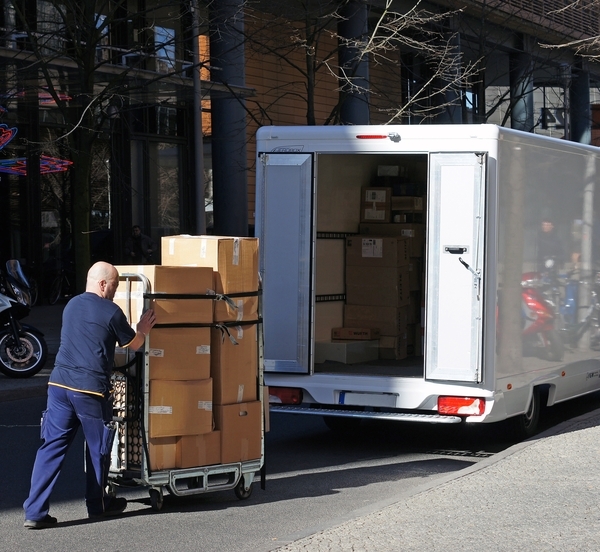
In the transport of goods, proper cargo securing plays an extremely important role. If transported improperly, it can be damaged and poses a threat to the driver and other road users. The sender is responsible for any damage resulting from improper packing of the goods.
Cargo securing depends primarily on its type, weight, dimensions, and the body of the vehicle used for transport. Two types of methods are used to secure goods (individually or simultaneously):
– blocking method, which consists of arranging the cargo in such a way that it blocks itself by resting against the rigid structural elements of the vehicle. Additionally, items such as shoring bars, wedges, airbags, nets, and tarpaulins with tensioners are used here to reduce the amount of free space between the loads.
– lashing method, in which straps, ropes, and chains are most commonly used. This method involves tying the loads together or fastening them to the cargo bed. Using adjustable tensioners, the goods are pressed down to minimize the possibility of shifting during transit.
It should be mentioned that the person commissioning the transport of a shipment to a logistics company or intermediary is responsible for the proper packing of the goods and, if required by the dimensions or type of shipment, for placing it on a pallet.
Legal regulations regarding cargo securing
Standards regarding the placement of cargo on a vehicle are defined by the Road Traffic Act, Article 61. It contains notes regarding the maximum total weight of the vehicle and its load capacity, axle load distribution, proper marking of goods, their maximum dimensions, or situations involving non-standard cargo protruding beyond the vehicle’s outline. The cargo should be secured in such a way that it does not shift during transport, does not cause noise, does not emit odors, and does not leak.
Additionally, within the European Union, the so-called PN-EN 12195-1 standard applies, which specifies the type of fastening elements, i.e., straps, chains, ropes, edge protectors, and anti-slip mats. Detailed guidelines contained in this standard allow for the calculation of the number of fastening elements required, along with the tension force with which they should operate. The inertia force resulting from the vehicle’s acceleration, braking, and cornering is taken into account here. The type-approval regulation governs the amount of safety equipment that must be present in commercial vehicles. In the case of full truckload shipments, the carrier selects the appropriate means of transport with the correct equipment.
Courier shipment transport – how to secure general cargo
In the case of so-called general cargo, i.e., all goods intended for transport in the form of small packages, the loader often does not have detailed information regarding the contents of each parcel. This makes it difficult to use lashing straps with the appropriate tension force. Therefore, when loading, the mutual blocking method is mainly used. Courier shipments are secured by grouping them on pallets and wrapping them with stretch film or using parcel cages. Taller pallets are placed at the front of the vehicle so that in the event of braking, they cannot fall. Sometimes it is also possible to stack the cargo.
How to prepare a parcel for transport?
Goods in parcels must be secured by the sender in such a way that no damage occurs during transport. General cargo is often reloaded between warehouses and vehicles. Therefore, one should be aware of this and pack the parcel for the circumstances of transport and potential reloading. This applies particularly to international shipments. In the case of ADR hazardous materials, the courier company must be absolutely informed about this. It is necessary to properly mark the goods along with the packing group and information for the carrier. ADR transport can only be carried out by appropriately prepared and trained carriers.
Appropriate information and marking also apply to the temperature above or below which a given product should not be stored. In the case of, for example, chemicals, cosmetics, or electronic devices, it is good to indicate the minimum and maximum temperature on the waybill. This is of particular importance during severe frosts or heatwaves, during which goods on a curtain-sided trailer could be destroyed.
Proper securing of cargo intended for transport largely depends on its specifications. The most important thing is always to ensure that it does not contain any loose elements, is stable, the packaging has no damage, and the carrier knows all the details necessary to properly organize the transport.
The article was prepared by Magdalena Jagieła – Transport and Forwarding Coordinator at Globkurier.pl. Project Manager in agile methodology. Experienced leader in effective team management. Expert at the e-Chamber. Coordinates the organizational area of cooperation with carriers.