











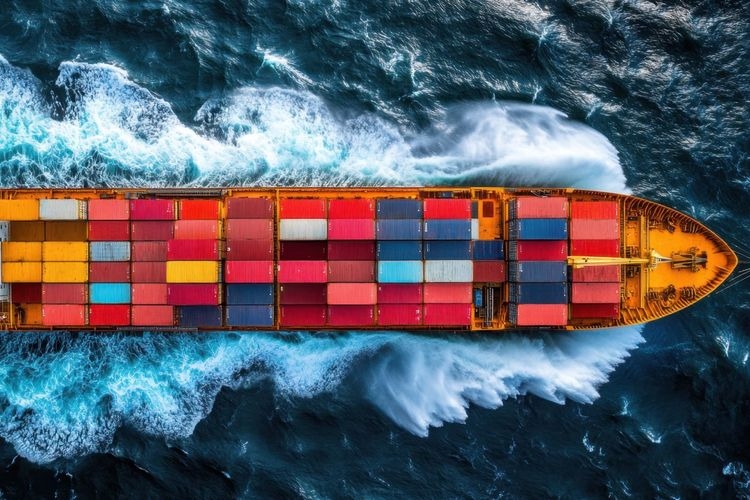
Sea container transport is one of the pillars of international trade. It is responsible for moving the majority of cargo in global trade – from electronics and clothing to industrial machinery. Thanks to standardized cargo units, such as TEU and FEU containers, seamless integration of sea, road, and rail transport is possible. As a result, an optimal container transport system is created, ensuring safety, punctuality, and cost-efficiency.
What is sea container transport?
Sea container transport is the process of moving cargo in sea containers – standardized units that facilitate transshipment between ships, trains, and trucks. This enables the efficient organization of sea transport on a global scale.
Sea transport is dominated by TEU containers (Twenty-foot Equivalent Unit) and FEU containers (Forty-foot Equivalent Unit), which allow for flexible transport planning. This type of transport is highly versatile, as it allows for the carriage of neutral, refrigerated, hazardous, and oversized goods.
Types of sea containers and their applications
Depending on the nature of the cargo, different types of sea containers are chosen:
- Standard sea containers (20’DV, 40’HC) – used for transporting most goods.
- Refrigerated containers (Reefer) – for the transport of food and other products requiring controlled temperatures.
- Open Top containers – allow for top loading, ideal for cargo with non-standard dimensions.
- Flat Rack containers – designed for transporting machinery, steel structures, and other oversized goods.
- Specialized containers – used in specialized transport, e.g., for chemicals or liquid cargo.
Selecting the right container is a key step in ensuring cargo safety and transport efficiency.
Full Container Load (FCL) and Less than Container Load (LCL) transport
Depending on the quantity and type of cargo, two basic transport models are used:
- Full Container Load (FCL) – the entire container is intended for one shipper. This solution guarantees maximum safety and shorter lead times.
- Less than Container Load (LCL) – allows for the shared transport of smaller batches of goods in one container. It is more economical for small shipments, although it requires a longer delivery time.
The choice between FCL and LCL depends on the cargo volume, delivery deadline, and transport costs.
Organizing sea transport step by step
Effective organization of sea transport requires precise planning. The process usually includes the following steps:
- Analysis of requirements and cargo type,
- Booking sea freight,
- Loading the container at the shipper’s site,
- Transport to the seaport,
- Customs clearance and documentation,
- Sea transport,
- Delivery to the consignee and unloading.
Furthermore, a comprehensive and professional container transport service often includes warehousing services and customs clearance consulting.
Intermodal container transport – a modern solution
Intermodal container transport involves using various modes of transport – sea, rail, and road – without transshipping the goods. This allows for cost reduction, shorter delivery times, and minimization of damage risks. It is intermodal transport that forms the basis of an efficient supply chain today, ensuring full transport flexibility and better adaptation to industry needs.
Seaports and the global network of connections
Seaports play a key role in the international supply chain, serving as central transshipment points in sea container transport. It is there that most logistics operations take place — from loading and unloading ships to container storage and customs clearance. Thanks to extensive infrastructure and specialized technical facilities, seaports enable the smooth organization of sea transport on a global scale.
The largest container ports in Europe, such as Rotterdam, Hamburg, Antwerp, or Gdańsk, handle millions of sea containers annually. Their strategic location makes them major trade hubs. It is from these ports that containers travel further inland, using intermodal transport — rail and road — which enables efficient distribution of goods across Europe.
Container transport costs
Sea freight is the main component of the price of container transport. However, transport costs are also influenced by, among other things:
- distance and route of the voyage,
- type of container,
- type of cargo (e.g., refrigerated, neutral, hazardous),
- seasonality and market situation,
- additional port and fuel surcharges.
For a full quote, an individual calculation is necessary. It is worth noting that for larger volumes, container transport with discounts is possible.
Summary
Sea container transport is an inseparable element of modern logistics and international trade. It combines efficiency, safety, and the ability to integrate with other branches of transport. Thanks to the development of intermodal transport, global trade is becoming faster, more economical, and more sustainable.