









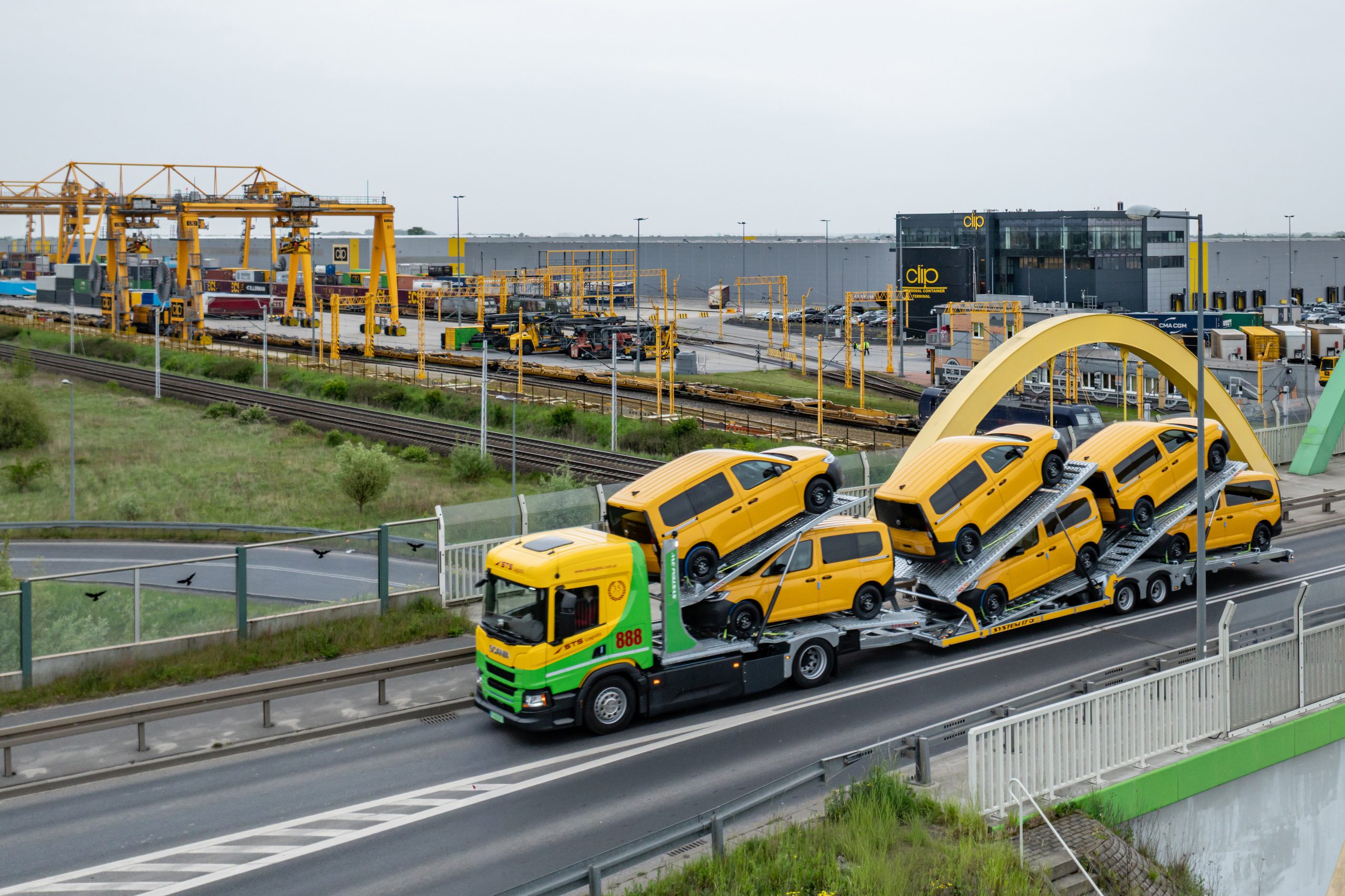
A specialized Scania truck with an electric drive and Rolfo bodywork will join the STS Logistic fleet. The project demonstrates that electromobility in heavy transport is entering new, demanding market segments – including the logistics of new cars.
Scania Poland has delivered the first electric truck in Poland designed for car transport to STS Logistic. The vehicle was prepared in cooperation with the specialized bodywork manufacturer Rolfo and will be used in the daily operations of one of the largest car logistics operators in Poland.
The project is an example of the practical implementation of electromobility in the heavy transport segment, which requires not only the right vehicle but also precise bodywork matching, route analysis, charging organization, and operational preparation. In the case of car transport, the predictability of tasks, cargo safety, loading and unloading efficiency, and the ability to integrate charging into natural operational stops are of particular importance.
The electrification of heavy transport has long since ceased to be limited to urban distribution and transport carried out by tractor units. We are increasingly talking to customers about specialized applications where an electric vehicle can work in a real, demanding operational model. The joint project of STS Logistic, Scania Poland, and Rolfo shows that car transport can also be an area for implementing zero-emission solutions. This is an important step for the market and a practical example of how technology, application analysis, and partner cooperation translate into a ready-made solution for the customer.
– says Paweł Kurzawa, Electromobility Director at Scania Polska S.A.
Responding to market needs
The automotive industry is paying increasing attention to reducing emissions throughout the entire value chain — from production and warehousing to the distribution of vehicles to dealers and end customers. Car transport is one of those areas where electromobility can bring measurable benefits, especially where routes are planned in advance and logistics operations take place between distribution centers, storage yards, production plants, and dealership points.
The implementation of an electric truck in such an application will allow STS Logistic to gain experience in operating a new type of vehicle, analyze energy consumption in real transport tasks, and check how charging planning can be integrated with loading, unloading, and fleet management processes.
As an operator specializing in car logistics, we are constantly analyzing solutions that can increase the efficiency of our operations and meet customer expectations. In this project, it is not only the technology itself that is important to us, but the opportunity to test it in practice – in demanding, well-organized transport based on high safety standards. The electric Scania vehicle with Rolfo bodywork will allow us to gather concrete operational experience and evaluate the potential of such solutions in our fleet.
– says Paweł Szumski, President of the Management Board of STS Logistic Sp. z o.o.
A solution prepared for specialized work
The electric vehicle for STS Logistic was developed as a complete transport solution. On the Scania side, it was crucial to match the vehicle configuration to the task, analyze the possible application, and provide support in terms of operation and service. On the Rolfo side, it involved preparing bodywork that allows for car transport while maintaining the functionality, safety, and ergonomics characteristic of car carriers.
The electric car carrier for STS Logistic was built on the basis of a Scania P270E B4x2LB chassis with batteries with a gross capacity of 356 kWh (320 kWh net) and a Rolfo System 3.17 bodywork designed for vehicle transport.
The configuration was prepared with 24/7 operation in mind, where repeatability of operations, appropriate vehicle weight, driver ergonomics, and efficient loading and unloading are key. Thanks to Scania’s modular design, it was possible to combine a traditional two-axle chassis, an electric powertrain with a continuous power of 270 kW, a medium-sized battery pack, and a compact cab into a vehicle that meets the specifics of the customer’s work.
Rolfo bodywork
The Rolfo System 3.17 is an evolution of the well-known car carrier concept, adapted to the requirements of electric trucks on rigid chassis and modern vehicle logistics. The Rolfo System 3.17 is valued for its exceptional ease and speed of loading, payload capacity, full-width loading platforms, and the ability to carry out loading and unloading operations under conditions of maximum safety and comfort. A key advantage is that the driver can perform all activities while standing firmly with both feet on the ground, which ensures higher ergonomics and safety in daily work.
The bodywork is based on the use of the original design configuration and does not require the intervention of any third-party company, which simplifies chassis logistics, increases operational reliability, and shortens delivery time. The Rolfo System 3.17 mounted on the electric Scania chassis offers a payload of over 7 tons, making it ideal for transporting two vehicles, including larger and heavier models such as SUVs or light commercial vehicles.
Using the same Rolfo bodywork that is used in vehicles with conventional drive facilitates the implementation of the electric car carrier into daily operation and reduces differences in operation for drivers and the fleet operator. An important element of the configuration is also the power take-off driven by the vehicle’s electric motor, thanks to which the bodywork can operate in a manner similar to solutions known from diesel vehicles. The project shows that electromobility in heavy transport today includes not only urban distribution but also specialized applications — from local operations with smaller battery packs to regional transport with batteries with a capacity of up to 623 kWh.
A car carrier is a specialized vehicle where every element counts: bodywork geometry, weight, safety of the transported cars, driver ergonomics, and durability in daily operation. In the case of an electric chassis, it is particularly important to precisely match the design to new technical requirements. Cooperation with Scania and STS Logistic allowed us to prepare a solution that meets the operator’s needs and the nature of car transport.
– says Svetlana Jitarasu, Area Manager, ROLFO SPA.
Partnership in transport
The project is significant not only because of the vehicle itself. For Scania Poland, it is an example of the development of electromobility in a segment that requires an individual approach to vehicle configuration, bodywork, and working methods. For STS Logistic, it is an opportunity to test an electric car carrier in real operational tasks. For Rolfo, it is another stage of adapting specialized bodywork to the technological transformation in heavy transport.
The first period of vehicle operation will allow for the collection of data on energy consumption, charging organization, driver comfort, and the impact of the electric drive on daily car logistics. The conclusions from the use will be important both for the further development of the STS Logistic fleet and for subsequent projects for the electrification of specialized transport applications in Poland.
For Scania, it is crucial that electromobility is implemented in a responsible manner tailored to the customer’s real needs. An electric vehicle must be part of a larger ecosystem: routes, charging, service, driver work, and the operator’s business goals. This project shows such an approach very well.
– adds Paweł Kurzawa.
Before its official release in Poland, the vehicle was picked up in Italy by an STS Logistic driver and driven to Poland on its own wheels, with a load. The journey was an opportunity to practically verify charging planning, driving comfort, and the behavior of the electric car carrier over a longer distance. The driver’s report from this route will be presented on Scania Poland’s social media channels as a practical record of the first experiences with using the vehicle.
Source: Scania Polska S.A.