








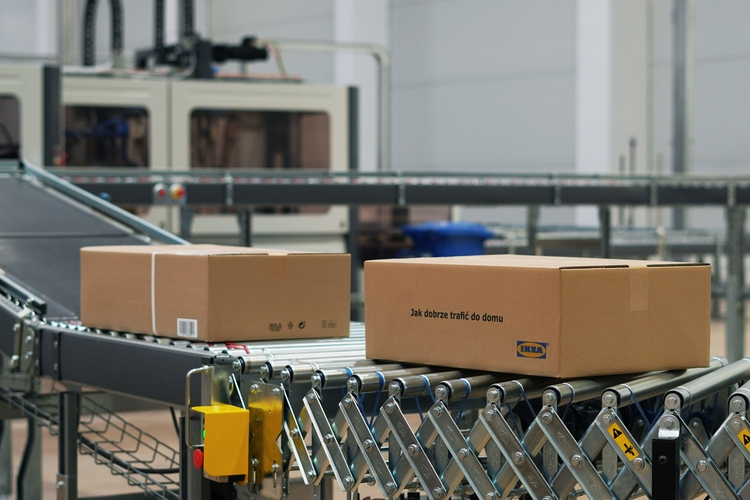
For the first time in Poland, Locus Robotics robots have been deployed at the FM Logistic warehouse in Wiskitki near Warsaw to fulfill parcel orders from across the country. This is the largest logistics process automation implementation for FM Logistic in the Central European region and another step in the development of IKEA’s omnichannel strategy in Poland.
The new FM Logistic warehouse, which has dedicated 16,000 square meters of space to IKEA, will handle approximately 7,000 types of items, including small furniture and home furnishing products such as selected mattresses, rugs, pillows, glasses, and candles. Currently, the warehouse allows for the handling of over 1 million orders in its first year of operation. The space allocated for IKEA, however, secures the prospect of an increase in the number of parcels and the development of the e-commerce channel for the next few years. Furthermore, locating the facility in central Poland will reduce the average number of kilometers traveled by parcels and contribute to a reduction in CO2 emissions. The automated logistics solutions used, such as Packsize and equipment that trims carton height to the size of the products, will also ensure lower paper consumption, thereby reducing the negative impact on the environment.
Development of omnichannel – meaning not just the cash and carry model
The new project by IKEA and FM Logistic is a response to the dynamically changing market and customer purchasing preferences. According to a report by the research company Gemius E-Commerce in Poland, as many as 77% of internet users declared making online purchases in 2022. According to Strategy & Polska (PWC Group), the value of the Polish e-commerce market grew by 127% between 2018 and 2022, from 48 billion PLN to 109 billion PLN. By 2027, according to the forecast presented in the report, the value of the Polish e-commerce market will grow to 187 billion PLN.
– At IKEA, we make the world of home furnishing affordable, sustainable, and more convenient for everyone. Buying and assembling furniture has always been natural for IKEA customers, but now they expect different options. An omnichannel approach to sales ensures that our customers receive high-quality home furnishing items – whenever, however, and wherever they want – says Sebastian Kaczmarski, Central Logistics Operations Manager, IKEA Distribution Services S.A., and adds: – This investment is also another chapter in the over 20-year cooperation between IKEA and FM Logistic in Poland.
Locus Robotics robots for the first time in Poland
It is in the FM Logistic warehouse that, for the first time in Poland, 46 assisting robots from the American company Locus Robotics have been used for order fulfillment, which is the only solution on the market that fully collaborates with humans. This is also the world’s first implementation of second-generation robots. Their load capacity has been doubled to 36 kg. The machines allow for the preparation of up to 4 orders at the same time, while simultaneously assisting warehouse staff with picking. They drive to the appropriate shelf and display on the screen which item and how many pieces should be picked. Then, thanks to laser sensors, they determine the shortest route between shelves and move to the next employees. In the next step, the orders go to an automatic line, where they are sorted for packing according to various technologies: from packing in envelopes to packing in cartons with height reduction or custom-cut cartons, and finally, they are assigned to separate loads for the appropriate courier companies.
– At FM Logistic, we follow the principle of automating logistics processes only for measurable results. In this project, wanting to meet both the high quality expectations of our client – IKEA, and the end consumers, as well as to facilitate the work of our warehouse teams, the use of large-scale automation was the best solution – says Guilhem Vicaire, Central Europe Business Solutions Director, FM Logistic, and further explains: – Due to the high diversity of products, as well as their dimensions, we used several different technologies. Currently, about 50% of orders are packed fully automatically. The other half of the orders are packed manually, where about 8% of products are so-called sensitive products, such as glass, and 10% are bulky products, which due to their size cannot be picked by robots. We estimate that thanks to the solutions used, we have achieved an efficiency level of 225% in order picking and 175% in packing. This is real support for the implementation and development of our client’s omnichannel strategy.
Omnichannel sales environment
Omnichannel at IKEA means giving customers the option to choose the most convenient place and way to shop, which is a response to their growing expectations and needs. Today, customers can meet IKEA in stores, planning studios, or when picking up products at collection points, IKEA Lockers, or Paczkomaty – in total at over 23,000 points located throughout Poland. All this to guarantee customers seamless shopping regardless of which sales channel they choose.
Online shopping is an increasingly chosen form of meeting IKEA. The IKEA Mobile App is the “smallest store in the world,” which was downloaded by 1.7 million users in the last financial year. Poland is one of the fastest-growing IKEA e-commerce markets in the world. The share of sales from this channel amounted to as much as 29% in the 2022 financial year (globally it is 25%).
The new investment in Wiskitki is also consistent with the implementation of IKEA’s 2012 sustainability strategy – People & Planet Positive. According to it, IKEA strives to become a circular and climate-positive business by 2030, while growing the business, by reducing greenhouse gas emissions by more than the IKEA value chain emits. The company focuses on listening to and responding to people’s real needs, inspires them to use solutions tailored to every situation and budget, and offers them products that help live in a more sustainable way. According to the latest IKEA Life at Home report, as many as 57% of Poles believe that their home reflects who they are, while 62% of them believe that they can be themselves at home.