











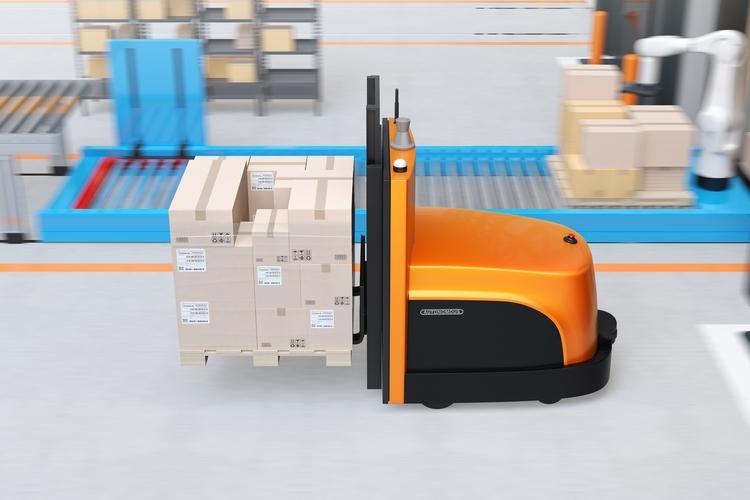
AGV and AMR systems, like any automation systems, are not the cheapest solutions. The question arises – in what cases is it actually worth incurring such a high cost? What profits can we count on in return? We explain when investing in mobile robots is most profitable. And who can benefit from the robotization tax relief.
The importance of digital transformation for companies is highlighted by the authors of the latest report from the Humanites Institute study, “Barriers and trends. Technological transformation of companies in Poland.” As they emphasize, digital transformation provides an opportunity for company development and building technological and competitive advantages. At the same time, it is a tool for implementing changes, not an end in itself. The next step in the transformation of companies towards Industry 4.0 is the automation and robotization of production. Will more companies decide to implement innovative solutions in this area thanks to the tax reliefs provided under the “Polish Deal” program?
Who can benefit from the robotization tax relief?
Companies that want to improve production through the use of industrial robots, and which have not yet decided on this solution due to the need to incur large investment outlays, can benefit from the industrial robotization tax relief.
Currently, the costs of obtaining revenues incurred for robotization include, among others, costs related to the purchase of new industrial robots and other fixed assets used to ensure ergonomics and work safety in cases where there is interaction between a human and an industrial robot, as well as costs incurred for the purchase of intangible assets that are necessary for the proper commissioning and acceptance for use of the robots. As a result of the proposed robotization tax relief, taxpayers will deduct an additional 50% of these costs from their income.
The robotization tax relief is intended to help companies improve employee safety, increase productivity and competitiveness in the domestic and international market, and generate savings. This step can also become an impulse for entrepreneurs to invest in further effective and long-term development projects.
The robotization tax relief has been in effect since January 1, 2022, and is planned for the next 5 years. It is worth considering an investment in robotization today and, thanks to the purchase of new robots and equipment, increasing the company’s production potential.
Improving employee safety
According to a 2020 Statistics Poland (GUS) report, in industrial processing, almost 8 out of 1,000 employees experienced work-related accidents, and in the transport and warehousing industry – almost 6 out of 1,000 people. Moreover, as many as 60.8% of work-related accidents were caused by incorrect employee behavior. Human errors cannot be eliminated unless we eliminate human participation in certain activities, e.g., those related to internal transport. We can do this, among other things, thanks to mobile robots.
– Implementing mobile robots makes sense not only where employees work with dangerous or heavy objects and are exposed to work-related accidents, but also where the work environment is simply difficult for humans. AMR robots created as part of the EU’s LOTIS project are able to work at temperatures even below -20oC. Therefore, instead of endangering employee safety and risking the need to pay compensation for health damage, it is worth investing in modern, automated solutions – emphasizes Olaf Dudek, Manager of the Mobile Robotics Research and Development Department at Etisoft Smart Solutions.
Increasing efficiency
In the operations of warehouses or production plants, there are many activities that do not bring much value but are necessary to perform. Locating goods, picking, and moving are some of them. If the nature of the company’s business requires these activities to be carried out for large quantities of materials or goods, then thanks to robots, this can be done faster and with less risk of costly mistakes. This is precisely why AGV and AMR systems are mainly used in larger plants. Increasing efficiency is also possible because mobile robots, unlike humans, do not have days of reduced productivity, do not need vacation, sick leave, or breaks after a shift. In addition, they charge instantly, which minimizes their downtime at work.
Savings
The implementation of AGV and AMR systems is also recommended for companies where many people are needed to carry out processes related to internal transport. This eliminates the need to incur fixed costs for salaries, as well as for the equipment itself used for such tasks, such as forklifts. In the long term, this generates significant savings. Everything indicates that they will be even greater, as specialists from Etisoft Smart Solutions are on the verge of developing an automatic battery replacement system as part of the EU’s HEPIS project. Thanks to it, it would be possible to reduce the operating costs of AGVs and AMRs.
– Financial outlays incurred for AGV and AMR systems can usually pay for themselves within 2 to 5 years of implementation. We also provide our clients with the possibility of cooperation in a subscription model. Thanks to this, smaller companies that cannot afford a large one-time expense can also decide to automate internal transport processes. In such a case, the return on investment can appear even in the first month after implementation – says Olaf Dudek.