








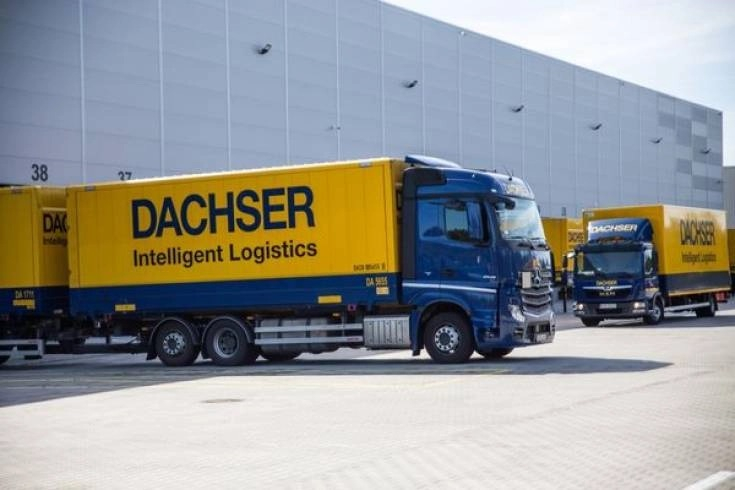
Autonomous vehicles have enormous potential for use in logistics. One of their possible applications is the full automation of the swap body maneuvering process. But how can this be done safely and effectively in a busy transshipment yard? The DACHSER branch in Langenau near Ulm has investigated this under real-world operating conditions.
At the DACHSER transshipment terminal, a Kamag PrecisionTractor takes an empty trailer from the parking lot and heads to Gate 35. During this time, the person behind the wheel can relax because the articulated truck is driving autonomously. What distinguishes this tractor unit are three large round sensors located on the front bumper, one at each end and one in the middle, from which bright green cables lead to the vehicle’s digital interior. Even more sensors and antennas are located on the roof of the vehicles.
At the DACHSER branch in Langenau, in southwestern Germany, a vision of the future is becoming reality. As part of the SAFE20 research project funded by the Federal Ministry for Economic Affairs and Climate Action (BMWK), the regular operation of two fully automated vehicles is being tested. Both tractors, moving at speeds of up to 20 kilometers per hour, blend seamlessly between pedestrians and human-driven cars. The vehicles, built by Kamag, a specialist in yard logistics, must deal with many unknowns on their route, including avoiding obstacles, changing direction, and reacting to pedestrians and cross-traffic. This poses a real challenge for sensor technology and the associated IT systems. Lidar scanners are used for this purpose, which capture and create a digital image of the surroundings using laser light. In turn, precise vehicle positioning while driving is ensured by a GPS antenna placed on the tractor’s roof. The vehicle is also equipped with a second antenna that receives data from external infrastructure sensors, providing information obtained from radar and camera data.
– Automating the maneuvering of swap bodies and trailers from their parking spaces to the transshipment terminal for loading and unloading has huge potential – especially given the shortage of drivers in the labor market – says Stefan Hohm, Chief Development Officer at DACHSER.
Ensuring completely safe automated truck transport in a logistics facility is a complex process, which is why cameras and sensors were also installed outside the buildings as part of the research project. For example, if one of them detects someone crossing a pedestrian crossing, the autonomous vehicle receives a warning in advance. In this way, the tractor can reduce its speed and, if necessary, stop immediately, even before that person appears in its field of vision.
Integrated into traffic flow
– In the case of operations in our yard, which involve various vehicles and people, it is crucial that these autonomous ones do not become an obstacle – says André Bilz, Team Leader Truck & Terminal Equipment at DACHSER headquarters. Currently applicable safety regulations specify that such vehicles can only move at speeds of 6 to 8 km/h. However, the tractors tested here are three times faster and move at speeds of up to 20 km/h. Therefore, they must fit into the “normal” traffic flow occurring at the branch.
– We have assigned demanding transport tasks in the automation zone, such as moving swap bodies and trailers, to special vehicles that perform them completely autonomously – explains André Bilz.
The three-and-a-half-year research project examined the practical application of the solution in logistics operations. During this time, it was placed on solid foundations, such as building a comprehensive safety concept, which was verified in continuous operation under real conditions. The next step is to incorporate the project results into the development of legally compliant guidelines for automated freight transport in transit terminals. In addition to DACHSER, seven other partners are involved in the SAFE20 project, including the Fraunhofer Institutes for Material Flow and Logistics IML and the Fraunhofer Institutes for Transportation and Infrastructure Systems IVI. ZF Commercial Vehicle Systems from Hanover acted as the project coordinator and was responsible for the conversion of the Kamag PT tractor. In turn, Kamag Transporttechnik supplied two special vehicles, which were then equipped by various partners with appropriate sensors and onboard electronics for data processing. SICK AG, specializing in this field, provided the sensors and was responsible for developing the safety concept. Meanwhile, the company Götting, as an expert in the field of automation, provided the necessary components for vehicle positioning.
Currently applicable safety regulations specify that such vehicles can only move at speeds of 6 to 8 km/h.
André Bilz and Christoph Ehrhardt, Department Head Trends and Technology Research in the Corporate Research & Development department, are satisfied with the progress of the test conducted on such a large scale in real conditions.
– We do not have a ready-made solution yet, but we have managed to gather valuable experience and data that we can use to shape further actions – says Christoph Ehrhardt. André Bilz adds that it will now be possible to show that safe mixed operation is feasible. – In addition to increased process reliability, we also expect a noticeable reduction in the number of damages resulting from collisions. The vehicles can maneuver not only swap bodies but also trailers.
In both cases, driving the vehicle must be done with centimeter-level accuracy. This means that the sensors must always be fully active and work even in difficult lighting conditions, for example at dusk or dawn. – Sometimes we had problems in extremely bad weather conditions, such as heavy snowfall, but these problems can be solved.
At the DACHSER branch in Langenau, in southwestern Germany, a vision of the future is becoming reality: the SAFE20 research project, funded by the German Federal Ministry for Economic Affairs and Climate Action, is testing the regular operation of fully automated vehicles.
Valuable addition
In times of a severe driver shortage, autonomous vehicles can provide useful support. However, they are not yet able to perform maneuvers in the yard completely without human intervention. Tasks such as securing a trailer with wheel chocks or opening and closing doors must still be performed manually. For this purpose, appropriate processes have been defined and in some cases, loading personnel take over responsibility. An automatic coupling system has been installed both to handle the automatic coupling function and to connect compressed air to the braking system and electricity to the lighting. However, the need to equip every trailer with such a system would have a negative impact on profitability. Moving swap bodies is much easier.
A key result of the SAFE20 project is the way in which potential improvements for future market solutions have been identified. There is certainly one important issue that this groundbreaking research project shows: the safe and economical integration of autonomous vehicles into logistics operations on closed premises is within reach.
Source: Dachser