











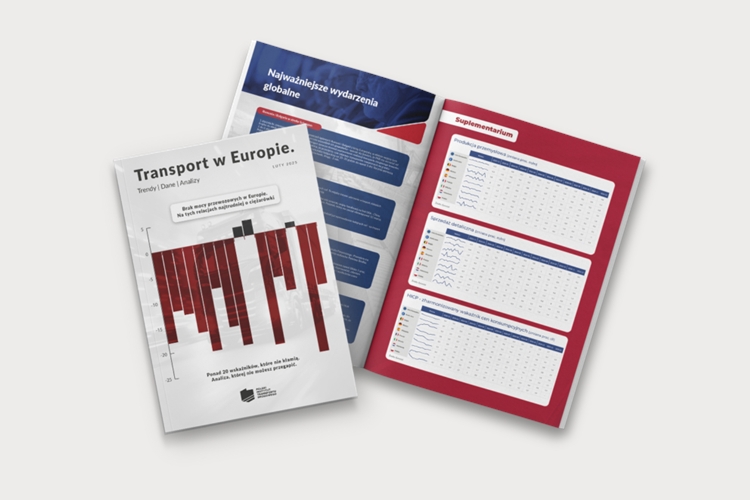
The beginning of 2025 brings clear signals that European road transport is entering another stage of transformation. The report “Transport in Europe. Trends | Data | Analyses”, prepared by the Polish Institute of Road Transport (PITD), shows not only the scale of the challenges but also the growing tension between rising demand and the limited supply of transport services. There are more freights. The problem is that there is no one to carry them.
For shippers, this is a warning signal – the growing number of freights does not guarantee efficient transport execution today. It requires greater flexibility, better planning, and deeper insight into data – which is exactly what we provide as CargoON.
Economic stagnation in the background
The year 2024 ended exceptionally poorly for European economies. On a quarterly basis, only in Poland did GDP growth exceed 1%, and in Spain, it was close to this threshold. Meanwhile, Germany and France recorded GDP declines in the last quarter – for Germany, it was the second consecutive one.
On an annual basis, only Poland and Spain recorded noticeable growth – by 3.7% and 3.5%, respectively. These two countries are most often mentioned in the report as exceptions against the backdrop of pan-European stagnation.
Consumption is not driving the market
Consumer demand is shifting towards services – and this limits the scale of orders in the TSL sector. In December, retail sales fell in most of the analyzed countries, including by 1.5% in Poland and 1.6% in Germany. There are also no clear impulses in industry – with the exception of Spain.
Consumer demand is shifting towards services – and this limits the scale of orders in the TSL sector. In December, retail sales fell in most of the analyzed countries, including by 1.5% in Poland and 1.6% in Germany. There are also no clear impulses in industry – with the exception of Spain.
The beginning of 2025 brings interesting changes to the market – both contract and spot. We see a dynamic increase in the number of freights, which, with a stable economy, can translate into higher rates and greater needs for cost optimization. Companies that flexibly manage the allocation of loads and vehicles gain an advantage.
– says Piotr Roczniak, Head of Business Consulting & Data at CargoON
Costs and investments under pressure
Fuel prices – the main cost of transport operations – are rising. In December, the average price of diesel in Europe was €1.57/l (an increase of 4.6%). At the same time, carriers are limiting investments. In Poland, registrations of trucks over 16 tons fell by 22.8%. Instead of investing in a new fleet, many operators are choosing a “survival” strategy – they are repairing older vehicles and limiting their operations.
Forecasts for 2025 are cautiously optimistic. GDP growth in EU countries is expected to be slightly higher than in 2024, but it is difficult to speak of an economic breakthrough. For shippers, this is a moment of decision – how to adapt purchasing and operational strategies to the new realities? One thing is certain: in 2025, those who can combine market data with flexible transport management will win.
The full version of the report “Transport in Europe. Trends | Data | Analyses” is available at hello@cargoon.eu.
Source: Trans.eu Group S.A.