








Proper tools for settling driver working time and remuneration help save significant resources in transport companies. Investments in training should also be treated as an opportunity to generate benefits for the enterprise. In times of economic slowdown, controlling costs becomes a matter of survival for carriers. Experts discussed the best ways to save money during the panel “How to reduce costs in road transport?” at the Poland as Europe’s Logistics Hub conference on April 26, 2023.
COVID-19 accelerated the digitalization of transport-related processes
– Among modern technologies that allow for cost reduction, fuel consumption monitoring should be mentioned. Fuel cards or route optimization tools help with this, among other things. Telematics ranks next. Mobile applications are becoming increasingly popular. They also streamline communication with the driver, fleet management, and improve safety. In general, 50% of fleet managers see the benefits of modern tools. However, what about the other 50%? There is a large field for action here, because they have the tools but do not use all the functions. One should always calculate what to use and at what cost – presents Agnieszka Szwaj, Regional Marketing Manager, Poland & EE Webfleet.
Reducing fuel consumption is the most common practice
– Fuel accounts for one of the largest shares in the cost pool. Fuel consumption reduction can be achieved through the digitalization of processes. Currently, tools that reduce fuel expenses are the most sought after on the market. One should monitor drivers’ driving style and fuel consumption on individual routes. Active coaching is also recommended while driving. Proper tire selection and air pressure monitoring yield measurable results. Our research shows that a 5% drop in pressure results in a fuel consumption increase of over a dozen percent – points out Agnieszka Szwaj.
Alternative fuels can generate savings
– The main activities at Shell are currently investments in alternative fuels and supporting our customers in reducing their consumption. We help them integrate with IRP and TMS. Thanks to this, we mobilize drivers to reduce fuel consumption. Polish transport companies are among the most technologically advanced. I am not just talking about the fleet with Euro 6 engines, because most have already replaced their vehicles with them. A fuel card is already almost a basic tool. Today, these are integrated cards with which a driver can pay for many services. This is the direction we want to head in. Data management and information exchange are key issues today. We can share data with the customer. Moreover, fleet and fuel cards are able to organizationally lower costs through discounts related to purchasing volume. Having everything in one place: fuel, road tolls, VAT and excise duty recovery. One should learn to save during prosperity to be ready for difficult times. We observe customers after two major crises. You can see how customers function more maturely – lists Michał Niemiec, CRT Sales Manager Poland, Shell Polska Sp. o. o.
A loyal driver is a profit for the company
Year after year, the shortage of professional drivers in Europe is deepening. However, companies that enjoy a good reputation and provide stable employment conditions do not have problems finding personnel. Moreover, drivers recommend such companies to their colleagues.
– Investing in drivers is a very good idea. Our rates are 15-20% higher than the competition. We mainly handle routes to Scandinavia. We require experience and competence there. We pay very good rates to ensure proper service. Currently, for young people, work is not the most important thing. Drivers are willing to earn less but be home more often. In our company, we are like a 200-person family. We follow the rules. If the employee is fair, the company is fair to them. We have a clear bonus system, bonuses for ecodriving and fuel saving. We share the generated savings with the drivers – lists Łukasz Grajcar, CEO at Imex Logistics Sp. z o.o.
– Investments in drivers pay off. Training is an investment, not a cost. A trained employee does not make mistakes. The report on driver earnings showed that few were trained on the Mobility Package, and the regulations apply to them as well. Most often, ecodriving training was conducted. The more training, the more drivers become part of the company – adds Dr. Eng. Justyna Świeboda, President of the Polish Institute of Road Transport.
The 2/1 work system can attract new drivers
The 2/1 work system means that the driver is on the road for 2 weeks, after which they can return home for 1 week. Recently, it has been observed that it is gaining popularity and more and more companies are offering it to their employees.
– The 2/1 system is becoming a lure for new people. You have to be flexible because it is a difficult profession. The driver spends a lot of time away from home. The more often drivers return home and at the same time have certainty about return dates, the lower the turnover in companies. This allows them to plan their life or family activities. ZMPD, together with IRU, conducts research which shows that a significant issue for female drivers is clearly defined return frameworks. This could increase the number of women in the profession. In addition, training binds the driver to the company. Documentation, rest, driving time, or ecodriving are the most frequent training topics. There is a large role for representatives of carrier associations to adapt training to drivers and company needs – presents Alicja Chodorowska, Chief Specialist of the Transport Department at the Association of International Road Carriers (ZMPD).
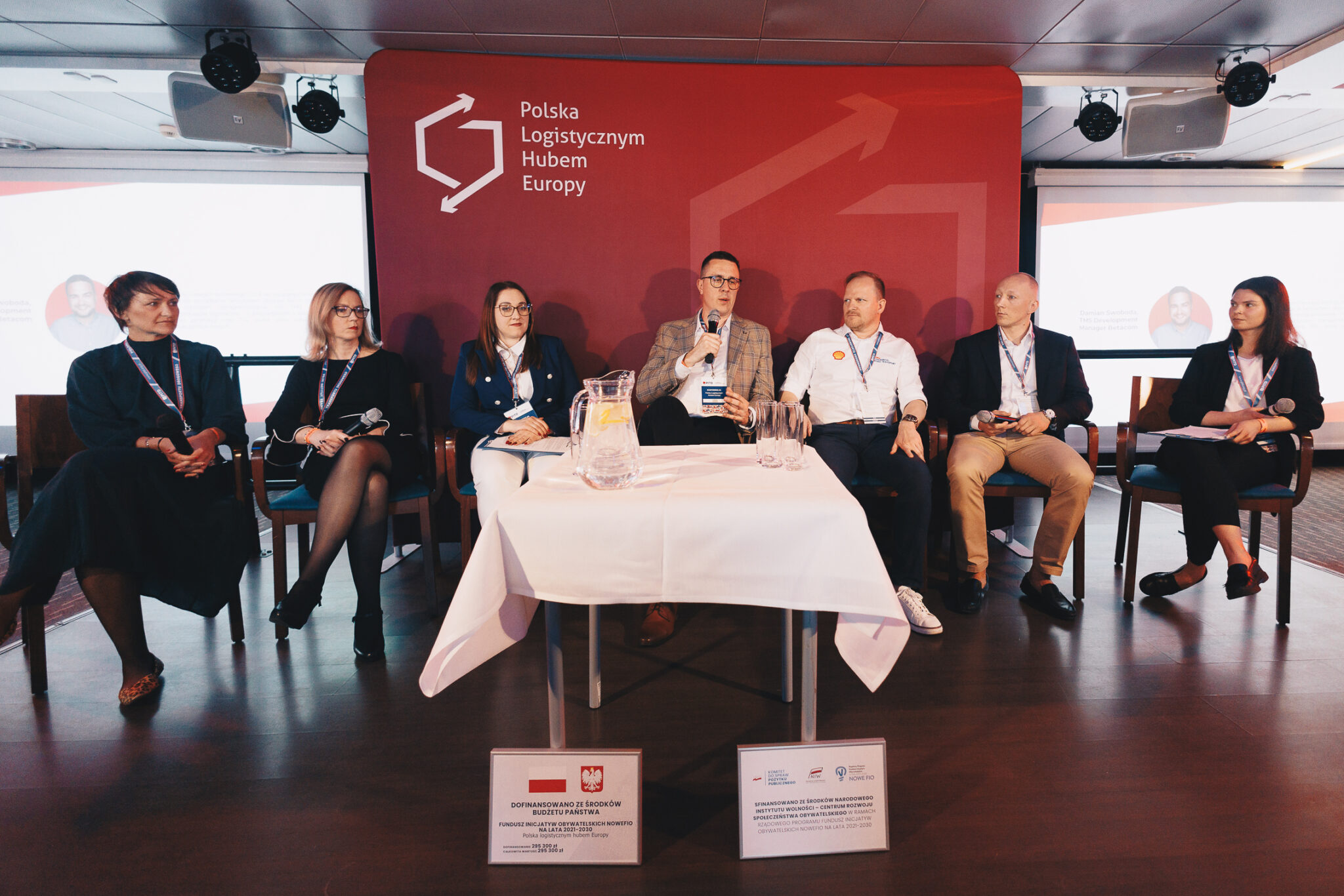 PITD Poland as Europe’s Logistics Hub Conference
Let’s respect the driver’s profession
– We try to reward our drivers. We serve tourist-attractive regions in Scandinavia. Once a year, a driver can take their family on the route, and we finance such a trip. We always respect our staff. Out of a group of almost 400 drivers over 13 years, only 4 people were from abroad. This shows that we do not have a problem with acquiring our drivers. We have them mainly from Poland because we also care about this family atmosphere in the company. Moreover, 4% of the staff are women. In general, women like to drive to Scandinavia because they spend the nights on the ferry then – points out Łukasz Grajcar.
– At PITD, we launched the “Respect My Way” campaign, which promotes the driver’s profession. In it, we show real-life stories concerning our truckers. Their difficulties and joys. What they like and value about their work. It is worth mentioning that our research showed that, in general, professional drivers like their work – presents Dr. Eng. Justyna Świeboda.
Good insurance can limit the company’s overall costs
– Insurance accounts for between 5-10% of total fleet costs. This mainly consists of required fleet insurance. On the topic of insurance, I propose a comprehensive, holistic approach. One should take into account factors such as post-accident repairs, towing, and vehicle recovery. These costs cumulatively make up the insurance. One claim abroad can generate high costs because the scope of insurance was not sufficient. We look at the costs of post-accident repairs, those that we cover ourselves, and those that the insurer will cover. We always perform an insurance audit first, indicate the scope of insurance, or policy dispersion. We look for the best solution for a given company. I recommend one insurer with whom it is possible to negotiate a favorable rate and receive something to start with. We look for insurers who will help train drivers or give a discount for using telematics in the company. As an example, I will use finding a better price and a good scope of insurance. From the initial 600 thousand, we found an offer for 570 thousand, plus subsidized training for drivers in the package. If we treat this as a discount, the savings become quite decent. It is worth mentioning that insurers like to reward driver training and telematics. A trained driver causes fewer accidents, and the loss ratio then drops – points out Michał Parol, Business Development Director at MAK Ubezpieczenia.
– In Poland, the topic of insurance is still treated as a necessary evil. There is a strange belief that nothing will happen. Smaller carriers look for the cheapest policies, but they do not allow for much. In my large fleet, something is always happening. It is good to have a good insurance broker. We found a driver’s liability solution that, for a premium of 186 PLN, gives 10 thousand per year for damages caused by them, but committed unconsciously – adds Łukasz Grajcar.
Information about the PITD Road Report is available at the link.
Source: Polish Institute of Road Transport