








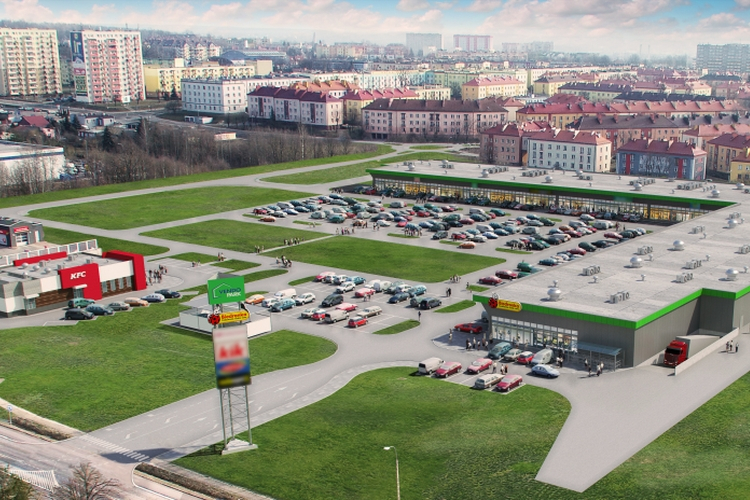
The retail real estate market in Poland remains in a phase of dynamic growth, thanks to the development of the retail park segment (over 5,000 sqm GLA) and convenience-type facilities (retail parks with a GLA of less than 5,000 sqm). Since 2016, over 160 transactions involving such assets have been completed.
– Small convenience-type facilities still dominate investments in the retail real estate sector in Poland. Facilities of this type are often based on grocery discounters and so-called “value retailers,” which consistently enjoy popularity, even in times when consumers are paying increasing attention to the prices of essential goods, and shopping is often limited to the bare minimum. As strange as it may sound, rising inflation and the resulting decline in purchasing power paradoxically work in favor of convenience centers and retail parks, which are characterized by a discount offer – says Michał Ćwikliński, Principal, Managing Director – Poland at Avison Young.
Attractive capitalization rates in the sector
In Q1-Q3 2022, the value of investment volume in the retail sector in Poland was over 20 percent higher than in the corresponding period of 2021. However, this result is mainly due to joint venture projects completed by EPP in the first quarter, which account for 75% of the sector’s result.
– Capitalization rates for prime properties in Poland show an upward trend. The difference between capitalization rates for prime retail parks (6.8 percent) and prime warehouse (5 percent) and office (4.7 percent) properties exceeds 180 basis points, which is an exceptional result compared to Western European capitals. In the case of retail parks, Poland still offers investors attractive capitalization rates. In the Central and Eastern European market, Hungary (7 percent) and Romania (7 – 7.25 percent) also stand out with high rates in the sector – comments Michał Ćwikliński.
However, due to the lack of product and high interest in retail parks and convenience facilities, Avison Young expects further compression of capitalization rates in this segment.
Number of transactions breaks records
In the years 2016-2019, the share of transactions involving retail parks and convenience centers in the total volume of the retail sector in Poland did not exceed 10 percent on average. In 2020, we recorded a two-fold increase (20 percent), as many other investments were halted due to the pandemic. In 2021, the result was at the level of 12 percent (117 million euros), and in Q1-Q3 2022 – 15% (127 million euros). The number of transactions in this segment is breaking records. High liquidity with a lower total volume reflects investor interest in small formats, including those located in smaller towns. In Q1-Q3 2022, as many as 17 out of 26 transactions recorded in the retail sector concerned retail parks and convenience centers, which was the highest share since the market’s inception.
A lot in the hands of developers
The growth dynamics of this sector are relatively small because most investors operating in it implement long-term strategies. Therefore, transaction volume depends largely on developers and the supply of new facilities. In Q1-Q3 2022, 40 percent of transactions were completed with new facilities – present on the market for less than 2 years.
More and more new investors
The sector consistently attracts new investors. In 2022, Lords LB and LEOFF Group debuted in Poland, acquiring properties in Wrocław and Opole. Avison Young expects that by the end of the year, other players, including those from France, Israel, and the Czech Republic, will appear on the domestic investment market, attracted by the sector’s attractiveness. Over the last two years, the shape of the investment market in the sector has been mainly influenced by two investment entities, which together accounted for 36 percent of the transaction volume in the period 2021 – Q1-Q3 2022. Over the last 2 years, entities from Germany (76 million euros in total) and Great Britain (54 million euros in total) have mainly invested in retail parks and convenience centers in Poland. Other sources of capital, smaller in terms of invested capital by half, are Western European countries, the USA, Central and Eastern European countries, Israel, but also Poland.
What influences the valuation of a retail park
– Prices and estimated values of retail parks depend particularly on the tenant structure, including the presence of a grocery operator of recognizable chains. The highest prices, and thus the lowest capitalization rates, are achieved by facilities with a WAULT of over 7 years, with attractive grocery operators with lease agreements for longer than 15 years. Depending on various market factors and the specifics of the property, prices range from 800 to 2,000 euros/sqm of leasable area. Yields most often fall in the range of 7.00 – 8.5 percent – comments Monika Bronicka, Director, Head of Valuation and Advisory at Avison Young.
Among the largest single facilities that changed owners this year were Power Park Opole (20.7 thousand sqm), Franowo Retail Park in Poznań (15.9 thousand sqm), and Młyn Retail Park in Wrocław (10.6 thousand sqm).
Convenient shopping in the neighborhood – a trend that is strengthening
– Customers are looking for quick, daily, and convenient shopping in the neighborhood or on the way home. Thus, convenience-type retail parks are constantly developing, also exploring the retail markets of smaller towns. Their tenants usually include a grocery discounter, a drugstore, basic service points, and “value retailers.” A new player in this group is, among others, the German Woolworth, which will enter the Polish market at the beginning of 2023. It will open its first two stores in retail parks located in Kraków and Łódź, but the chain’s expansion plans include over 400 locations. Interestingly, lower rents and service charges are now encouraging fast fashion brands to expand outside traditional, large shopping centers and locate their stores in smaller retail formats. – informs Artur Czuba, Associate Director at Avison Young.
E-commerce does not always work
– Cheap and frequently changing offers encourage customers to make spontaneous visits to retail parks. Pepco, one of the most popular non-grocery discount chains, recently withdrew from online sales after a trial year. The low price of products, which is the basis of the chain’s retail business, made it impossible for it to build profitable online sales. It turned out that customers prefer to visit brick-and-mortar stores rather than pay for delivery costs – Artur Czuba, Associate Director at Avison Young.
Polarization of transactions in the sector
Investments in the sector are strongly polarized in terms of location between large agglomerations and smaller towns with fewer than 50,000 inhabitants, of which there are definitely more. The distribution of investment transactions shows, on the one hand, a large appetite of investors for assets in prime locations, and on the other – the intensive development of convenience-type retail real estate in increasingly smaller towns, which attract customers from the surrounding area.