











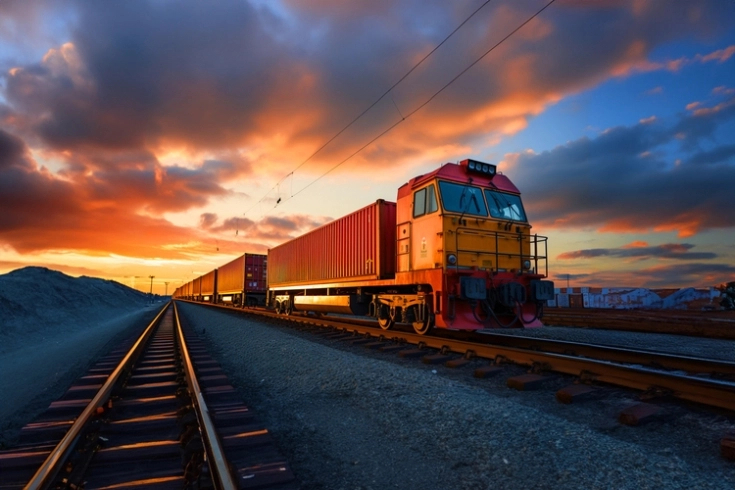
In Poland, the share of rail in land freight transport in 2021 was 22%, which ranks it 14th among 27 European countries. The remainder of the cargo is handled by road transport (78%). Rail is used most extensively for freight transport in Lithuania (62.5% share) and least in Ireland (0.6%). The Office of Rail Transport (UTK) has published a report presenting rail against the background of alternative land freight transport modes in Europe.
The latest UTK publication, “Rail vs. alternative modes of transport in Europe,” presents the results of an analysis of Eurostat and UTK data for 23 European countries regarding transport performance, as well as the share of individual land transport modes: rail, road transport, and inland waterways. The data shows, among other things, that in 2022, rail accounted for less than 17% of transport performance in land freight transport. For road transport, this value was over 78%. In the case of inland waterways, it was less than 5%. Among 27 EU countries, rail was used most extensively for freight transport in Lithuania (62.5% share), Latvia (53.4% share), and Estonia (40.1% share). In 2021, road transport in these countries accounted for 37.5%, 46.6%, and 59.9% of land freight transport, respectively. For comparison, the share of road transport in freight carriage in Ireland is 99.4%, in Greece 97.1%, and in Spain 95.7%. Rail in these countries accounts for 0.6%, 2.9%, and 4.3%, respectively.
According to the European Commission’s assumptions, transport emissions are to be reduced by 90% by 2050. This is to be achieved, among other things, by doubling rail freight traffic by 2050. This ambitious plan has a chance to reverse the proportions of land transport mode usage in Europe. The challenge is significant, as the share of rail in this sector varies greatly on a European scale, as presented in the UTK publication.
In accordance with the requirements of the European Green Deal, significant ecological benefits can be achieved through the development of the rail freight market. Although rail, like no other mode of transport, fits into the strategy for sustainable and smart mobility, the “green initiatives” undertaken in recent years have not caused a significant modal shift. Road transport still dominates freight transport in the EU, accounting for almost 77% of greenhouse gas emissions in transport [1], while rail accounts for less than 0.4%.
The UTK analysis also describes Swiss, Austrian, and Spanish examples of transport policy aimed at even greater use of rail in these countries (and thus achieving climate goals). One of the most interesting is the new waste management act in Austria. According to its provisions, as of January 1, 2023, low-emission transport, including rail transport, is required for waste weighing over 10 tons and transported over a distance of at least 300 km. This minimum distance is to be reduced to 100 km by 2026.
Since the launch of the strategy for sustainable and smart mobility in December 2020 and the actions taken so far, many national regulations and technical barriers still hinder the increase of rail competitiveness. A significant problem is the insufficient level of infrastructure development. Paradoxically, a significant increase in rail transport brings challenges related to capacity, which affects the quality and reliability of rail services. This, in turn, makes planning difficult and increases costs.
The publication is available for download in the “Studies of the Office of Rail Transport” section.
[1] Statistical Pocketbook 2022 EU Transport in Figures.Source: Office of Rail Transport