








Optimization of location and zoning in distribution networks – part 3.
The purpose of this article is to present a procedure for determining the service area for a distribution center. The reader will first become familiar with the types of routes in a customer service system. The mode of operation in determining the area will be presented in the form of a task consisting of two sub-tasks: assigning a customer to an appropriate means of transport and determining routes for each of them. The solution – the connection of routes – will be presented in graphic form.
When working on building an appropriate service system, the decision-maker has three basic types of routes to choose from. The first of these is circumferential-arc routes – they connect customers along a path similar to an arc, at various distances from the bases.
Fig. 1. Circumferential-arc route
Another type of route is the terrain-zonal route – they connect customers along a path in a concentrated area. It is worth noting that in the case of terrain-zonal routes, the driver can supply several towns, starting from 1, 2, 3, …, n and returning to pass through location no. 1 again. In contrast, in an arc route, the means of transport clearly moves along an arc, as if circling the base, and the return takes place directly from the point served last.
Fig. 2. Terrain-zonal route
The last of the presented route types is the radial-star route, also called the hub-and-spoke system. In this type, we have a clearly individualized service system in its pure form: one means of transport, one route, one recipient.
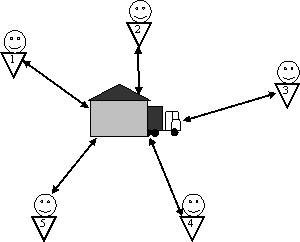
Fig. 3. Radial-star route
Routes and service areas are designed for a certain number of means of transport and drivers employed to operate them. As with most methods, certain boundary assumptions are necessary, which we present below.
Assumptions:
- products are relatively homogeneous and can be transported by a uniform means of transport. We will assume that the homogeneity of the products allows for the introduction of a common measure of load capacity – pallet load units formed on EUR 1200 x 800 mm pallets.
- products are to be collected from one warehouse, e.g., the manufacturer’s product warehouse, which we will further denote with the symbol PO, and delivered to n recipients, which we will denote with the symbols O1, …, BN. In the further part, recipients will be identified by index numbers.
- we assume that we have customer orders, and due to the homogeneity of the products, they are expressed in load capacity units. The order of recipient Oi, i = 1, …, n is written as Zi. In the further part, for brevity, we will identify recipients by their indices alone.
- products will be distributed by identical means of transport, each with a load capacity of QP. We will assume that QP > Zi (i.e., the truck’s load capacity is greater than the recipient’s order). At first, it may seem that this is a very significant limitation. However, if a recipient’s order is greater than the load capacity, then the number of full-truckload deliveries should be maximized, while the remainder should be combined with other deliveries.
- a significant and realistic assumption will be the introduction of a maximum permissible duration of transport by one means of transport. The time spent on the route cannot exceed T time units for any of them. This results in an important limitation: the travel time from the manufacturer to any customer and back cannot exceed T.
- in practice, delivering cargo requires some time for its unloading at the recipient’s site, so we will define a certain conventional unloading cycle for one pallet load unit twpjł and determine its duration. The time required for unloading will result from the product of the average unloading cycle time of a single pallet load unit and the number of units unloaded at a given recipient. If the unloading time (tw) is greater than the duration of the break in work (tpp) resulting from the Act on Working Time of Drivers or the Labor Code, then we will take the unloading time for calculations.
To determine service areas by assigning appropriate means of transport to tasks, we must adopt a certain mode of operation. At the beginning, it is necessary to determine the number of means of transport and their routes that allow for servicing all customer orders while maintaining transport conditions so that the total service time for all customers is minimal.
The task consists of two sub-tasks:
- assigning a customer to an appropriate means of transport,
- determining routes for each of them, taking into account breaks resulting from loading activities.
A construction warehouse is located in Bydgoszcz and acts as a distribution center for commercial points located in the following cities: (1) Elbląg, (2) Gdańsk, (3) Gorzów Wlkp., (4) Koszalin, (5) Olsztyn, (6) Piła, (7) Poznań, (8) Słupsk, (9) Szczecin, (10) Toruń. The goal is to meet the demand of individual recipients for adhesive mortar. The demand with the quantities given in Table 1 occurs 3 times a week. It is necessary to answer what the route will look like, knowing that each means of transport is operated by one driver, the driving time cannot exceed 10 hours, the condition marked as T. The maximum load capacity of the means of transport is 32 pallet load unit spaces, the limitation marked as B.
Fig. 4. Graphical representation of the network