












Absorbent materials are widely used in the field of electromagnetic field shielding. The effectiveness of field shielding by a shield is a function of the material from which it is made (permeability, conductivity, and thickness), the frequency, and the distance of the EMI source from the shield.
Using the method developed by S.A. Schelkunoff, the total shielding effectiveness of a solid conductive shield can be expressed as the sum of reflection losses (RdB), absorption losses (AdB), and multiple reflection losses (BdB). (Figure 1)
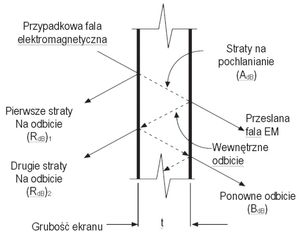
Fig. 1. Losses on a solid conductive shield.
Reflection losses are proportional to the electromagnetic wave impedance (Zw) and inversely proportional to the internal impedance of the shield (ZB). Absorption losses are proportional to the thickness (t) and the absorption coefficient of the shield (a). The reciprocal of the absorption coefficient gives the skin depth (δ). Skin depth is a magnetic property that causes the flowing current to be displaced to the surface of the conductor. The skin depth becomes smaller (shallower) as frequency, conductivity, or permeability increases. The electromagnetic field is attenuated by 1/e ≈ 0.37 for every skin depth δ into the shield. The greater the number of multiples of the skin depth δ in a given material thickness, the greater the losses resulting from absorption. As the skin depth becomes shallower with increasing frequency, absorption losses at high frequencies become the main and dominant component. Multiple reflection losses strongly depend on absorption losses.
The article will present the results of actual measurements of the attenuation of commercially available absorbent materials and an example of their application to eliminate undesirable effects in the RFID field.
The article contains 16,800 characters.
Source: Logistyka Magazine
Mackowiak_Sieczkarek_Lobaziewicz_Mozliwosc_zastosowania_materialow.pdf