









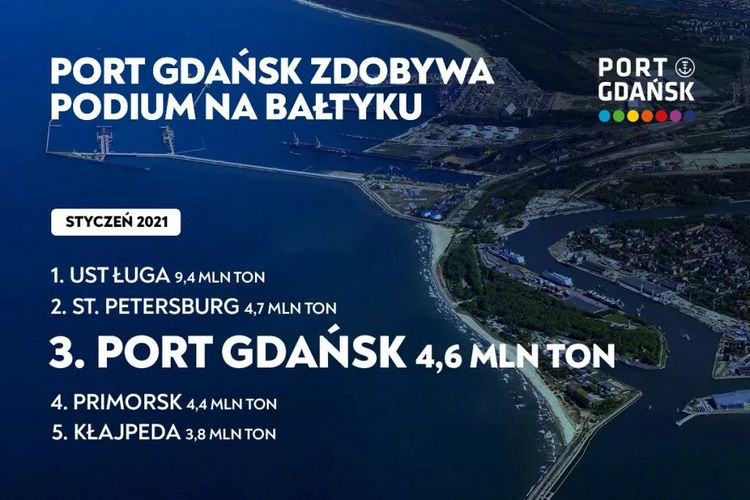
For at least a decade, the presence of three Russian ports on the Baltic podium (Port of Ust-Luga, Port of St. Petersburg, and Port of Primorsk) has been a constant trend. In January 2021, for the first time, there was a shift in power on the Baltic Sea. The Port of Gdańsk advanced to the third position, achieving a result of 4.6 million tons of cargo handling, which means an increase of 8.8% compared to January 2020.
The bulk ports of Ust-Luga and Primorsk, as well as the main transshipment gateway of Northern Russia, the Port of St. Petersburg, have dominated the Baltic in terms of cargo handling until now. All three ports have a significant share in handling Russia’s foreign trade. In total, in 2020, they handled 241.5 million tons of cargo, recording a 5.8% year-on-year decline. At the end of 2020, the difference between the Port of Gdańsk and the Port of Primorsk was 1.3 million tons of cargo. However, the beginning of the year brought a new deal. The podium is opened by the Port of Ust-Luga with a result of 9.4 million tons (+3.6%), followed by St. Petersburg in second place with 4.7 million tons (-0.8%). In January 2021, the Port of Gdańsk recorded a result of 4.6 million tons of cargo, thus overtaking the Port of Primorsk, which fell to fourth place in the ranking with transshipments at the level of 4.4 million tons (-26.3%). The Port of Klaipėda remains in fifth position, achieving 3.8 million tons (+10.8%).
– The advancement to the third position of the Port of Gdańsk proves not only the great flexibility of our port, and consequently our operators, but also points to its universal character in the context of other ports in the Baltic Sea region. The global pandemic has affected the condition of the entire maritime industry. It was also an important test for Polish ports, which we managed to pass – says Adam Kłos, Commercial Director of the Port of Gdańsk.
The share of the Port of Gdańsk in handling Poland’s maritime trade remains at a high level and in 2020 it amounted to 46.2%, which is the highest among all Polish ports. The global pandemic did not prevent the Port of Gdańsk from maintaining a high position in the rankings. During the period of prosperity, it developed the fastest of all European ports, and when the pandemic affected all ports, it recorded one of the smallest declines.
– This is definitely a good start to the year for the Port of Gdańsk. This is largely due to the hard work of our operators. We are very impressed by their determination. Our goal is to continuously strengthen our position on the Baltic Sea. Thanks to investments and clearly defined directions, our contractors are increasing their transshipment capabilities, and the Port of Gdańsk is growing in strength. Today, we are already a port without limitations. This is influenced by: the deep-water fairway, thanks to which we can receive the largest vessels with a draft of up to 15 meters in the Outer Port; the lack of tides, i.e., constant water depth, as well as the lack of icing, allowing for year-round operation. Furthermore, we are finishing our key investments both from the land and water side. Real quality improvement regarding infrastructure in the Inner Port will be visible from the middle of this year, when all quays will be modernized and the fairway will be deepened to 12 m. Operators will be able to use the new infrastructure, which will be another opportunity for them to increase transshipment capabilities – says Łukasz Greinke, President of the Port of Gdańsk.
Source: Port of Gdańsk