











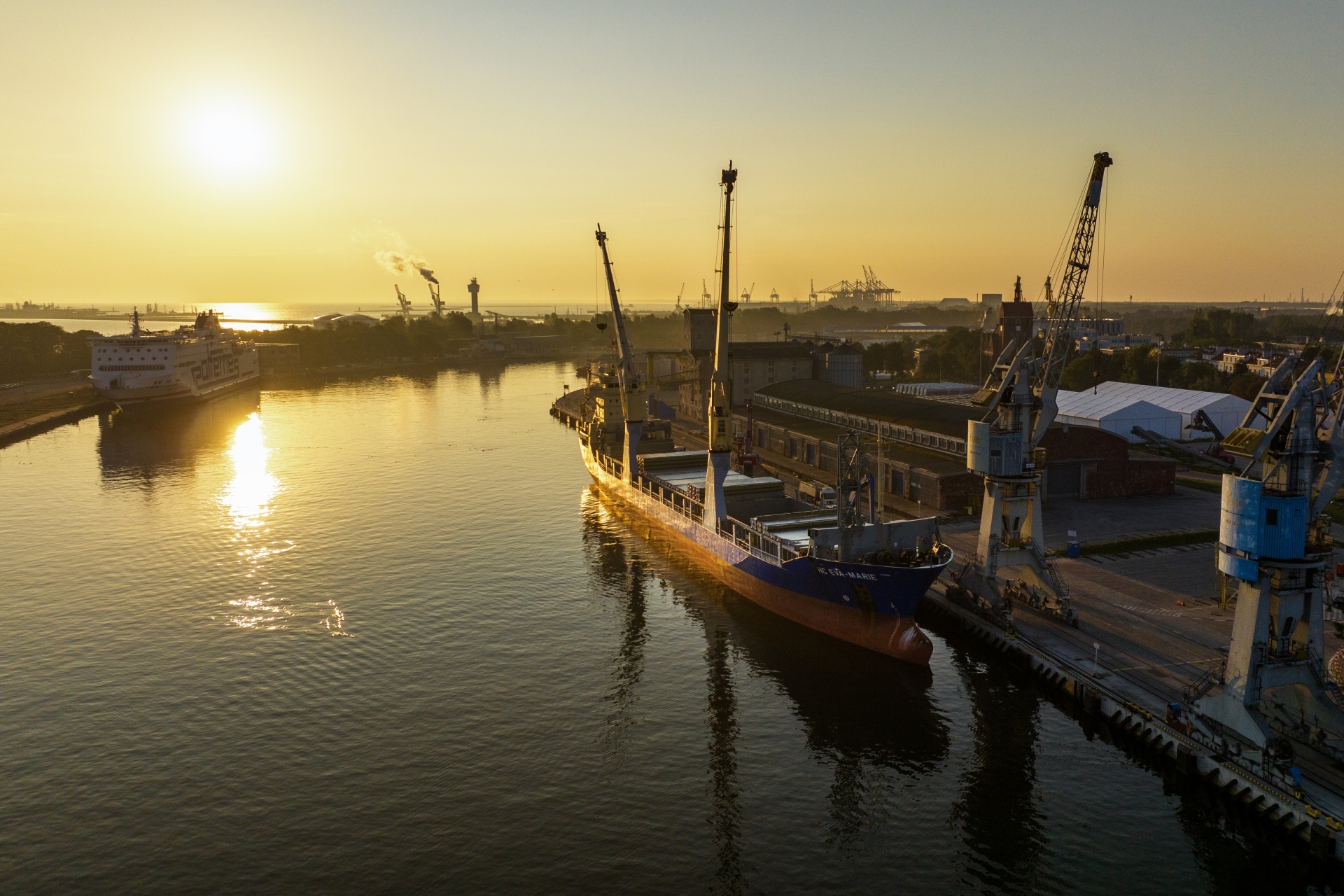
The Port of Gdańsk has entered the top three largest ports in the European Union in terms of short sea shipping cargo handling, according to the latest Eurostat report “Key figures on Europe – 2025 edition”. This is a historic advancement of two positions compared to 2022, thanks to which the Port of Gdańsk has overtaken such renowned port hubs as Trieste and Amsterdam.
According to Eurostat data for 2023, the Port of Gdańsk handled 61 million tonnes of cargo in short sea shipping (total cargo handling amounted to 81 million tonnes), which placed it on the podium just behind the largest ports of Western Europe – Rotterdam (159 million tonnes) and Antwerp-Bruges (119 million tonnes). For comparison, Trieste ended the year with a result of 46 million tonnes, and Amsterdam with 39 million tonnes.
Back in 2022, the Port of Gdańsk ranked 5th among the largest EU ports in short sea shipping. A year later, thanks to dynamic growth in cargo handling, the port advanced to 3rd place, overtaking competitors from Southern and Western Europe.
This is a huge success that confirms the growing importance of the Port of Gdańsk as a strategic maritime gateway for all of Europe. This high position is the result of the trust of business partners, the hard work of port staff, and consistent investments in infrastructure. It is proof that our actions are yielding tangible results, providing an important signal to investors that the Port of Gdańsk is a modern, dynamically developing hub, ready to meet the growing demands of the market.
– comments Dorota Pyć, President of the Port of Gdańsk.
A strong maritime Poland
Short Sea Shipping (SSS) covers maritime transport over relatively short distances – primarily between EU ports, and to and from countries in the Mediterranean and Black Sea basins. It is a key transport segment for the Community’s economy – in 2023, it accounted for 56.6 percent of total EU maritime freight transport.
The total mass of goods transported via SSS in the EU in 2023 amounted to 1.6 billion tonnes, which means a decrease of 5.4 percent compared to the previous year. It is worth noting that as many as 16 of the 20 largest ports in the Union recorded a decline in cargo handling during this time. The largest declines were recorded by Amsterdam, Barcelona, Haropa, and Rotterdam. One of the exceptions was the Port of Gdańsk – its growth rate was among the highest in Europe (+40 percent).
This is the second-best result in Europe, second only to Italy’s Taranto (+50 percent). For comparison, Genoa recorded an increase of 13.5 percent, while many leading ports, such as Rotterdam and Antwerp, struggled with declines. The results of the Port of Gdańsk in the liquid fuels segment are particularly impressive, where cargo handling increased by as much as 50 percent year-on-year, reaching 31 million tonnes. In this area, it ranked among the top in Europe, overtaking, among others, Trieste.
Strategic gateway of Northern Europe
Eurostat emphasizes that the development of ports is part of a larger trend of shifting European trade routes to the east. Polish maritime infrastructure is becoming an increasingly important link connecting Northern and Central Europe with the North Sea and Baltic Sea basins.
The growing importance of the Port of Gdańsk is also the result of consistent investments in port and terminal infrastructure. The modernization of quays, the development of the Baltic Hub container terminal, and investments in access infrastructure (road and rail) mean that the port is not only increasing its capacity but also improving its competitiveness on an international scale.
On the scale of the entire European Union, Poland belongs to the group of countries that recorded the largest increase in short sea shipping in 2023. According to Eurostat, the Polish result increased by 21.6 percent, which places us on the podium alongside Malta (+40.4 percent) and France (+22.6 percent). This is a historic success for a Polish port, which – alongside Rotterdam and Antwerp-Bruges – is setting the directions for the development of European short sea shipping today.
Source: Port of Gdańsk Authority S.A.