









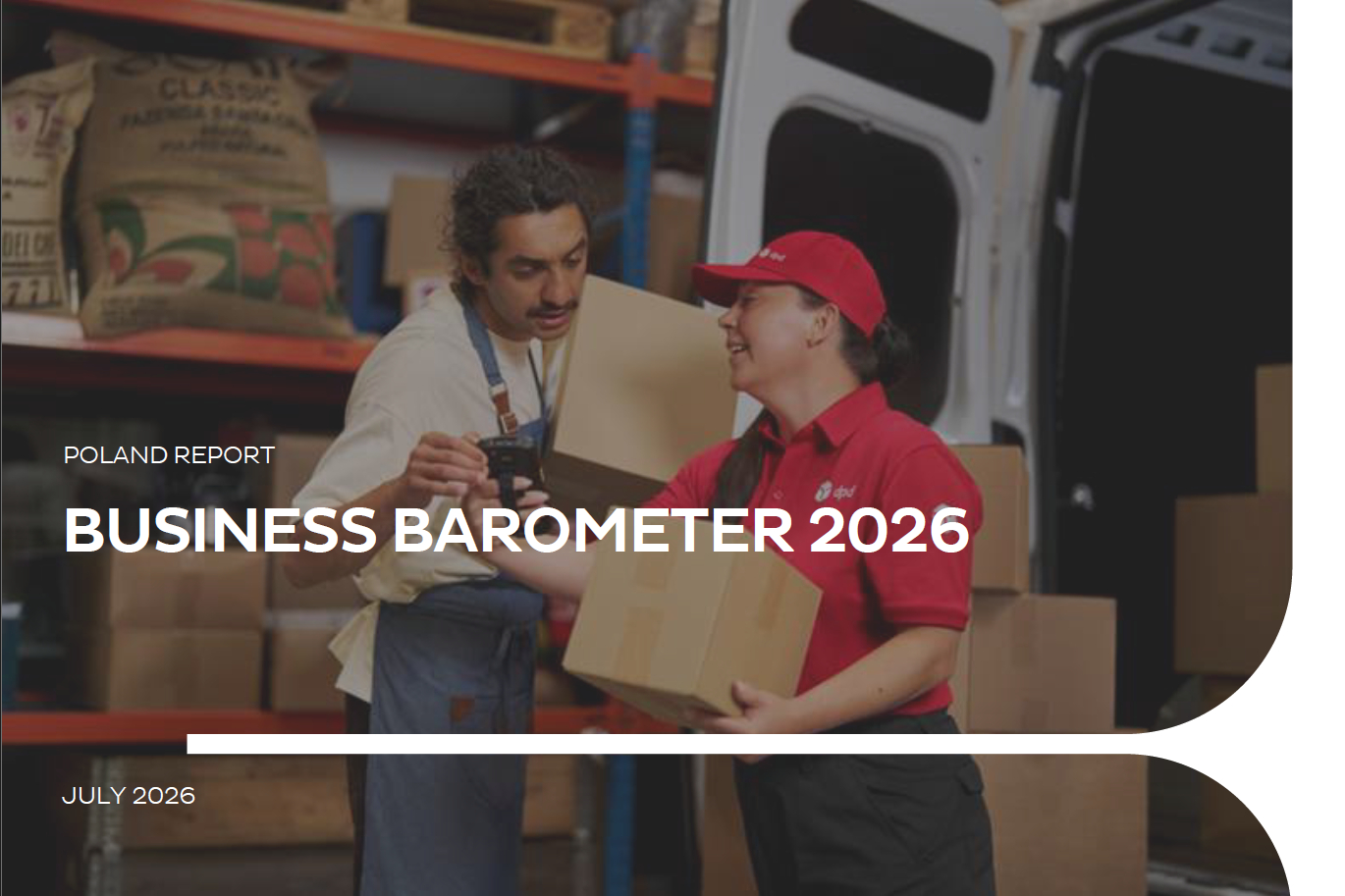
Polish small and medium-sized enterprises, more often than their European counterparts, choose domestic suppliers and search for them online. Nearly one in four also uses artificial intelligence support. From logistics companies, they primarily expect fast problem-solving, predictability, and flexibility that allow them to align deliveries with their operational rhythm. This picture of the Polish SME sector emerges from the Geopost Business Barometer 2026 study. The Polish edition of the report analyzes the supply process for companies from the perspective of the parcel recipient – from choosing a supplier and receiving parcels to handling returns.
The study results show that delivery has ceased to be merely an auxiliary service for small and medium-sized enterprises. Today, it is one of the conditions for smooth and continuous business operations. Quality and price remain equivalent criteria for Polish SMEs when selecting a supplier. 46% of respondents consider product quality to be very important, while 45% consider price or costs to be very important – less than the European Union average (51%). However, companies also take into account longer payment terms for invoices (31% vs. 27% in the EU) and immediate availability of goods (29%). The lower weight of price does not mean, however, that it has ceased to matter. In the open-ended responses from participants, price still appears as one of the main barriers to working with suppliers. This is a signal that a competitive price is an expected standard for companies, rather than a factor that distinguishes an offer.
Logistics is not only an operational element but also a significant factor influencing business continuity, cost efficiency, and customer service quality. A shipment may contain raw materials necessary for fulfilling an order or goods whose timely arrival directly affects the recipient’s experience. Every delay or unforeseen complication can therefore trigger further business consequences. For this reason, the price of the service, although still important, more and more often serves only as a starting point for evaluating a logistics offer. Entrepreneurs primarily need predictability, access to up-to-date information, and flexibility that allows them to react to changing operating conditions.
– says Marcin Dembkowski, Director of Domestic Sales at DPD Poland.
Domestic suppliers, online searches, and AI assistance
The report also shows where Polish companies source goods and how they look for partners. The impact of the geopolitical situation on corporate purchasing decisions is visible here: the uncertain international situation prompts some entrepreneurs to look for partners closer to home, primarily within the country. Two out of three Polish companies cooperate with suppliers from other European countries (66% versus 72% in the EU), and only 8% cooperate with those from outside Europe (17% in the EU). Among companies that source goods both domestically and abroad, 13% have reduced the number of products imported from abroad in the last year due to the geopolitical situation.
The way of searching for suppliers is also changing. Polish SMEs combine traditional and digital methods. The Internet has become the most important channel for these searches (40% of responses, 25 percentage points more than in 2024), but they also use physical points of sale almost as often (39% compared to 25% on average in the EU). 23% of Polish SMEs are already using AI-based tools, significantly more than in Europe (15%).
Delivery as a condition for business continuity
Once a supplier is chosen, the success of the cooperation depends on whether the goods arrive on time and in good condition. Polish companies feel the consequences of logistics problems particularly severely, both in their daily work and in relations with customers or financial results. The most frequently cited consequence is operational delays (62% of responses versus 55% in the EU), while shortages of goods are less common (28% versus 37%). It is no wonder that fast problem-solving (77%) and delivering shipments in perfect condition (65%) are of key importance for Polish SMEs.
High satisfaction, but room for more
Against the backdrop of these expectations, the report also shows how companies assess current deliveries. Although the ratings are good, the percentage of very satisfied customers remains relatively low, especially in the case of international shipments (42%). It is similar with returns. 44% of companies use them, and 94% rate this process positively, but only 39% are very satisfied. Long turnaround times and unclear procedures lower satisfaction. Entrepreneurs clearly indicate the direction for change: better real-time shipment tracking (29%) and more efficient customer service, especially when solving problems (22%). Technology does not eliminate the importance of relationships. As many as 80% of Polish SMEs value having a regular, known courier.
SME sector companies today expect not only efficient service delivery from logistics partners but primarily solutions that support operational efficiency and allow for better management of daily business processes. Modern tools such as precise shipment tracking, ongoing access to information about their status, or greater reliability of fulfillment play a key role. However, direct contact with a person who knows the specifics of a given business and takes into account practical conditions, such as working hours or pick-up organization, remains equally important. Therefore, competitive advantage will be built by companies that can effectively combine the possibilities of technology with partnership relationships and operational flexibility.
– summarizes Marcin Dembkowski.
The report is available via this link.
About the study
The Geopost Business Barometer 2026 was conducted in cooperation with NIQ using the telephone interview method (N=275) between March 16 and May 13, 2026. The study covered companies employing from 0 to 200 people that receive parcels of up to 31.5 kg as part of their daily operations, from six industries selected by Geopost. Respondents were people handling shipments and decision-makers responsible for choosing suppliers or carriers. The results were compared with the European average and with the 2024 edition.
Source: DPD / Geopost