











Less than 4 years separate Poland from reaching the level of fully electric car registrations currently recorded on average in the European Union, according to the latest edition of the periodic report by PSNM and F5A, “Polish EV Outlook”. The critical point for the Polish market will be 2026 – the final period for public funding. How will electromobility in Poland develop in the coming years?
“Polish EV Outlook” is the most comprehensive analysis of the zero-emission transport market in Poland. The report presents a full picture of the passenger, delivery, and heavy-duty electric vehicle sector, as well as forecasts for its development until 2040.
Polish electromobility is currently on an upward trend, especially compared to the previous year. The number of passenger BEV registrations in the first three quarters has more than doubled, and their market share in recent months has reached 8%. However, this is still significantly lower than the current EU average. When will the Polish market really accelerate?
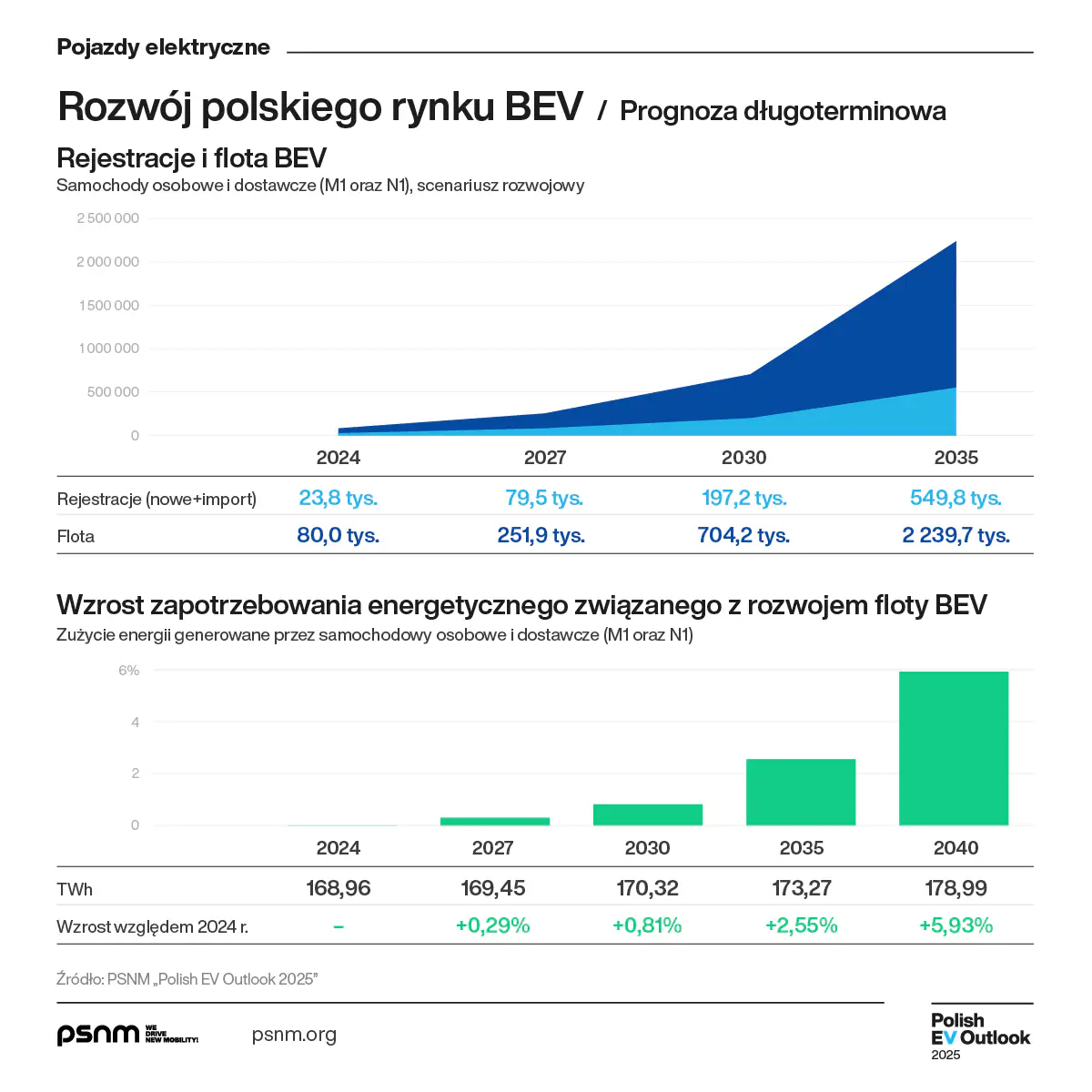
We provide answers to this question in the latest edition of “Polish EV Outlook” in two variant scenarios. A more optimistic forecast, which assumes, among other things, broad legal optimization, suggests that by 2030, the number of passenger and delivery BEV registrations could rise to approx. 197,000, and more than 700,000 such vehicles will be on Polish roads. That is almost 7 times more than today. The share of BEVs in the passenger vehicle market will approach the average currently recorded in the EU in less than 4 years. In 2029, in terms of share, we will approach the results observed today in Germany or France. However, we will not “catch up” with European leaders, particularly Denmark, until 2035.
– says Jan Wiśniewski, Director of the PSNM Research and Analysis Center.
And in the short term? Currently, a key factor driving the popularity of electric cars on the Polish market is the subsidies from the “NaszeEauto” program. Their conclusion in June 2026 will lead to a temporary decline in BEV registrations.
This decline is a natural phenomenon that we have observed before, not only in Poland but also in many other European markets. After a decrease in demand in the second half of 2026, the BEV segment will return to a growth path in 2027. This will be, among other things, a consequence of the need to meet emission reduction obligations resulting from EU Regulation 2019/631. Manufacturers that did not meet the minimum sales limits for zero-emission vehicles in 2025-2026 will have to make up for it in 2027. An equally important reason for the projected growth is the expansion of charging infrastructure and the progressive equalization of acquisition costs for ICE and BEV vehicles.
– adds Jan Wiśniewski.
The numbers confirm this. In the first half of 2025, the weighted average price of passenger “electric cars” sold on the Polish market was approx. 20% higher than that of internal combustion vehicles. A year earlier, the difference was as much as 39%.
The reason for the reduction of this difference is, among other things, the increase in the prices of internal combustion cars and the increased interest of Poles in smaller (and cheaper) “electric cars”. However, the real decrease in BEV prices is also significant. For example, the weighted average price of segment C electric cars decreased over the year from PLN 176,849 to just under PLN 174,748. The difference may not be significant, but it illustrates a trend that will have an increasingly positive impact on the development of electromobility in Poland in the coming months.
– says Albert Kania, Chief Operating Officer of F5A New Mobility Research and Consulting.
What else does the latest edition of “Polish EV Outlook” reveal?
Poles most willingly buy “electric cars” that are far from city car dimensions. The most popular vehicles on the Polish market are segment D vehicles, which accounted for 28% of all registrations in 2025. However, this trend is beginning to reverse – taking into account popular segments, the largest sales growth in 2025 was recorded among segment B SUVs. Electric cars in Poland are registered primarily to companies. In 2025, the share of entrepreneurs in the BEV market is approx. 82%. This is a slight decrease compared to last year, largely due to the rules of the “NaszEauto” program.
The largest fleet of “electric cars” is in Warsaw – 23% of Poland’s fully electric car fleet is registered in the capital. The total share of cities with 300,000 to 1 million inhabitants (Bydgoszcz, Lublin, Szczecin, Gdańsk, Poznań, Łódź, Wrocław, Kraków) is 26%. Considering the voivodeships, the leader is definitely Masovian, where almost 33,000 have been cumulatively registered. This is more than the total (!) in the next three voivodeships in the ranking (i.e., Greater Poland, Silesian, and Lesser Poland). The bottom of the ranking is invariably occupied by the Warmian-Masurian (a total of only 1,370 registered BEVs), Opole, and Lubusz voivodeships.
– says Albert Kania.
“Polish EV Outlook” also includes, among other things, a forecast of energy demand for the fleet of electric passenger and delivery cars in Poland until 2040. Contrary to many myths, the development of electromobility will not lead to a drastic increase in energy consumption. The BEV fleet, which could number as many as 2.24 million units in 2035, will increase energy demand by less than 2.6% compared to the demand in 2024 (169 TWh according to PSE data). In addition, the content of the PSNM and F5A report includes a rich collection of information on charging infrastructure in Poland, along with forecasts for the development of this sector until 2040. Much space is devoted to comparing the market share, degree of expansion, location, and network power of individual operators. Furthermore, the model offer in the e-mobility segment was analyzed in detail, along with changes in price trends in the BEV market. The study also contains comprehensive data on the zero-emission heavy transport market.
“Polish EV Outlook” is available in a digital form, based on the cloud and Power BI tools. As a result, the report provides previously unavailable opportunities for data analysis, trend visualization, and forecast comparison. Thanks to interactive dashboards, users can intuitively explore data, generate their own reports, and obtain information supporting business operations.
More information about “Polish EV Outlook 2025”, as well as the option to order the report, is available on the website: polishevoutlook.pl
Source: PSNM