









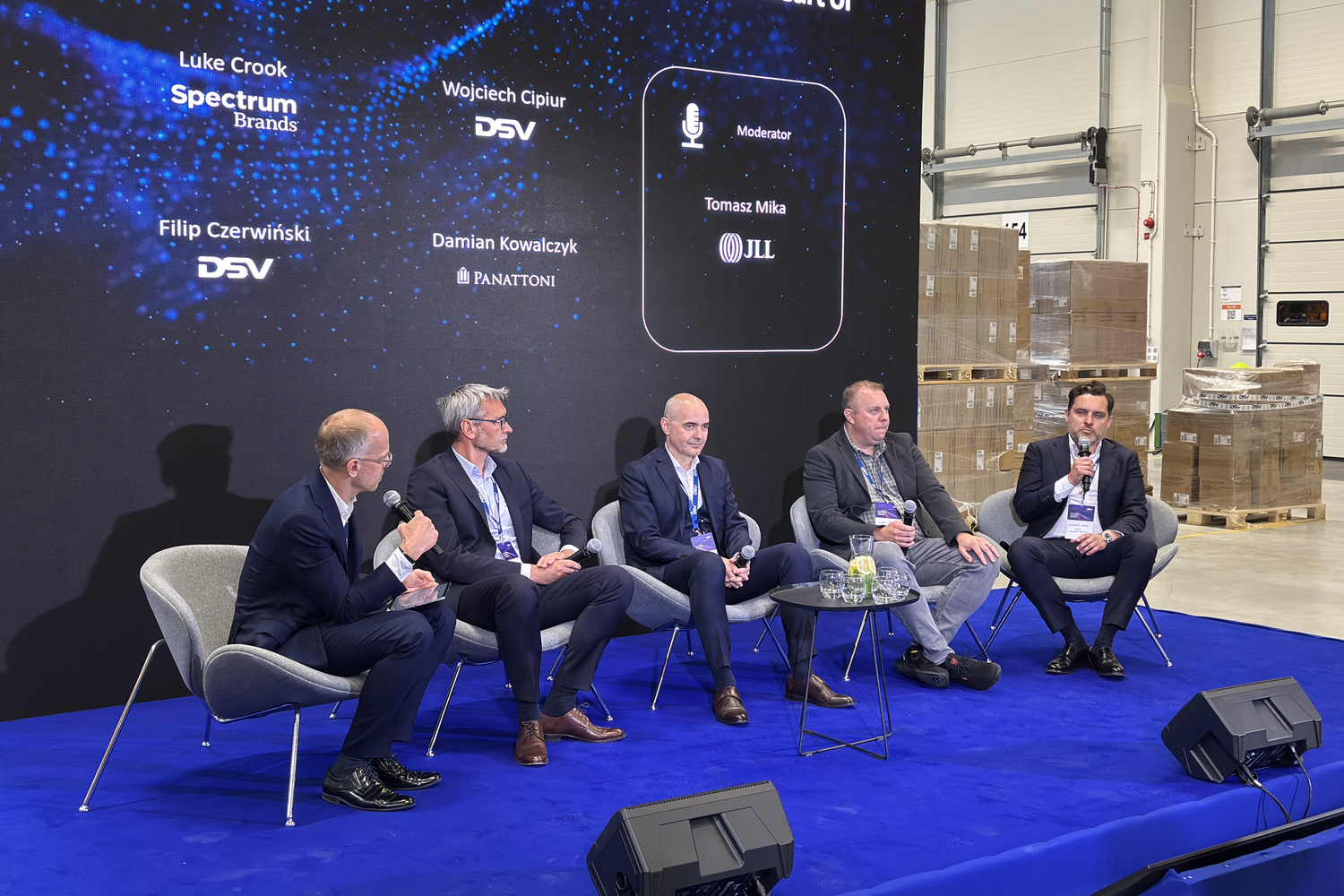
For years, Poland has been one of the most important points on the logistics map of Europe. It is no longer just an attractive alternative to Western markets, but a full-fledged operational hub for global companies seeking stability, efficiency, and access to competent employees. Participants of an expert debate held yesterday at the new DSV warehouse near Wrocław discussed why Poland has gained such a strong position in European logistics.
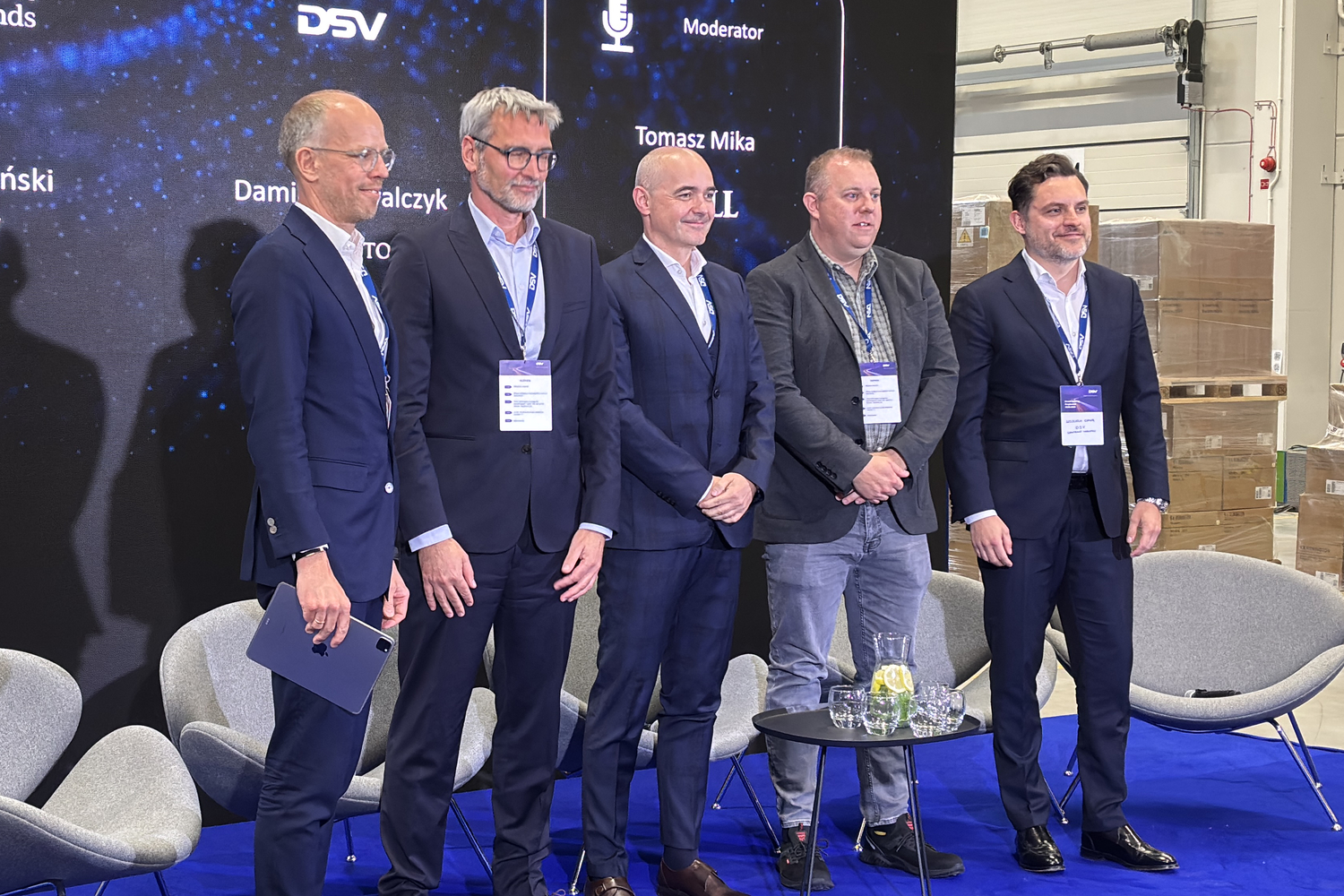
The discussion featured Wojciech Cipiur, CEO of DSV Contract Logistics Poland, Filip Czerwiński, CEO of DSV Road Sp. z o.o., Damian Kowalczyk, Regional Director for Lower Silesia at Panattoni Europe, and Luke Crook, Supply Chain Managing Director at Spectrum Brands. The panel was moderated by Tomasz Mika, Board Member of JLL in Poland and Head of the Industrial and Warehouse Department.
Key market scale
The moderator’s first question concerned a fundamental issue: what made Poland one of the fastest-growing logistics markets in Europe?
According to Wojciech Cipiur, Poland’s current position is the result of a long-term process of building economic potential.
It didn’t happen overnight. It was a long process of developing business here, building volumes, production, and warehouses, which created transport streams that made logistics more efficient, faster, and cheaper – he emphasized.
One of Poland’s greatest assets remains the scale of the market. Poland’s advantage stems not only from low costs but also from the availability of resources, experience, and a well-developed logistics ecosystem.
We live in a country of 37 million people, which helps us not only as a consumer market but also creates depth in the labor market. People and experts are needed to work in warehouses, distribution centers, and in production – added W. Cipiur.
Poland instead of Germany
An interesting perspective was presented by Luke Crook, representing Spectrum Brands – a DSV client who had previously considered locating their supply chain in Germany. As he admitted, Poland was not an obvious choice at first.
Our logistics center of gravity was in northeastern Germany. Poland was not the first option we considered – he said.
Ultimately, however, the proposal prepared by DSV convinced the company. The key element that tipped the scales turned out to be not just the building or the location, but above all, the people. In the end, the decision to move part of the operations to Poland proved to be, as he described it, “obvious.”
Poland has excellent transport connections. We can easily get to Germany, import through Gdańsk, and use very good infrastructure. It was a step into the unknown, but today we see that the infrastructure here will prepare us perfectly for the future – he said.
Poland’s advantage: speed, flexibility, and infrastructure
Damian Kowalczyk from Panattoni spoke about the role of Poland from the perspective of the logistics real estate market. In his opinion, one of the country’s greatest strengths is its ability to react quickly to business needs.
The best thing about Poland is that we are simply good at organizing things. We are able to deliver solutions, buildings, new services, or new structures for every client requirement – he said.
However, as he emphasized, costs remain a significant argument.
We operate in a very low-margin market, which allows us to offer interesting rental rates compared to other regions of Europe – he explained. – From the perspective of preparing investment land, rental attractiveness, and routes connecting us with the rest of Europe, Poland remains extremely attractive. In my opinion, we are still the strongest player in the European market.
Polish carriers as the foundation of European logistics
There would be no success for Polish logistics without a strong transport sector. As Filip Czerwiński from DSV Road pointed out, Polish carriers play a huge role in the entire European Union.
Poland has an exceptionally well-developed base of carriers; they are responsible for about 20 percent of freight transport in the entire European Union – he said, while emphasizing the important aspect of geographical location. – We lie at the intersection of major transport corridors in Europe.
Wrocław – the logistics gateway to Europe
The second part of the debate was devoted to Wrocław, which in recent years has emerged as one of the most important logistics regions in Poland.
According to Wojciech Cipiur, the choice of location always depends on the specific business model.
A lot depends on the type of business, the structure of operations, clients or recipients, where the goods are going, and where they are coming from – he explained.
Wrocław is increasingly chosen for warehouse locations because a combination of several important factors exists here.
You have access to the workforce, to qualified employees. Another important thing is the connection to transport hubs – the CEO of DSV Contract Logistics Poland lists. – The proximity of carriers and courier operators allows for cost reduction and shorter order fulfillment times.
Damian Kowalczyk, in turn, pointed to the enormous potential for further development of the region.
The potential of Wrocław is practically unlimited. Every time I think: this is too much, the market continues to grow – he said. – The city’s strength is not only logistics but also access to highly qualified employees. Advanced solutions need highly qualified staff. Every company today tries to rely on advanced solutions.
Technology is changing warehouses
One of the topics of the conversation was also modern warehouse solutions that allow for increasing operational efficiency. Wojciech Cipiur pointed to the example of VNA (Very Narrow Aisle) double-deep technology.
You always have to find the best, optimal solution inside the warehouse to accommodate as many goods as possible while maintaining efficient flows – he explained.
A modern warehouse is no longer just a space intended for storing products. It is an advanced center for managing the flow of goods.
One partner instead of many suppliers
Filip Czerwiński pointed out that the comprehensiveness of services is becoming an increasing value for clients.
We have joined the forces of our contract logistics and road transport departments, offering the client a comprehensive end-to-end solution – he said.
Such an approach allows for reducing the complexity of processes. In turn, Luke Crook confirmed that simplifying the supply chain was one of the main reasons for choosing this model of cooperation.
We were looking for a strategic solution that would answer the question: how can we simplify our business and focus on what is key for us? – he said.
Supply chain resilience and further development
In the final part of the debate, the moderator asked the participants about the future of logistics. The CEO of DSV Road pointed to the growing importance of trends such as nearshoring and friendshoring.
I believe that Poland will emerge from the current situation unscathed, taking advantage of new global trends – he said.
Damian Kowalczyk pointed to the growing importance of automation and technology.
All entities are constantly trying to improve their business and use the latest opportunities to deliver services even better, cheaper, and faster – he emphasized.
The Spectrum Brands representative, on the other hand, pointed to the three areas most crucial to him: supply chain resilience, technology, and artificial intelligence.
We want to be absolutely sure that we will use technology appropriately to simplify our business procedures as much as possible – he said.
According to W. Cipiur from DSV, Poland’s greatest advantage remains its people.
Behind everything in the industry, there are always specific people. In Poland, we simply have this innate drive to act – he concluded.
Polish logistics has undergone a huge transformation in recent years. Today, it is no longer just a place for cheaper production or warehousing. It has become a strategic center for European supply chains – a place where infrastructure, technology, experience, and human competence meet.