








According to the latest Newmark Polska report, “Industrial and Warehouse Market in Europe, H1 2024,” the European warehouse market, despite the observed slowdown in tenant and developer activity, continues to develop and seek a new point of equilibrium. Green solutions are increasingly entering both warehouse facilities and logistics operations. Despite the challenges observed in the warehouse real estate sector across the European Union, the market has good growth prospects ahead, especially in regions adapting to new trends, both in terms of tenant needs and new regulations.
After the record-breaking years of 2021-2022, when annual demand in the largest warehouse markets of the European Union exceeded 35 million sqm, we are observing a stabilization of tenant activity at an average level of approximately 25 million sqm per year. This value is similar to those observed before the pandemic (in 2018-2020), as well as in 2023, when net demand, i.e., excluding contract renewals, was just over 27 million sqm. The lower volume of tenant activity was influenced by factors such as economic uncertainty, higher interest rates, and the lengthening of the decision-making process by companies. Total net demand in the first half of 2024 reached almost 11 million sqm and was nearly 10% lower than in the same period a year earlier. Germany recorded the largest share in the leasing volume (excluding renewals) across the entire EU – over 22%. Poland (15%) and France (12.7%) followed.
The level of tenant activity in individual European Union countries shows significant variation. Many recorded declines in the first half of 2024 year-on-year, including the Czech Republic, France, Hungary, and Germany – by 34%, 23%, 8%, and 5%, respectively. In contrast, Poland stood out in the region, recording an increase of over 20%.
Different approaches to financing
– A more selective approach to financing new ventures and weaker demand from tenants mean that developers are also showing considerable caution. The number of warehouse investments started across the EU has been falling since 2021. At the end of June 2024, approximately 15 million sqm of warehouse space remained under construction, which is over 20% less than a year earlier – says Jakub Kurek, Head of Industrial and Warehouse Department at Newmark Polska.
Countries characterized by increased developer activity remain Italy (over 2.3 million sqm under construction), Poland (almost 2 million sqm), and France (nearly 1.8 million sqm). Furthermore, the share of speculative investments in the total volume of space under construction is gradually decreasing, especially in countries with high vacancy rates. At the end of June 2024, the share of speculative investments did not exceed 40%.
The slowdown in developer activity combined with decreasing land availability translates into a decline in the supply of new warehouse space, which in the first half of 2024 amounted to approximately 8 million sqm across the EU, which is almost 20% less than in the same period a year ago. It is worth noting that almost 40% of this space (new supply) is still waiting for tenants.
– The most new warehouses were built in Poland – almost 1.65 million sqm. High supply was also recorded in the Netherlands and Sweden, where 1.1 million sqm and 900,000 sqm were completed, respectively – adds Jakub Kurek.
The decline in tenant and developer activity translated into an increase in the overall vacancy rate in the EU, which slightly exceeded 5% at the end of June 2024. Increases were observed in most of the analyzed warehouse markets in the region. The lowest vacancy levels were characterized by Italy (2%) and the Netherlands (2.8%), while the highest rates were recorded in Spain (9.7%), Hungary (8.5%), and Poland (8.3%). In the coming quarters, however, we expect stabilization and even a decrease in the vacancy rate, especially in countries where there is a shortage of available land for the construction of new warehouse facilities. On the other hand, countries with large banks of investment land, including Germany, Poland, or France, continue to show great growth potential, especially in the era of the growing importance of nearshoring and friendshoring.
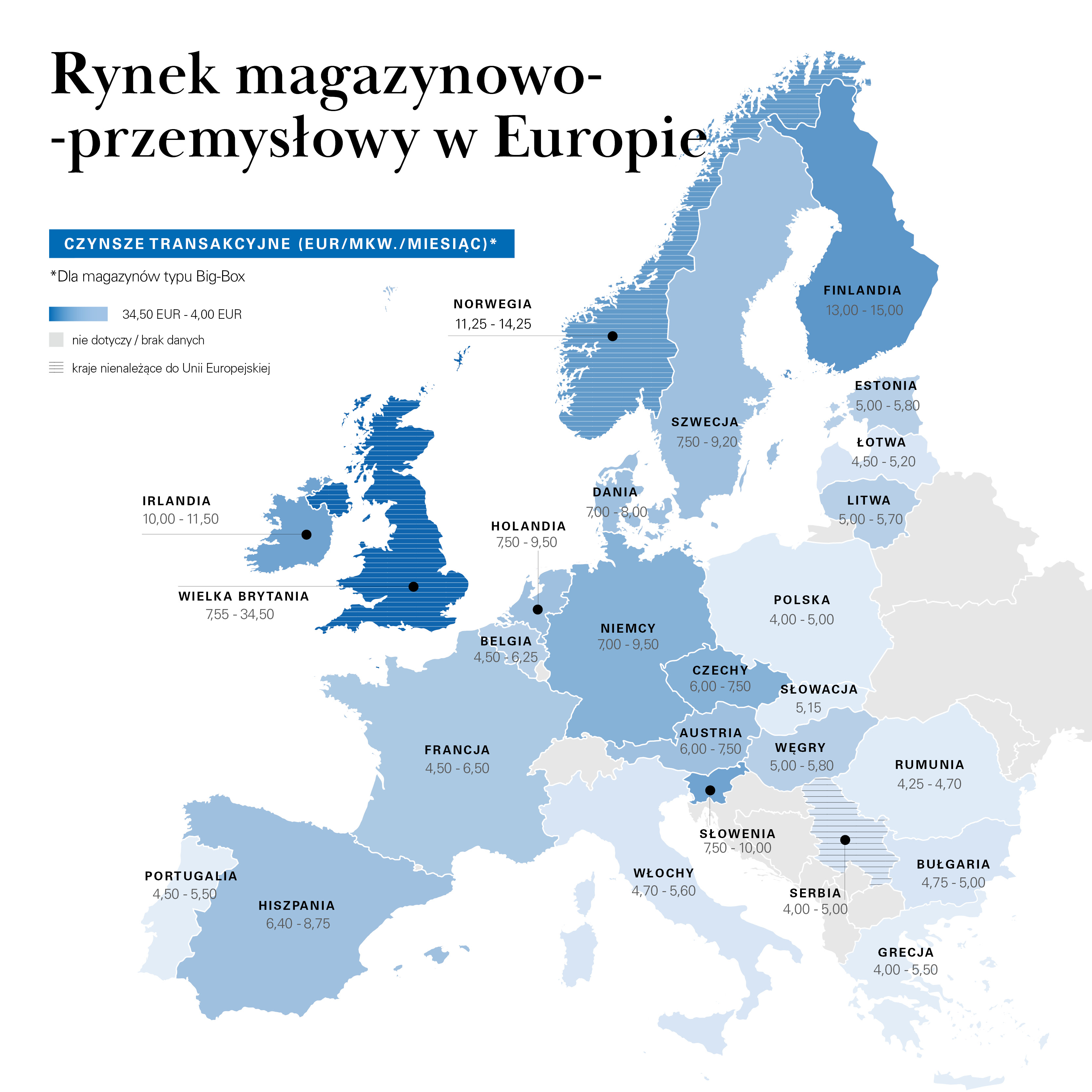
In the first half of 2024, warehouse rent rates in the EU continued to show an upward trend, especially in locations most desired by tenants. At the end of Q2 2024, the most expensive big-box warehouses were in Finland (13-15 EUR/sqm/month), Ireland (10-11.5 EUR/sqm/month), Germany (7-9.5 EUR/sqm/month), and the Netherlands (7.5-9.5 EUR/sqm/month). At the other end of the spectrum were warehouse facilities in Central and Eastern Europe, including Poland, where tenants paid 4-5 EUR per month for renting one square meter of warehouse space.
Green warehouses are in demand
Despite rising rental costs, demand for modern, sustainable, and energy-efficient warehouses remains high and is driven by technological advances in logistics and the growing need for ecological solutions. The differences between rent rates for space in top-quality warehouses and older facilities that do not offer ESG solutions are also deepening.
– Sustainability is becoming a key priority for many companies that invest in green warehouses ensuring energy efficiency and enabling compliance with ESG requirements. This is particularly important in the context of EU regulations that oblige companies to monitor their entire supply chain for environmental impact – says Agnieszka Giermakowska, Director of Research and Advisory, ESG Lead, Newmark Polska.
Source: Newmark Polska