








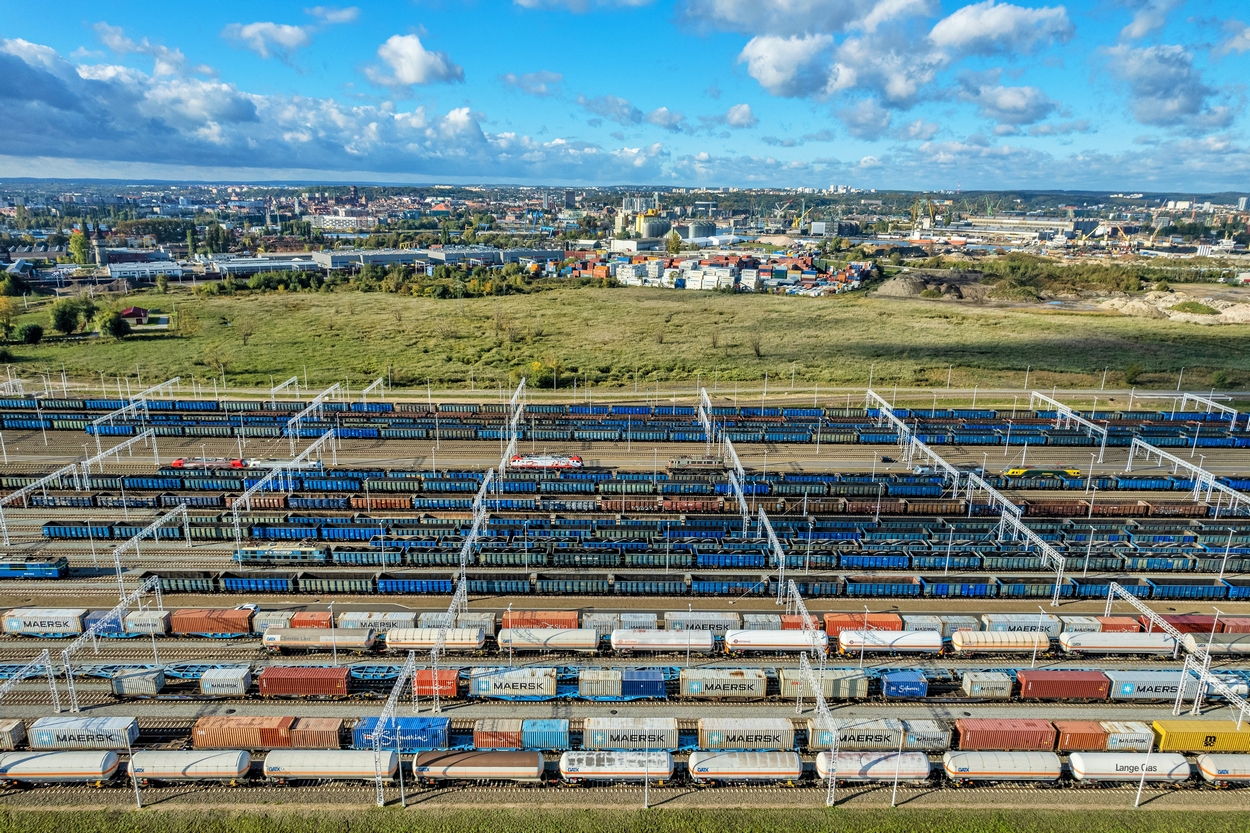
Polskie Linie Kolejowe S.A. and the Port of Gdańsk Authority S.A. have signed an agreement to expand the access infrastructure to the deep-water transshipment terminals of the Port of Gdańsk located on Stogi Island. The planned investment is strategic for the development of the port and, consequently, for the Polish economy.
Rail is the most efficient, safe, and environmentally friendly means of transporting goods. Consistently increasing its share in freight transport is one of the priorities of PLK SA.
The signing of the agreement with the Port of Gdańsk Authority S.A. regarding the development of preparatory documentation for the expansion of rail and road access infrastructure to current and planned deep-water terminals in the Northern Port in Gdańsk aligns with these goals.
No one needs to be convinced of the key role of seaports in the development of the Polish economy. To make them more competitive, we must plan further investments now, including those related to improving capacity on railway lines. Therefore, the fact that an agreement has been concluded between Polskie Linie Kolejowe and the Port of Gdańsk Authority is all the more gratifying.
– said Arkadiusz Marchewka, Deputy Minister of Infrastructure, during the event.
The implementation of the task is of strategic importance for strengthening the economy and national security by increasing the logistical potential of the Port of Gdańsk and the capacity of the railway lines managed by PLK SA. In 2024 alone, the Port of Gdańsk handled over 355,000 rail wagons (the figure refers only to Port of Gdańsk Authority contractors). At the same time, all rail transport moving traffic out of the deep-water part of the port takes place via a single bridge.
Jacek Karnowski, Deputy Minister of Funds and Regional Policy, emphasized that 200 billion PLN from EU funds will be available for spending next year.
The signed agreement between the manager of the national railway network and the Port of Gdańsk is an example of successful cooperation and sensible planning of infrastructure investments necessary for cargo transport. The Ministry of Infrastructure is probably the largest ministry that uses the largest part of these funds. Not only from the Polish envelope but also from the CEF (Connecting Europe Facility).
– added Piotr Malepszak, Deputy Minister of Infrastructure.
Rail for ports!
Dorota Pyć, President of the Port of Gdańsk, has repeatedly emphasized the need to build a second bridge or tunnel leading to the port island. It is there that specialized deep-water terminals are located, which account for over 80 percent of transshipments in the port. The operation of facilities such as Naftoport, Gaspol, or the Northern Port is crucial for the country’s energy security, while the activities of Baltic Hub constitute a strategic pillar of Poland’s economic and logistical development, strengthening Gdańsk’s position as one of the most important ports on the Baltic Sea.
The dynamically expanding Northern Port needs new rail infrastructure – additional tracks, sidings, and increased capacity at the Northern Port station. The current network is already becoming a limiting factor for our development. Ports cannot develop in isolation from the railway network. Therefore, the development of intermodal connections is one of the pillars of our strategy, which we are currently developing. Today’s agreement with PLK is not just a plan – it is a concrete response to the challenges facing us and the entire Polish logistics sector.
– said Dorota Pyć, President of the Port of Gdańsk, during the event.
The implementation of the investment through the construction of alternative access infrastructure to the Port of Gdańsk, including new bridges or tunnels, will contribute to improving rail traffic both within the Port of Gdańsk and in its hinterland. The investment will include the construction or modernization of port infrastructure and access to the Port of Gdańsk.
We are aware of the importance of rail transport in the daily operation of Polish ports on the Baltic Sea. That is why we are planning and implementing investments that improve capacity on routes to the quays and ensure fast, efficient, safe, and environmentally friendly rail freight transport. It is extremely important to connect this beating heart of the Polish economy, which are seaports, with the bloodstream of the economy, which is the railway network managed by PLK.
– said Marcin Mochocki, Member of the Management Board, Director for Investment Implementation, Polskie Linie Kolejowe S.A.
Aleksandra Dulkiewicz, Mayor of Gdańsk, was also present at the ceremony.
I am very glad that an alternative exit and entry route to the port will be created. It will relieve the port island, which is a unique place. We can already see how it is changing. Further changes must be prepared in a sustainable way – on one hand, we must take care of the strategic security of Gdańsk and Poland, and on the other, give residents and lovers of the port island a reason to continue loving this place.
– emphasized Aleksandra Dulkiewicz.
Three stages of investment
The goal of the cooperation between PLK SA and ZMPG SA is primarily to develop a feasibility study (Stage I in 2026 – 2027), and then to begin work on design documentation in 2028 (Stage II), the preparation of which will enable the commencement of the investment in the scope of rail infrastructure accompanying the expansion of the Port of Gdańsk (Stage III) by 2034, assuming the modernization of existing railway lines, their electrification, and the construction of new line sections enabling rail transport as part of the project titled “Improvement of rail and road access to current and future deep-water transshipment terminals located in the Northern Port.” The commencement of construction work will be possible after securing financial resources and obtaining the necessary administrative decisions.
Greater capacity on tracks to ports in the Tri-City
Investments implemented and planned by PLK SA on railway lines leading to the ports in Gdańsk and Gdynia are a response to the need to increase their transport potential. Between 2019 and 2024, rail access to both ports was improved, for which over 3 billion PLN net from the CEF – “Connecting Europe” financial instrument was allocated. As a result, more trains, longer and heavier, can reach the quays and carry more goods. Last year, PLK SA began the modernization of railway line No. 201 Bydgoszcz – Tri-City (work on connecting lines was carried out in 2021-2024), which is of significant importance for increasing the potential of the port in Gdynia. In September of this year, a tender was announced for the design and execution of construction works for the task titled “Increasing the capacity of the Tczew – Gdynia corridor: section Pszczółki – Pruszcz Gdański.” The construction of an additional track will improve capacity on the main exit from the Tri-City, including to the port in Gdańsk, and will allow for the separation of freight and commuter train traffic from long-distance connections. Completion of the work is planned for 2030.
Source: Port of Gdańsk Authority S.A. / PKP Polskie Linie Kolejowe S.A.