








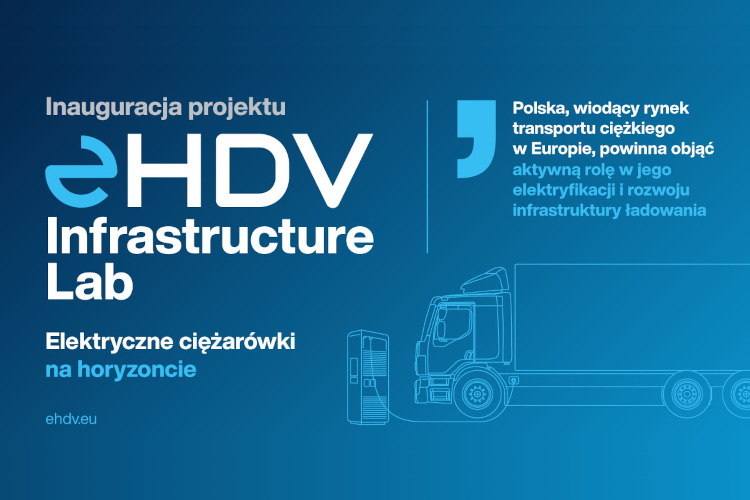
The Polish Alternative Fuels Association (PSPA), together with a number of entities actively operating in the area of sustainable transport development, is launching the sectoral eHDV Infrastructure Lab project, aimed at building Polish “know-how” in the implementation and operation of charging stations dedicated to heavy-duty vehicles and the development of electromobility in the freight transport sector.
In the face of increasing challenges facing the heavy-duty transport sector regarding fleet electrification and the expansion of charging infrastructure, PSPA has launched the sectoral project “eHDV Infrastructure Lab” (www.ehdv.eu). This is a comprehensive initiative aimed at the development of electric heavy-duty vehicles, implemented in the CEE region. One of the fundamental assumptions of the “eHDV Infrastructure Lab” project is to build Polish “know-how” in the field of electromobility development in the heavy-duty vehicle sector. As part of the work, technical requirements for charging stations will be defined, and potential locations for eHDV hubs in our country will be identified. An analysis of potential market support mechanisms will also be carried out, and the ultimate goal is to launch a pilot charging hub for electric heavy-duty vehicles.
– The “eHDV Infrastructure Lab” project is an important step for the transport sector towards decarbonization and, consequently, climate neutrality. It is one of the largest projects of this type implemented in the CEE region. A special expert group established within the project, consisting of representatives from the logistics, retail, OEM, and public administration sectors, will strive to build a fully functional, first-in-Poland charging hub dedicated to electric heavy-duty vehicles. These actions are intended to provide an impulse for the development of the entire electromobility sector and maintain the competitiveness of the Polish transport market on the international stage – says Maciej Mazur, Managing Director of PSPA.
With the project’s goals in mind, a working group has been created, consisting of representatives from the logistics and transport sector, vehicle manufacturers, charging station manufacturers, charging service distributors, retail, and the financial sector. The large cross-section of companies involved in the project is positive evidence of the growing awareness of the need for active participation in the development of electromobility in the broadly understood supply chain. The project partners are: Eleport, IKEA (Inter), PKO Leasing, DHL Parcel Polska, Amazon, Rhenus Logistics, InPost, H&M, No Limit, Volvo Trucks Poland, GreenWay Polska, ABB, Webfleet Solutions, Ennovation Technology, EKOCEL, Sobanscy Transport, Volkswagen Commercial Vehicles, IVECO.
It should be remembered that the heavy-duty transport sector – crucial in Europe’s pursuit of climate neutrality – is facing a number of challenges related to fleet electrification and the expansion of publicly accessible charging infrastructure. Heavy-duty vehicles account for 5% of the total vehicle fleet on the roads of the Old Continent. At the same time, they generate 19.2% of the total carbon dioxide (CO2) emissions from road transport in the European Union (EU). The main elements determining the market’s development towards decarbonization are the EU Regulation 2019/1242, which establishes CO2 emission standards for heavy-duty vehicles, and the regulations addressed in the Fit for 55 climate package. It is here that the regulations on the development of alternative fuels infrastructure (AFIR) were included. The goal is to densify the network of electric and hydrogen vehicle charging points. In the case of the TEN-T core network, heavy-duty vehicle charging zones should be no more than 60 km apart, and the power output is to be 1400 kW by the end of 2025 at the latest. By the end of 2030, it is to increase to 3500 kW. In the case of the TEN-T comprehensive network, the distance between stations should not be greater than 100 km. The aforementioned power levels should be achieved by 2030 and 2035, respectively. Furthermore, the number of stations is expected to reach 1 million in 2025, 2.5 million in 2030, 11.4 million in 2040, and 16.3 million in 2050.
– To meet EU regulations and satisfy the expectations of current and future electric vehicle users, Poland should soon become a giant construction site for new chargers, and investments should be counted in thousands of new stations within the next few years. One of the biggest challenges is precisely the heavy-duty transport sector. However, it is crucial from the point of view of the transport sector – adds Maciej Mazur.
Poland, as a leader in the heavy-duty transport sector in Europe (every 5th vehicle with a GVW over 3.5 tons in the European Union (EU) is registered in Poland), handling almost one-third of EU freight transport, is obliged to take an active role in the electrification of this sector and the expansion of the charging infrastructure that supports it. More than 150,000 entities operating in the national freight transport industry are facing the need to redefine their environmental protection strategies, business models, and approaches to fleet management, which today is 98% based on vehicles equipped with diesel engines. Poland’s actions in the field of heavy-duty vehicle electrification will be a key factor in the development of electromobility not only in Poland but throughout Europe.
In order to achieve one of the project’s goals (building and distributing knowledge), a website dedicated to the development of electromobility in the heavy-duty vehicle sector in Poland and Europe has also been launched (www.ehdv.eu). The platform will serve as the main source of information on the project’s progress and initiatives undertaken in the eHDV market.
Source: Polish Alternative Fuels Association (PSPA)