








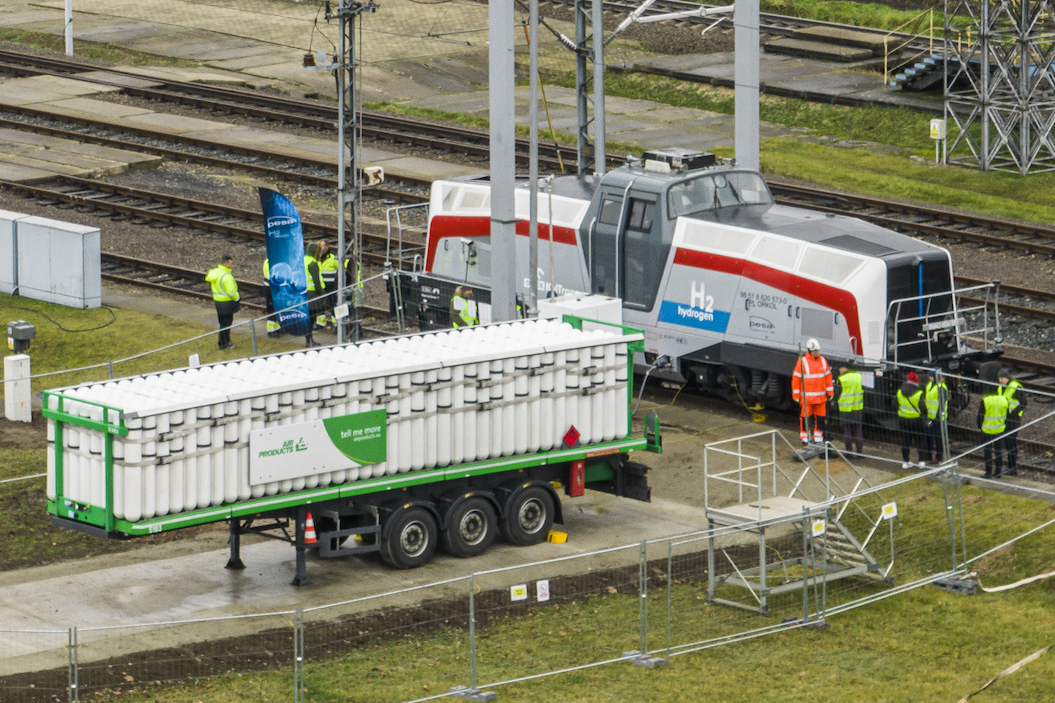
Pesa has completed the final stage of homologation tests for the SM42-6Dn hydrogen shunting locomotive. This was the first hydrogen-powered vehicle in the history of the Railway Institute’s center to undergo homologation tests in Żmigród. A special station for refueling hydrogen from a mobile unit was prepared at the test track, which allowed for the efficient execution of all dynamic tests.
– We have completed all tests according to plan. Now it is time to prepare the documentation for certification, followed by the homologation procedure. We assume that the locomotive will begin operation at the Petrochemia plant in Płock in April – summarized Dr. Lech Lipiński, Hydrogen Vehicle Contract Manager at PESA Bydgoszcz.
At the conclusion of the tests in Żmigród, Pesa invited several Polish and foreign freight carriers to a special presentation of the SM42-6Dn locomotive, featuring a demonstration of hydrogen refueling from a mobile station and test rides.
– The presence of dozens of representatives from cargo and intermodal carriers confirms the interest in our hydrogen shunting locomotive project. In addition to the modernization of the SM42-6Dn, we will offer customers on the Polish and European markets new hydrogen locomotives. Work on these projects as part of a zero-emission platform for locomotives and passenger vehicles is already underway – announced Krzysztof Zdziarski, President of the Management Board of Pesa.
The seminar part of the meeting was also attended by representatives of PKN Orlen, CUPT, PFR, and TUV Sud.
– We are ready to commercialize the hydrogen shunting locomotive project. We wanted to present our customers not only with the vehicle and the hydrogen refueling process but also to give them the opportunity to learn about various financial instruments that enable support for investments in hydrogen rolling stock and its refueling infrastructure – added Maciej Grześkowiak, Director of Strategic Projects and Communication at Pesa.
“Green Pesa” is one of the key elements of the Pesa2026+ strategy implemented by the company. It assumes not only the production of zero-emission, battery, and hydrogen rail vehicles but also the reduction of CO2 emissions in both production and the company’s entire operations.