











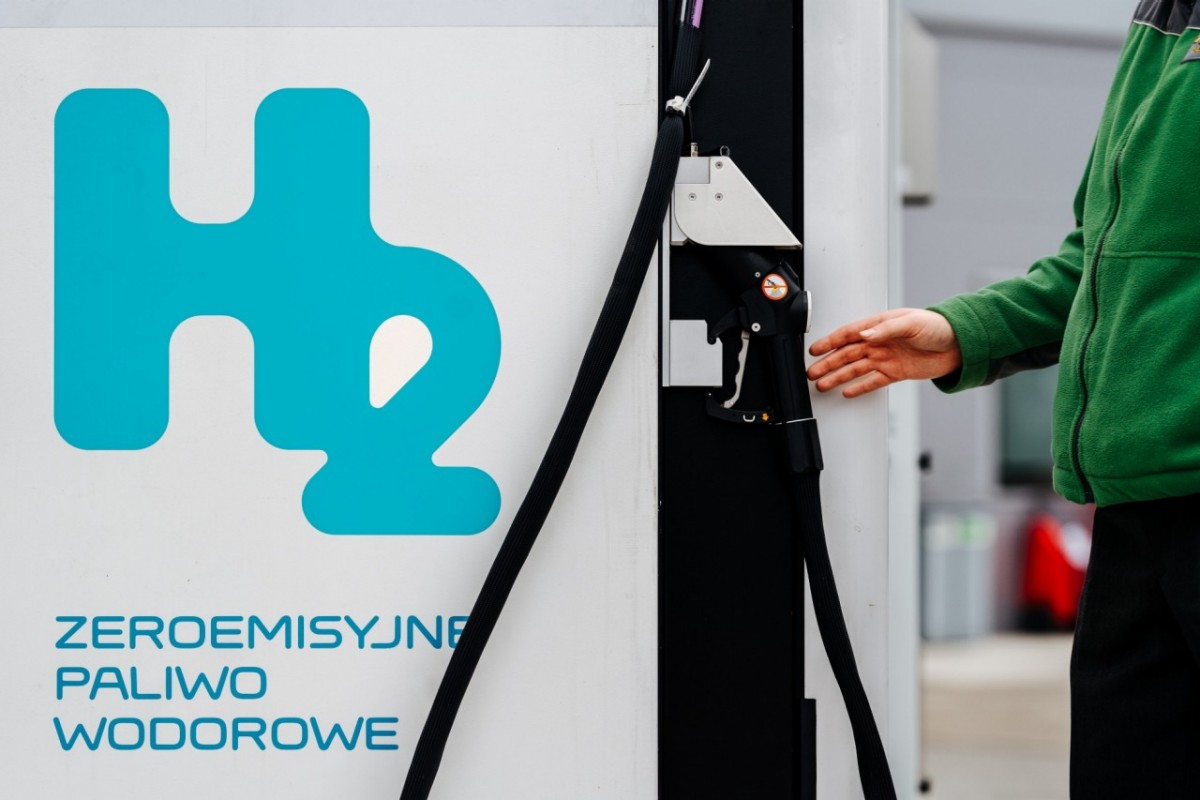
The HySPARK project, implemented by ORLEN and a consortium of 17 partners, is the first in Poland to secure funding from the EU’s Clean Hydrogen Partnership program. The funds, amounting to nearly 9 million EUR, will be used for purposes including the production of hydrogen vehicles and testing them for the needs of Chopin Airport and Warsaw’s public transport.
The innovative hydrogen vehicles produced under HySPARK will be powered by fuel supplied from the ORLEN hub in Włocławek. The station at Chopin Airport will be built in 2026, thanks to funding from the European CEF Transport AFIF Clean Cities Phase II program. Hydrogen-powered buses will be supplied by ARTHUR BUS, hydrogen tractors by Quantron, and ground support equipment for the capital’s Chopin Airport by the Italian company ATENA. The vehicles will be operated by Miejskie Zakłady Autobusowe in Warsaw, ORLEN, and LS Airport Services.
– Hydrogen is a safe, alternative energy source and one of the pillars of the transformation that will undoubtedly play a significant role in transport. Several local governments in Poland are already using hydrogen-powered buses from ORLEN, and our first publicly accessible hydrogen station for passenger cars is also operating in Poznań. The next stage will be testing ground support vehicles at Chopin Airport and public transport buses in Warsaw. The development and popularization of hydrogen fuels involve large investments, so I am pleased that it is our consortium that has secured EU funds for this purpose – says Grzegorz Jóźwiak, Director of the Hydrogen Technology and Synthetic Fuels Office.
HySPARK (Hydrogen Solutions for euroPean Airports & Regional Kinetics) involves broad cooperation among 17 partners from 5 countries: Poland, Germany, Italy, Ireland, and the UK, who will spend the coming years building a hydrogen distribution market in Central Poland. The project will be coordinated in terms of business by ORLEN, and in terms of administration and research and development by the Institute of Power Engineering – National Research Institute (IEN-PIB).
– HySPARK is a unique undertaking that combines key competencies necessary to achieve the selected goals of the Polish Hydrogen Strategy. The consortium’s activities, including the broad involvement of entities associated with the Masovian Hydrogen Valley, will realistically contribute to the decarbonization of transport, and the project results will be a model solution intended for replication in other urban agglomerations. The use of the project’s outcomes to build hydrogen ecosystems around other European airports was planned as early as the grant application stage – adds Prof. Jakub Kupecki, Director of the Institute of Power Engineering – National Research Institute.
Research and development activities within the project will be provided by IEN-PIB, the Warsaw University of Technology, RINA, and Bureau Veritas Polska. Entities responsible for activities related to disseminating information about the project include the Capital City of Warsaw, the Industrial Development Agency, the In Climate Foundation, and two international airports: SEA Milan Airports and Aer Arann Islands. The project is also supported by TOYOTA Central Europe, the Polish Aviation Group, ANWIL, the Transport Technical Supervision, Gdańsk Lech Wałęsa Airport, and the Polish Alternative Fuels Association.
HySPARK was created as part of the activities of the Masovian Hydrogen Valley Cluster, which already brings together 48 partners representing research institutes, universities, and public and private enterprises. The goal of the Masovian Hydrogen Valley is to create a regional hydrogen ecosystem in the Masovian region that will connect hydrogen producers with technology suppliers and end-users in various sectors, including transport (using hydrogen as fuel in vehicles) and industry (using hydrogen, e.g., for fertilizer production).
By 2030, the ORLEN Group plans to build a network of over 100 hydrogen refueling stations for individual, public, and cargo transport, as well as road and rail transport in Poland, the Czech Republic, and Slovakia. Hydrogen will be supplied to them through the construction of a European network of hydrogen hubs powered by renewable energy sources and innovative installations converting municipal waste into zero- and low-emission hydrogen. The total assumed capacity of electrolyzers in the ORLEN Group by 2030 will be approximately 1 GW, which, combined with waste-to-hydrogen projects, will enable the production of over 130,000 tons of renewable hydrogen annually by the end of the current decade.
Source: ORLEN