











In line with its strategy, Orlen aims to produce 70,000 tonnes of SAF (Sustainable Aviation Fuel) annually. EU requirements state that by 2035, this fuel should account for 20 percent of the fuel used, as it is a key factor in the decarbonization of air transport. In its work on new types of fuels, Orlen is also working on the production and use of green hydrogen. The development of both these segments is to be supported by the NEON III competition, recently announced in cooperation with the NCBR.
SAF is a specific product that Orlen is very interested in. This acronym stands for sustainable aviation fuel, which means that this product is classified as a bioproduct or derived from waste. We are changing our approach; we are not looking at fossil origins, we are looking at renewable origins within the framework of a circular economy.
– says Dr. Arkadiusz Majoch, Director of the Petrochemistry and Refinery of the Future Research and Development Office at the Orlen Group, to the Newseria agency.
The International Air Transport Association (IATA) reports that in 2024, global SAF production reached 1 million tonnes. This is twice as much as the year before, yet this fuel accounted for only 0.3 percent of global aviation fuel production. The organization’s forecasts indicate that this year production will double again to reach 2.1 million tonnes, and the share will increase to 0.7 percent of global production. This share is expected to continue to grow gradually in Europe as well. As part of the Fit for 55 package, the ReFuelEU Aviation regulation was adopted, which obliges carriers to gradually increase the share of renewable fuels in aviation fuel blends supplied to major airports in the EU – in 2030 it is to be 6 percent, in 2035 – 20 percent, and in 2050 – as much as 70 percent. In Poland, eight airports have been covered by the ReFuelEU Aviation regulation.
Developing such technology is the result of needs addressed by, among others, organizations representing operators and aircraft manufacturers who have declared their readiness to reduce the environmental impact of fuel use. This goal has its milestones. From 2025, we as fuel producers should increasingly feel the need to introduce this type of biocomponent. In the future, in the 2040–2050 perspective, we will be able to talk about the practically universal use of only such fuel, no longer as a blend with mineral fuel. These goals have already been transferred to business relations in Poland as well, so airport operators expect fuel producers to supply sustainable SAF fuel.
– indicates Dr. Arkadiusz Majoch.
As the company explains, e-fuels are created by combining hydrogen with carbon dioxide of biogenic origin or captured from the air. Although CO2 is emitted during their combustion by engines, its amount is intended to be balanced in the production process itself. Hence, e-fuels are said to be carbon-neutral.
Orlen is working on developing projects that will allow for the supply of appropriate volumes of SAF fuel to the Polish market.
An investment in such fuel is already underway, and the installation is located in Płock. We will be able to obtain this fuel from similar raw materials as those used for biodiesel for diesel oil. However, the chemical structure of this product is completely different. These are hydrocarbons, which makes it a more adequate product to the conventional one we know now, which makes the conventional one from crude oil easier to replace with our bio-product.
– explains the Director of the Petrochemistry and Refinery of the Future Research and Development Office at Orlen.
The development of this segment is to be supported by, among other things, cooperation with universities, the Warsaw University of Technology (Płock Branch), and the AGH University of Science and Technology in Kraków. An agreement in this regard was concluded in January of this year. Another initiative to support the development of SAF is the announcement of the NEON III competition. It is a joint venture between Orlen and the National Centre for Research and Development, where the call for applications will last until June 30, and which is aimed at developing innovations for the refining and petrochemical industry. One of the areas is precisely the development of SAF-type aviation fuel technology and synthetic gasolines using CO2 or other biomass-derived raw materials, as well as the development of innovative technology for the production of synthesis gas for the production of synthetic aviation fuels made from CO2 and H2, meeting the RFNBO (renewable fuels of non-biological origin) criteria.
We will focus on obtaining such fuel, on its technological process and optimization, while we are looking for more difficult waste streams that require greater care in acquisition and processing than raw materials used for food purposes. This is important to us – focusing on such non-competing streams, and NEON addresses this. We also have a need to develop such fuel in a synthetic gasoline version as well, so that we can have the application of sustainable fuel from renewable energy sources not only in aviation fuel but also in road transport.
– says Dr. Arkadiusz Majoch.
As part of the NEON III program, technologies for obtaining low- and zero-emission hydrogen from raw materials of various origins are also to be developed.
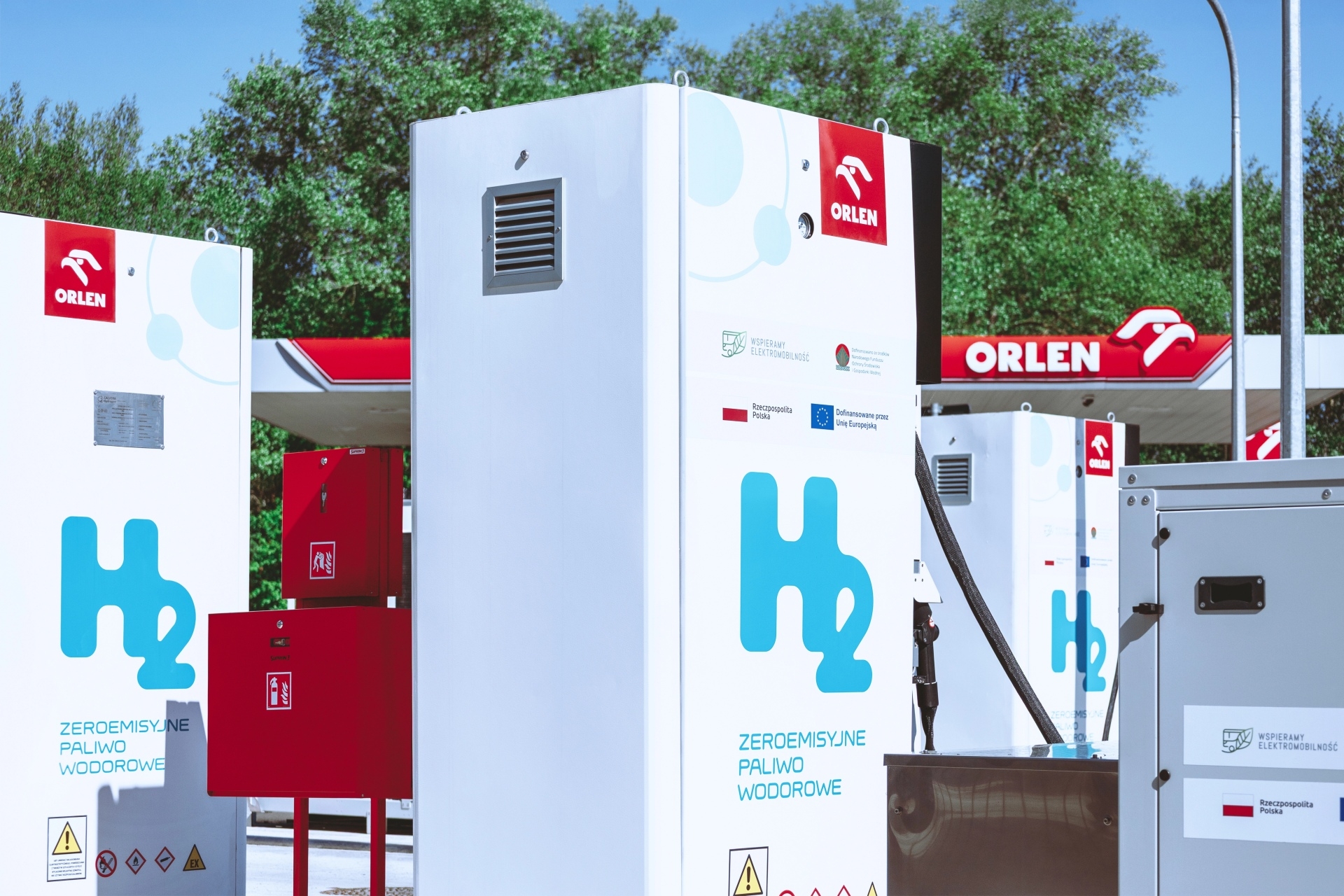
Low- and zero-emission hydrogen is actually our basic raw material of the future; obtained from renewable energy sources, it is both a raw material for use in our refineries and petrochemical plants, and it is, of course, immediately an energy carrier for transport. We are already offering such hydrogen in two dedicated hubs, which is used for transport purposes. The strategy and decarbonization very strongly address the issues of increasing the share of green, low- and zero-emission hydrogen for our production assets. Practically, the hydrogen produced today should be replaced by renewable or low-emission hydrogen in exactly the same amount. This means that investments in RES and investments in hydrogen obtained from RES are the main goal of the decarbonization strategy.
– emphasizes the Orlen representative.
The concern launched its first hydrogen hub in 2021 in Trzebinia, where grey hydrogen is currently produced. Ultimately, it is to produce low-emission hydrogen from renewable sources. As part of its hydrogen strategy, Orlen is also considering building a hydrogen hub next to the offshore wind farm under construction. However, everything depends on market demand.
Linking directly to offshore wind energy is a process that has been planned. In the first instance, it should be expected that the use of green energy will be dedicated to production assets where decarbonization and greening are essential. The market’s needs for green hydrogen, which would be obtained from wind power plants, and, for example, its application for transport, will in some sense be appropriately managed according to what expectations the market will set and on what scale. At the moment, we are ready to link the production of hydrogen from renewable energy sources with those we have at our disposal, but of course, appropriate regulations and market demand are needed, which will directly address the need to use green hydrogen, and not just the hydrogen that is currently available.
– says Dr. Arkadiusz Majoch.
The Orlen VC fund announced in mid-May that it had invested in Hystar, a manufacturer of PEM electrolyzers for the mass production of zero-emission hydrogen. The solution patented by the Norwegian company allows for the use of membranes up to 10 times thinner than in standard electrolyzers, which significantly increases efficiency and reduces the costs of hydrogen production. The concern emphasizes that this solution can be a significant support in achieving the concern’s strategic goals for the next decade. By 2035, it wants to use 350,000 tonnes of renewable and low-emission hydrogen annually.
Source: Newseria