











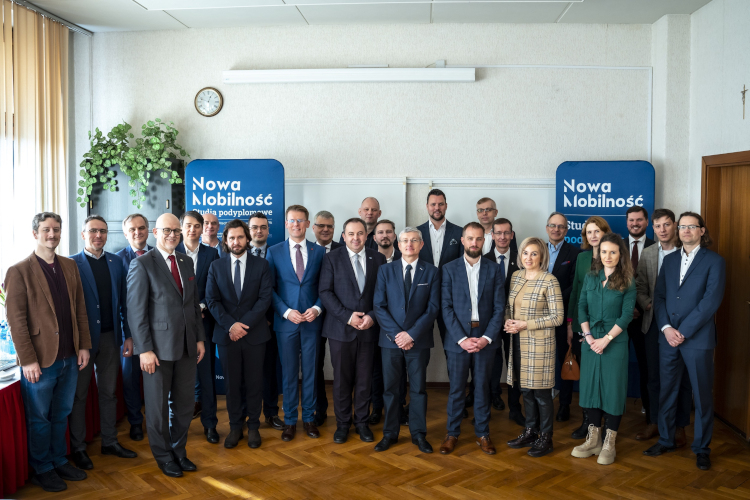
On February 28, 2023, the “New Mobility” postgraduate studies were officially inaugurated at the Faculty of Automotive and Construction Machinery Engineering of the Warsaw University of Technology. They represent a response to the needs of a changing labor market. They are aimed at management staff and company specialists building competencies in the area of sustainable transport and the broadly defined e-mobility sector. This is a milestone in the education of highly qualified personnel, who will be essential in the propulsion transformation of transport and the creation of new areas related to new mobility.
The launch of the New Mobility postgraduate studies, implemented by PSPA and the Faculty of Automotive and Construction Machinery Engineering of the Warsaw University of Technology (SiMR WUT), marks the culmination of several years of preparatory work. 48 lecturers are involved in the program, including those from the Inter-faculty Staff of the Warsaw University of Technology from the Faculties of Automotive and Construction Machinery Engineering, Electrical Engineering, Chemistry, and Transport, as well as 39 practitioners from the business sector.
– The first classes for the New Mobility course are already behind us. I had the great pleasure of conducting the first of thirty subjects that will be implemented over the course of two semesters. From the very beginning of PSPA’s operations, education has always been a priority for us. We are involved in a number of projects aimed at building awareness by imparting reliable knowledge. The inaugurated postgraduate studies are the best example of this – says Maciej Mazur, Managing Director of PSPA.
The launched postgraduate studies are a response to, among other things, the increasing demand for electric vehicles, the transformation of the transport sector, and the development of new mobility. In 2021, the number of newly registered electric vehicles worldwide reached 6.6 million. For comparison, in 2015, 351,000 electric cars were sold, while in 2010 – 7,300. Based on forecasts by the International Energy Agency (IEA), in 2030, more than one in three vehicles sold worldwide will be equipped with a traction battery. The electrification of fleets is associated with huge changes in the entire automotive industry, including a very dynamic increase in the demand for appropriately educated specialists.
– Deepening knowledge in the field of electromobility is no longer just pure curiosity, but a duty for people involved in fleet management. Solid knowledge, supported by practice and professional experience, is the best thing a student will receive. Bearing in mind that over 70% of new cars are registered to companies and it is mainly they that drive electromobility in Poland, in the Electromobility Management subject, I will focus on the transformation of car fleets through the eyes of a fleet manager – comments Marek Andruchów, President of the Association of Fleet Managers.
“New Mobility” is a course aimed at, among others, management staff and specialists from companies and institutions building competencies in the subject area. A modern approach to the didactic process will provide graduates with a comprehensive resource of knowledge unique on the Polish labor market related to electromobility, the electric vehicle market, charging infrastructure, the development of zero-emission technologies, including hydrogen, as well as all legal, social, and economic issues affecting the sustainable transport market.
– Reskilling and upskilling are currently two issues dominating discussions among automotive market experts. Anyone who decides to go in a new direction and pursue valuable education supporting the transition to zero-emission transport as early as possible seems to have all the aces up their sleeve in the context of the uncertain job market that we can expect in the coming years. – comments Alicja Pawłowska-Piorun, Expert – Sustainability at ING Bank Śląski, lecturer of the subject Electromobility for climate and environment. – Currently, several trends are clashing, hence it is difficult to make unambiguous predictions. On the one hand, we have production automation, so we can expect a reduction in employment in production, while at the same time, new jobs related to electromobility are being created. In the opinion of many, these changes may result in a net zero for the labor market (the number of people who will lose their jobs vs. the number of people who will find employment in new professions related to electromobility) – adds Alicja Pawłowska-Piorun.
The inaugurated classes are held as part of the 1st edition of the “New Mobility” postgraduate studies. The inauguration of classes at the university was accompanied by a ceremonial meeting of lecturers and people involved in the creation and organization of the studies.
There are still a few spots left for those interested in enrolling in the “New Mobility” postgraduate studies.
Below we present the full list of subjects and lecturers:
Semester I
- Fundamentals of electromobility – Maciej Mazur, Michał Kurtyka
- Electric vehicles – compendium – Maciej Gis, Andrzej Gemra
- Electric vehicle charging infrastructure – compendium – Albert Kania, Bartosz Kubik
- Charging electric vehicles from a legal and business perspective – Rafał Czyżewski, Jacek Zboina
- Lithium-ion batteries – Maciej Kwiatkowski, Łukasz Bednarski
- Electromobility and the power system – Adrian Sienicki
- Electromobility market – Piotr Michalczyk
- Law for electromobility – Poland – Filip Opoka, Andrzej Ziółkowski
- Law for electromobility – European Union – Aleksander Rajch, Katarzyna Barańska
- Electromobility management – Marek Andruchów
- Fundamentals of electrical engineering and electronics – Michał Rolak
- Fundamentals of mechanics – Piotr Przybyłowicz
- Elements of motor vehicle operation – Marek Guzek
- Energy transformation and the development of power electronics – Marek Jasiński
- Fundamentals of electric vehicle drives – Arkadiusz Hajduga
Semester II:
- Economics in the aspect of electromobility – Agnieszka Czajka, Wojciech Drzewiecki
- Financing electromobility – Przemysław Szywacz
- Business models in the electromobility sector – Piotr Arak, Janusz Grądzki
- The future of electromobility – Maciej Mazur, Małgorzata Kulis, Maciej Dryjański
- Hydrogen in transport – Andrzej Szałek, Jacek Pawlak
- Autonomous vehicles – Marcin Ślęzak, Małgorzata Pełka
- Electromobility in everyday life – Adam Jędrzejewski, Maciej Panek
- Electromobility for climate and environment – Ewa Łabno-Falęcka, Alicja Pawłowska-Piorun
- Electromobility in local governments – Hanna Zdanowska, Adam Wieczorek, Łukasz Franek
- Electromobility logistics and transport – Sebastian Anioł, Wojciech Rowiński
- Electromobility in public collective transport – Jan Wiśniewski, Jan Kuźmiński
- Diploma seminar – Jacek Dybała
- Energy storage and processing in electric and hybrid vehicles – Adrian Chmielewski
- Designing materials for chemical power sources – Władysław Wieczorek
- Elements of automotive diagnostics – Piotr Zdanowicz
More information on the portal: www.nowamobilnosc.pl