








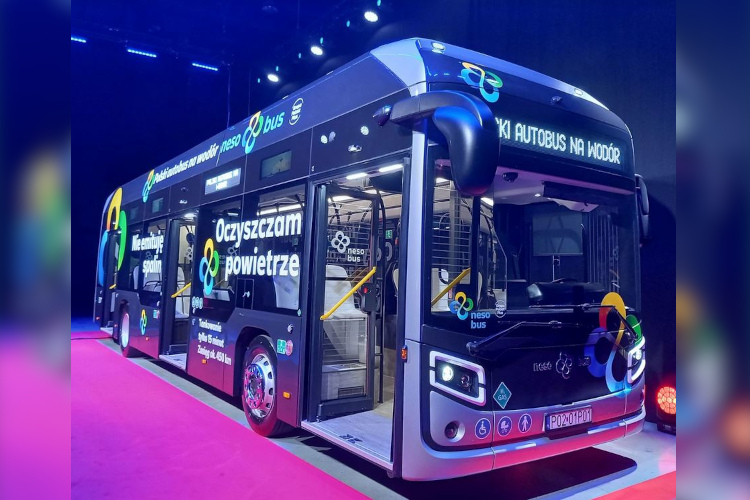
NesoBus is a completely new, zero-emission city hydrogen bus manufactured in Poland. Powered by green hydrogen, it is the most ecological bus for city residents and public transport. It was created by Polish designers and engineers in cooperation with partners from Europe and around the world. It is 12 m long, has up to 93 seats, including up to 37 seats, its range is about 450 km, it does not emit exhaust fumes, it cleans the air, and the only thing it emits is water vapor. The design of the NesoBus – a Polish hydrogen bus – is created from scratch as a hydrogen one – it is not a conversion or modification of a combustion or battery-powered bus. The start of serial production is planned for 2023 in the factory being built in Świdnik.
Public transport causes extreme air pollution in cities. Any air pollution can be a cause of diseases – not only of the respiratory system, but also strokes, cancers, heart attacks, allergies, etc. We have created a hydrogen bus that, powered by green hydrogen, does not emit exhaust fumes and additionally cleans the air. NesoBus is an ideal solution for city residents – it eliminates the emission of toxic substances – apart from CO2, these are primarily nitrogen oxides or dust, in particular fine PM 2.5 dust.
NesoBus, a Polish hydrogen bus, is an electric bus – it has an electric motor. It generates electricity on an ongoing basis from the refueled hydrogen using a fuel cell. Physically, hydrogen from the tank combines with oxygen taken from the air, and electricity is generated to power the electric motor. There is no combustion process. As a result of combining hydrogen with oxygen in the fuel cell, the bus emits water vapor from the exhaust pipe. This water is fully distilled.
NesoBus generates electricity on an ongoing basis by taking oxygen from the air and combining it with hydrogen from the tanks using a fuel cell. There is no combustion process. The intake air must be fully cleaned by special filters so that the fuel cell receives pure oxygen. Then the oxygen combines with hydrogen and energy is created, which powers the electric motor. NesoBus used on green hydrogen does not emit exhaust fumes and cleans the air.
The brand of the “Neso” hydrogen bus is an abbreviation for “Nie Emituje Spalin i Oczyszcza” (Does Not Emit Exhaust Fumes and Cleans) the air. NesoBus has a range of up to 450 km, and refueling takes only 15 minutes. Thanks to this, the fully ecological NesoBus does not waste many hours charging batteries. Instead of standing and charging for many hours, it can drive all the time. NesoBus is very efficient – it consumes an average of about 8 kg of hydrogen per 100 km. The tanks have a capacity of 37.5 kg of hydrogen, which allows for a range of approx. 450 km. In the SORT-2 test, it achieved a consumption of 5.5 kg of hydrogen per 100 km.
NesoBus is 12 m long, 2.55 m wide, 3.4 m high, its curb weight is less than 13 tons, and it can accommodate up to 93 passengers, including up to 37 in seats.
The design was created from scratch for a hydrogen bus and options are tailored to the needs of individual cities and carriers. It is created from scratch as a hydrogen one – it is not a conversion or modification of a combustion or battery-powered bus. The bus is built from scratch with hydrogen technology in mind – thanks to which it is very easy, for example, to replace hydrogen tanks with higher pressure ones and increase the range.
The bus is built modularly, with the possibility of adapting it to the needs of specific cities. It is built from very high-quality components. The exterior and interior were designed by the Italian company Torino Design, specializing in the automotive industry, the fuel cells come from the world leader in this field, Ballard, and the hydrogen tanks from Hexagon, specializing in the production of hydrogen tanks.
Source: Cyfrowy Polsat S.A.