











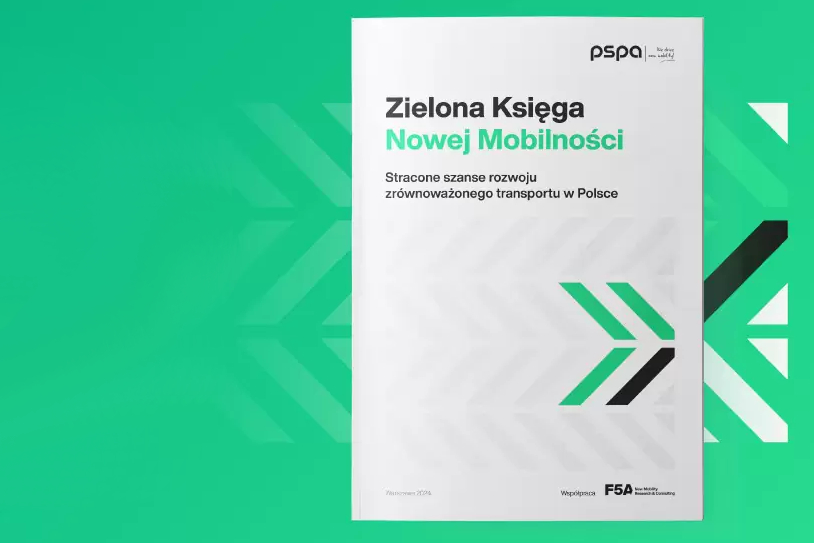
Poland ranks among the lowest in the EU in terms of the development of its zero-emission vehicle fleet and charging infrastructure. This is largely a consequence of insufficient support for zero-emission transport by public administration. The “Green Paper on New Mobility” prepared by PSPA contains a diagnosis of the current state of the e-mobility market, examples of missed development opportunities, and a list of 10 priority actions to be taken by the government in key areas. The report, along with the “White Paper on New Mobility” – a collection of over 120 specific legislative solutions announced many months ago, on which over 250 industry representatives worked – has been submitted to the Minister of Climate and Environment.
Streamlining connection procedures for charging stations, optimizing and expanding support programs (including for zero-emission heavy-duty vehicles and used electric cars), facilitating the installation of private chargers, and setting strategic goals for the e-mobility industry are some of the demands of the “Green Paper on New Mobility” prepared by PSPA. The report contains a list of 10 priority actions that the new government should take as soon as possible to accelerate the development of sustainable transport in Poland.
– The share of electric cars in Poland is almost four times lower than the European average. We are being overtaken not only by Western European countries but also by many countries in the CEE region. This is the result of the fact that the development of new mobility has never been a priority in Poland. It is high time to change this and start acting for the benefit of the economy, the climate, and society. If it were not for numerous neglects, the Polish sustainable transport sector could be in a completely different place than it is today – says Aleksander Rajch, Deputy Director of PSPA.
In order to diagnose the causes of the insufficient development of the Polish electric vehicle market, especially in the regulatory and systemic area, PSPA has prepared the “Green Paper on New Mobility”. The report points out the greatest neglects, contains a list of untapped market and economic opportunities, and presents the necessary actions that the new government should address first.
– The “Green Paper” is an appeal to the government administration to prioritize the zero-emission transport sector. Otherwise, we will lose a unique, historic opportunity for economic development and the reduction of harmful emissions. There are currently about 57,000 fully electric cars on Polish roads, and we also have about 6,000 charging points. Despite the growth, considering the size and potential of the Polish automotive market, we are at the tail end of Europe in both of these areas – says Maciej Mazur, Managing Director of PSPA, President of the European organization AVERE.
In the “Green Paper on New Mobility”, PSPA points out that the central administration has been very late in implementing necessary EU regulations (partially included in the Electromobility Act), many of which have not yet been introduced into the Polish legal order (including the so-called RED II/III directives aimed at increasing the share of RES in member states). Goals in the e-mobility area (the “famous” million electric cars by 2025) were unrealistic from the beginning and were in practice treated only as political slogans. Furthermore – unlike many countries around the world – strategic goals regarding electromobility in economic terms were not set at all. In addition, subsidy mechanisms for electric vehicles and charging infrastructure were introduced much later than in most EU member states.
– The “My Electrician” (Mój Elektryk) program has been operating since 2021, in practice since 2022, because only from that date can we talk about the launch of the most important call for proposals, addressed to companies and leasing providers. Meanwhile, subsidies for electric cars in Romania were available as early as 2011, in Croatia and Slovenia in 2014, in Hungary and Slovakia in 2016, and in Lithuania in 2018. The assumptions of “My Electrician” have not been updated for 2 years. As a result, Poland has one of the lowest BEV sales shares in the EU (less than 4% in 2023). An even more unfavorable situation prevails in the infrastructure sector – chronic connection procedures mean that the time to launch fast DC charging stations is the longest in Europe and often amounts to as much as 2 years (or over 3 years in the case of charging HUBs in some locations). This means that as of today, we have no chance of meeting the requirements of the EU AFIR regulation (the total power of the infrastructure should more than double in just 2 years). Furthermore, in 2023, only 10 out of 37 obligated local governments met the statutory goals regarding the minimum number of points (the deadline for this obligation expired almost 3 years ago). In turn, the blocking of KPO funds meant that over 1,700 electric buses did not hit Polish roads. This is more than the entire current fleet of these vehicles in Poland – explains Jan Wiśniewski, Director of the PSPA Research and Analysis Office.
According to the “Green Paper on New Mobility”, another neglected area is the industry sector related to sustainable transport. The Polish automotive industry currently accounts for 8% of Poland’s GDP, 13.5% of annual exports, and provides almost half a million jobs. However, the vast majority of Polish companies focus on supplies for conventional automotive. Meanwhile, from 2035, it will no longer be possible to register cars with internal combustion engines in the EU. This is a very serious challenge for the entire industry, and in the meantime, the central administration has done very little to support the inevitable transformation of the industry towards zero-emission. Vocational schools, high schools, and universities in Poland are still not programmatically adapted to educate appropriately qualified staff for the e-mobility industry. Moreover, it is regularly heard in the media that investors who considered Poland as a location for their factories or research centers ultimately chose another country, very often in the CEE region. Even Poland’s leading position in the field of lithium-ion batteries is at risk. According to BNEF data, by 2025, not only Germany or Sweden but also Hungary will overtake us in Europe in terms of production capacity. What is more, subsequent automotive factories are being closed in Poland or their production is being limited (examples include Scania plants in Słupsk, Volvo in Wrocław, or FCA in Tychy).
The “Green Paper on New Mobility” also shows that the development of the electric car market on a mass scale will not be possible without optimizing and expanding the support system. It is particularly advisable to introduce the possibility of deducting 100% VAT on the purchase and operation of fully electric cars. Unlike many European Union member states, Poland still lacks effective tax instruments encouraging the purchase of BEVs. Unlike subsidy programs, tax incentives are not limited by a reserved budget and, consequently, can cover a much larger number of potential beneficiaries. The “Green Paper” also includes proposals to increase the original budget of the “My Electrician” program (which will be exhausted by the end of the first half of 2024 at the latest) and to update the assumptions of this program (e.g., by increasing the maximum price of subsidized vehicles).
– Considering the purchasing power of Polish society and the structure of the domestic automotive market, it is also advisable to introduce subsidies for used electric cars. This will facilitate access to BEVs for many Poles who, for economic reasons, are unable to purchase a new zero-emission vehicle. We also postulate amending the law and introducing subsidy programs for the zero-emission heavy-duty vehicle market and the necessary infrastructure for eHDV. In light of EU regulations and the progressing electrification of fleets in other member states, the current lack of support for this area creates a risk of Poland losing its position as a leader in European heavy transport. And the TSL industry creates over 950,000 jobs in Poland and accounts for almost 6% of GDP – says Jan Wiśniewski from the PSPA Research and Analysis Center.
Based on the “Green Paper”, a priority for the new government should also be to reduce transport challenges through the development of various forms of new mobility, such as car sharing or electric bike rentals. It is also important to implement Directive (EU) 2023/2413 of the European Parliament and of the Council of 18 October 2023 (RED III) into the Polish legal order. It introduces, among other things, binding goals in the transport area (a minimum share of RES in final consumption by 2030 at the level of 29% or – alternatively – a reduction in greenhouse gas emission intensity by 14.5%). It also introduces mechanisms allowing charging station operators to participate in the so-called “carbon credits” system. The government should also start treating the development of new mobility not only as a challenge but also as a great, historic opportunity in economic terms. Therefore, the “Green Paper” contains a postulate to introduce a comprehensive “Support Program for the Automotive Industry during the Powertrain Transformation” including a schedule for implementing instruments that allow maintaining at least the current level of employment and the share of the automotive industry in Poland’s GDP. This corresponds to the proposal to prepare and implement the “PL Electromobility HUB” plan.
– The Green Paper is a diagnosis of the current situation in the area of zero-emission transport in Poland and directional postulates. However, a set of over 120 proposals for specific regulatory and systemic changes is contained in another, complementary PSPA report, namely the “White Paper on New Mobility”. Its preparation took over 1,000 hours of work, and over 250 partners from the entire sustainable transport value chain as well as 10 law firms and consulting companies were involved in the project. The “White Paper” is an absolutely key initiative addressing the main challenges and barriers to the development of the new mobility market in 12 areas. We assumed that the identification of these barriers and the development of appropriate postulates should take place with the participation of entities that are directly and indirectly affected by the prepared solutions. We hope that as many of them as possible will be implemented as quickly as possible, because the time window for their introduction is slowly closing. We have handed over both the Green and White Papers on New Mobility to the Minister of Climate and Environment, Paulina Hennig-Kloska – says Maciej Mazur, Managing Director of PSPA, President of AVERE.
The full text of the document is available on the website: Green Paper on New Mobility