











In recent years, the logistics industry has been struggling with major difficulties, primarily including: a drastic increase in the prices of packaging materials, fuel, and services, changes in legal regulations under the Mobility Package, growing requirements in the environmental sphere, and changing consumer trends directly related to the rapid development of e-commerce. In today’s world, to stay on the market, courier companies are facing challenges related to seeking savings and solutions within the framework of sustainable development while simultaneously needing to increase the volume of handled shipments. The increase in costs and shipment volumes, resulting from, among other things, the current geopolitical situation, the dynamic development of e-commerce, and growing customer expectations regarding delivery speed, makes the necessity of investing in modern technologies for fleet management, warehousing, and the shipment preparation process seem obvious.
The printer as an essential element of a courier’s efficient work
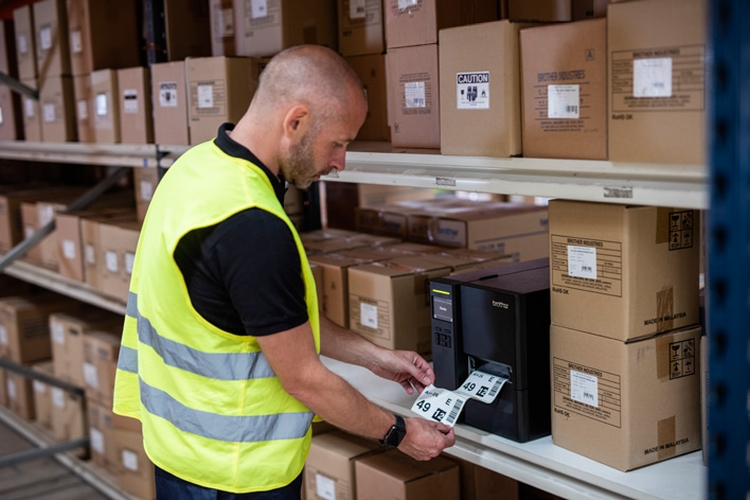
In the context of these activities, a properly designed operational infrastructure plays a key role, including, for example, efficient, ergonomic, and inexpensive printers for logistics labels. A logistics label printer is not only a tool that facilitates parcel labeling but also an important element in optimizing logistics processes. A properly selected printer allows for fast and precise printing of labels with necessary shipment information, waybills, location markings, pallet identification stickers, product labels, etc., which translates into shorter shipment preparation times and a reduction in the risk of errors.
Choosing the right printer: key features
When choosing the right logistics label printer for a courier, several key features should be considered:
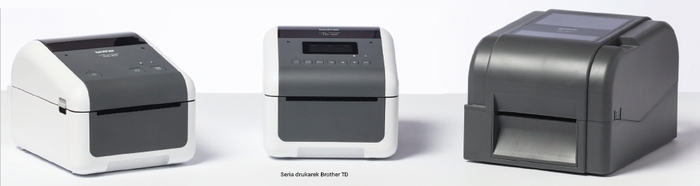
- Print speed: in the case of high shipment volumes, it is important to choose a printer that ensures efficient operation, allowing for fast parcel labeling. High-volume Brother TJ series industrial printers (e.g., TJ-4021TN) are perfectly suited for production, transport, and logistics applications. They offer high print speeds, large ribbon capacity, and an internal rewinder in selected models.
- Print quality: the printer should ensure high print quality, which is crucial for label readability and ensuring correct shipment identification. Professional Brother TD series printers (e.g., TD-4210D) stand out here, offering the ability to print high-quality labels, receipts, RFID tags, and wristbands tailored to the user.
- Ease of use and durability: an ergonomic design and an intuitive user interface are essential for smooth and efficient device operation. Brother industrial printers can operate even in the most demanding production conditions.
- Compatibility and easy integration: the printer should work with various label formats and operating systems, which will ensure easy integration with the company’s existing IT infrastructure. Modern printers support various printer command languages, including ZPL2 emulation, making their replacement very simple.
Summary
A properly selected logistics label printer is an essential tool in the courier industry, enabling effective management of the shipment preparation process. Thanks to print speed, high print quality, and ease of use, this printer supports the optimization of logistics operations and contributes to saving time and resources, which is crucial in the dynamic TSL business environment.