











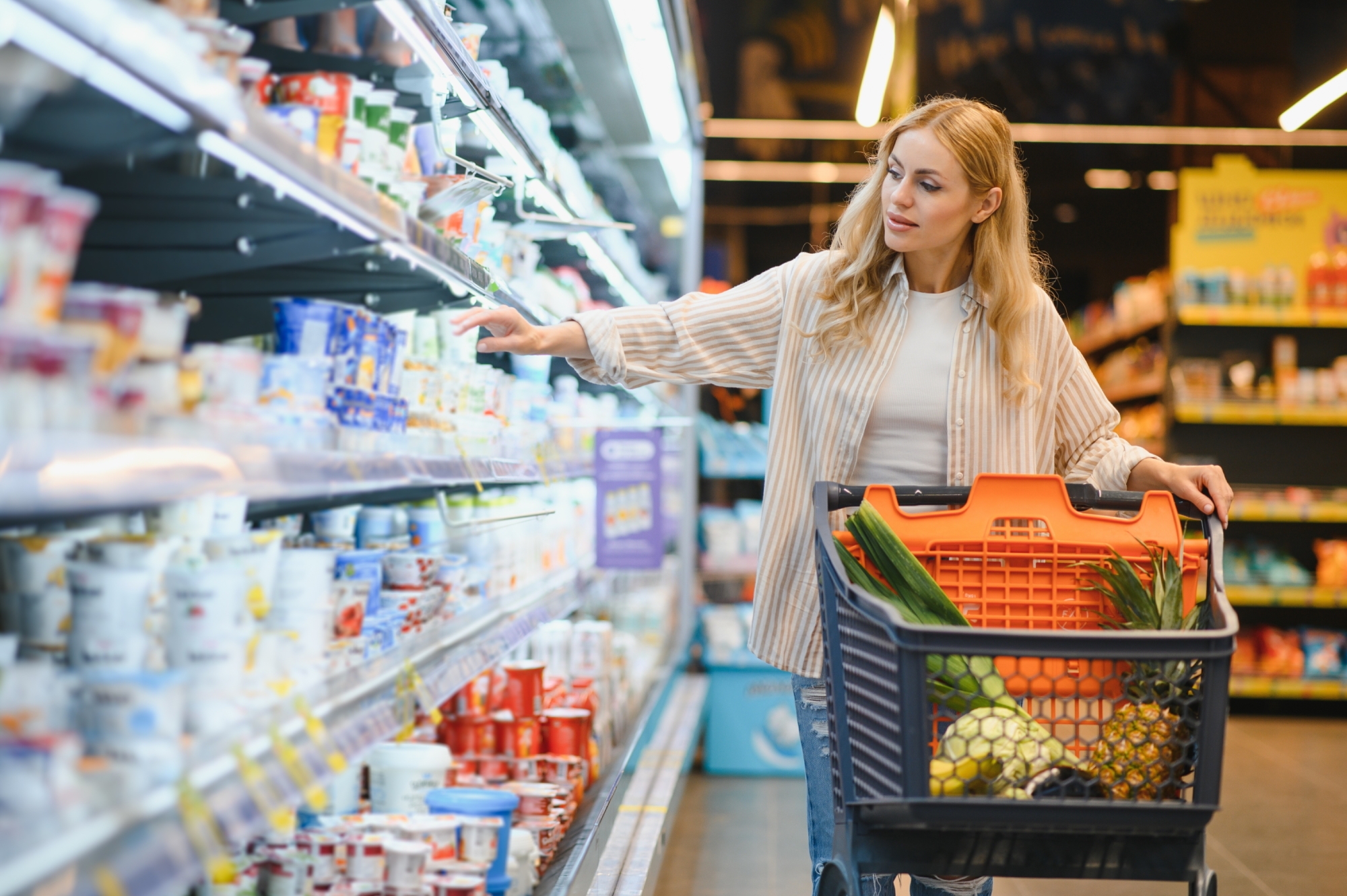
One of the fundamental roles of packaging, beyond storage and transport, is its visual appeal, which helps a product stand out on the shelf, capture customer attention, and drive purchase decisions. However, packaging serves many more functions, and beyond the consumer, it should also be readable by algorithms. We are talking about artificial intelligence, which, when used in shelf management systems, facilitates product availability monitoring and streamlines logistics. To effectively support logistics and sales processes, it is necessary to apply AI-friendly design solutions. So, in today’s world of multipacks, promotional sets, and bulk packaging, how do we create product packaging that increases operational efficiency, improves analytics, and ultimately boosts sales?
Calculations by the Polish Chamber of Commerce[1] based on Statistics Poland (GUS) data show that total retail trade in Poland in February 2025 amounted to nearly 96 billion PLN. The largest share of retail sales was held by food, beverages, and tobacco products (26.1 percent), i.e., fast-moving consumer goods, which also include cosmetics (together with pharmaceuticals and orthopedic equipment, they accounted for 8.4 percent of retail sales). FMCG products are intended to rotate quickly on the store shelf, and their sale is facilitated by appropriate packaging. Manufacturers often focus on its visual side and adaptation to logistics requirements, but properly designed packaging can also be used to collect data that translates into sales efficiency.
The same product, many packages
Beyond attractive design, packaging must be functional, protect the product inside well, and at the same time facilitate transport and storage. Logistics considerations are therefore just as important as the consumer’s aesthetic experience. When thinking about packaging, one must also take into account the requirements of modern trade. The same product can be sold in various forms – from multipacks and mixed cartons to occasional product sets. It often requires conversion for a specific sales channel – retail chains, discounters, e-commerce, and sometimes customization related to occasions such as holidays or special events.
From a logistics perspective, the most important thing is to adapt the packaging to a specific sales channel, store format, or the specifics of a given season. More often than unit packaging, we are talking here about various types of bulk packaging. Specialized services such as co-packing or labeling, where the product is repacked, assembled, or labeled, have become particularly important for manufacturers. Promotional campaigns like “buy one get one free,” occasions such as Valentine’s Day, or launching a new product on the market often require specific logistics operations. Adapting the product to the form of, for example, a multipack or a gift set, however, translates into operational benefits and streamlines sales.
– explains Mariusz Jóźwik, regional director responsible for warehousing, co-packing, and co-manufacturing at FM Logistic Central Europe, one of the largest logistics operators operating in Poland.
Packaging through the eyes of AI
A less obvious feature of product packaging than design is its readability for systems analyzing shelf exposure. Meanwhile, its importance is growing because more and more companies are reaching for tools based on artificial intelligence, such as Shelf Recognition AI, which are revolutionizing the way exposure is managed in the FMCG industry. They facilitate monitoring product availability, analyzing their placement, and streamlining logistics processes. The effectiveness of these tools depends not only on the advancement of the algorithms but sometimes also on the design of the packaging of the products being studied. A challenge for AI can be packaging, both unit and bulk, designed in a way that does not sufficiently differentiate individual product variants, e.g., different weights or flavors. Sometimes the effect of co-packing activities, and thus promotional packaging, multipacks, or limited editions, can be problematic. On the other hand, matte labels following the eco trend work great here.
Most of these challenges can be solved relatively simply by including the needs of AI in the packaging design, as it likes to pick up characteristic graphic elements. It is worth for manufacturers to know that such measures can significantly improve analytics, providing them with valuable sales data. Interestingly, many of them are identical to the needs of consumers and can also help them identify a specific product on the shelf. Combining good design with principles that facilitate recognition by artificial intelligence is the future of packaging design. What might seem like an additional requirement for designers today is actually an opportunity for better brand visibility, a better customer experience, and greater sales efficiency.
– says Paweł Majsiej, Chief of Marketing & Shelf Recognition AI at eLeader, a company specializing in providing IT tools that support sales management.
Will logistics considerations and AI-driven design become the new standard in creating FMCG product packaging? Good design will certainly remain valuable, but it must be remembered that sales are influenced by more than just the visual layer. What the consumer usually does not notice is equally important.
[1] https://kig.pl/aktualnosc-ekonomicz/sprzedaz-detaliczna-w-lutym-2025-roku-2/
Source: FM Logistic Central Europe