








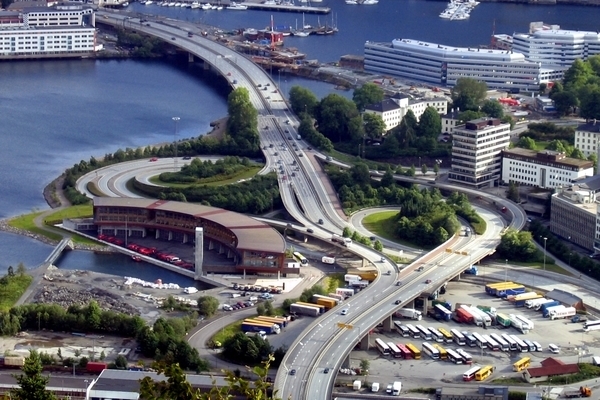
Dense urban networks are characterized by both a high concentration of intersections in a limited area and significant heterogeneity in traffic flow volumes and speeds. This can lead to frequent disruptions in traffic flow fluidity.
Furthermore, the variability of traffic conditions in time and space, expressed by varying degrees of saturation of individual urban network elements, often causes congestion and increased travel time, which is particularly severe during peak traffic periods. Urban networks are areas where many interdependent events occur. Some of these may necessitate the closure of individual elements to traffic, leading to disruptions in the functioning of the city’s entire transport system. Hence, modeling traveler behavior in dense urban networks is a particularly complex issue.
The high density of an urban network, expressed by the number of infrastructure elements of various types per unit area, provides greater route choice possibilities compared to other types of networks. Consequently, the traffic flow moving between the origin and destination is distributed across a larger number of alternative routes, and the degree of utilization of each is often difficult to estimate. Among the basic factors influencing route choice in a network, the so-called generalized cost of travel, the main component of which is travel time, is cited as the most important. Therefore, a significant problem when constructing a model for assessing the consequences of road network element closures is determining the magnitude of the increase in travel time, both from the perspective of the entire system and individual travelers. Disruptions in the urban network caused by congestion are cyclical over a certain time horizon and are usually typical for a specific element of the transport network. In dense urban networks, the source of communication problems is mainly intersections, from where disruptions propagate to segments between intersections and further to other elements of the transport network, leading to traffic jams. Any additional unexpected disruption resulting from the closure of a specific urban network element can trigger atypical communication behaviors among network users, resulting from their disorientation and the making of often irrational decisions. Only after a certain period of adaptation to the new traffic conditions can one speak of a new state of equilibrium. This state can be disturbed again upon another change in network structure associated with the end of the closure. One of the basic elements of an urban network is the street, which serves as a place for the joint functioning of various transport subsystems (e.g., individual, public, and freight transport systems). Therefore, the effects of disruptions resulting from its closure can affect the efficient operation of each of these subsystems. (…)
The article contains 54,698 characters.
Source: Logistyka Magazine 4/2012