








We present to you the sixth chapter of the latest edition of the “Logistics in Poland” report, dedicated to current trends and the existing situation in the warehouse market.
 In the years 2016 – 2017, the warehouse space market recorded significant growth. Analysts were unanimous in their assessments, pointing out that the results were record-breaking. However, published data differ due to the adopted method and scope of research as well as data sources. According to the Central Statistical Office (GUS), in 2016, the total increase in new warehouse space amounted to 2.97 million sq. m. According to the same source, over a ten-year period (2007 – 2016), the total supply of new warehouse space amounted to almost 27 million sq. m. Real estate agencies, whose focus is on transactions in the commercial warehouse space market, estimated its growth in 2016 at 1.2 million sq. m., and in 2017 at 2.3 million sq. m. Similar growth was recorded in studies by the Institute of Logistics and Warehousing.
Compared to GUS data, in the decade 2007-2016, the increase in commercial warehouse space amounted to approx. 7.5 million sq. m. Similar to the years 2013 – 2014 covered by the previous study, the source of high growth dynamics was primarily the good performance of the economy and the accompanying decline in unemployment, which resulted in an increase in internal consumption reinforced by the government’s pro-family policy. The groundwork for the growth of investments in the warehouse space market was prepared in the years 2013 – 2014, during which GDP amounted to 3.4% and 3.6% respectively, and forecasts for the following year predicted further growth. Therefore, 2015 ended not only with an increase in commercial warehouse space of over 800,000 sq. m., but also with a similar amount of warehouse space remaining under construction and approximately 70% secured by preliminary lease agreements. Although the GDP indicator in 2016 turned out to be lower than the previous year by approx. 0.9%, the amount of new warehouse space put into use was still greater than the year before.
The renewed GDP growth, which reached 4.6% at the end of 2017 and was one of the highest in Europe, translated into record results in the warehouse market, not only in terms of the size of new investments but also the amount of leased space, the number of transactions, and a decrease in the vacancy rate.
Commercial warehouse space
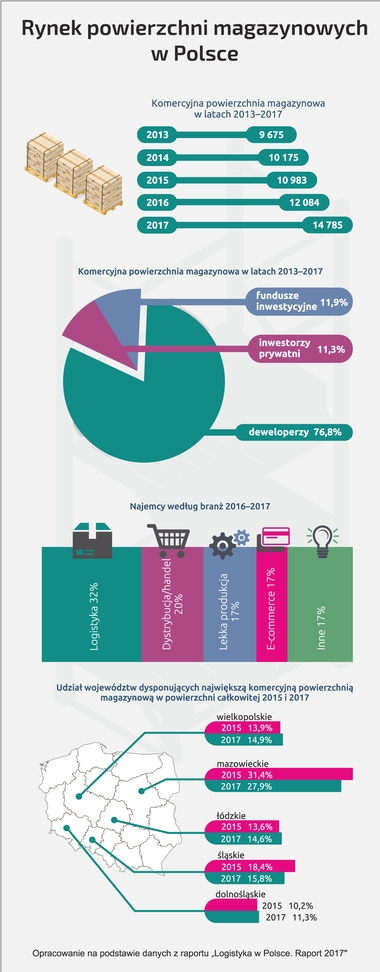
According to research by the Institute of Logistics and Warehousing, commercial warehouse space in Poland at the end of 2017 amounted to almost 15 million sq. m., which included not only new large-scale warehouses that are the object of interest for companies analyzing transactions in the warehouse real estate market and mediating in their leasing, but also smaller warehouse facilities not in their field of interest. In 2016, the amount of new space put into use amounted to over 1.1 million sq. m., while the year before it was approx. 0.8 million sq. m. In 2017, the growth was even higher and amounted to almost 2.8 million sq. m.
One of the effects of this growth was the lively activity of industrial developers in regional markets, which were treated marginally in previous years. Furthermore, the development of e-commerce brought several spectacular investments in terms of size of the BTS (Build-to-Suit) type (Amazon, Zalando) and caused some of the previously used warehouse facilities, utilized for servicing this distribution channel, to prove inefficient, which prompted their users to extend lease agreements. The year 2017 brought not only almost 2.8 million sq. m. of completed new commercial warehouse space but also approx. 1.3 million sq. m. of space under construction, which promises another good year. A comparable amount of warehouse space remaining under construction was also recorded in 2016. As in previous years, industrial developers dominate among the owners of modern warehouse space. Compared to the previous study, the share of individual types of investors in total warehouse space has also changed little. However, numerous acquisitions of previously built facilities were observed, not only by investment funds, which was characteristic of the years 2014 – 2015, but also between industrial developers. Their scale was larger than before. In 2017, investors not only completed investments started a year earlier but, taking advantage of the good economic climate, built an additional 1.4 million sq. m., which gave a total increase of approx. 2.8 million sq. m. Unlike in previous years, investments secured by preliminary lease agreements and BTS-type projects dominated, their total share in new space amounting to approx. 70%, as a result of which the average vacancy rate not only did not increase but decreased by 0.9% compared to 2016, although it varied across individual regional markets.
(Full content of Chapter 6 in the attachment).
->> Read also the other chapters of the Report:
– Chapter 1 – Digitization of transport chains
– Chapter 2 – Logistics in the Polish economy in the years 2016-2017
– Chapter 3 – Logistics market in Poland 2016-2017
– Chapter 4 – CEP market in Poland
– Chapter 5 – Transport and forwarding market
– Chapter 7 – Assessment of the state of logistics in companies operating in Poland in 2016 and 2017
– Chapter 8 – Logistics education