









In the fourth chapter of the latest edition of the “Logistics in Poland” report, we read about the courier, express, and parcel (CEP) market.
The CEP market in Poland does not have a long history, unlike other segments of the logistics services market. The first companies with foreign capital opened their branches in our country about 30 years ago. Small Polish companies developed almost in parallel, which were eventually acquired by Western corporations. As a result of acquisitions and mergers, this market has become increasingly consolidated. Not only has its structure changed, but also the types of clients and industries served. Currently, CEP operators strive to provide comprehensive services available in one place (one-stop-shopping) in order to be the company of first choice.
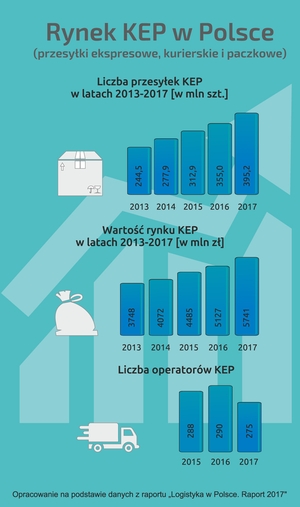
The CEP market is specific compared to other segments of the TSL sector. Its main differentiator is high concentration – about 77% of revenues in Poland come from the four largest entities, while in TSL it is only 5-6%. It is also characterized by higher barriers to entry, which result from the need to have a dense and extensive operational network, necessary for timely and relatively inexpensive deliveries. The activities of CEP operators in Poland are subject not only to transport law regulations but also to postal law. This involves additional requirements and in some cases complicates the companies’ operations, e.g., the obligation to report and organize tasks for the defense of our country. The final differentiator of the CEP market is that the senders and recipients of shipments are not only legal entities but also individuals. This causes not only a different approach to customers but also their operational handling (e.g., home delivery including carrying the goods inside, the problem of the recipient’s absence at the addressed location).
The structure of the CEP market in Poland is very similar to the structure of other markets in the European Union. Almost all groups of suppliers are present here, i.e., CEP integrators – global companies providing courier and express services based on foreign capital (UPS, DHL, FedEx) and entities with a European reach (DPD, GLS); local CEP operators – large companies offering express parcel delivery services operating on the domestic market (Geis, InPost) and smaller players that are dynamically developing (e.g., Delta Kurier, Patron Service); postal operators (mainly Poczta Polska); many companies with a local reach (e.g., Agap, X-press Couriers). The market is also created by relatively new organizational forms, such as brokers aggregating offers from several courier companies (sendit.pl, apaczka.pl, kurjerzy.pl, etc.) and price comparison websites for courier services (kurierem.pl, znajdzkuriera.pl, etc.).
CEP Service
Over the years, the nature and scope of the CEP service have changed. Currently, it can be defined as a service consisting of delivering a shipment from the sender to the recipient or to a place designated by them, by a specialized company, using an appropriate operational (logistics) network, with the possibility of tracking information about the shipment status, with a specified delivery time, in the shortest possible time, while maintaining appropriate costs and in accordance with customer expectations.
 At the beginning, CEP services were performed in a “door-to-door” system, in which the courier delivered the shipment directly to the recipient. Currently, the conceptual scope of shipment delivery is broader and includes delivery to a specific place (e.g., a store) or device (e.g., a parcel locker). The subject of delivery is most often three categories of shipments: documents (offers, tenders, commercial contracts, and other information transmitted in printed form), parcels (finished products, material samples, spare parts, other commercial goods of low weight), and small shipments (palletized, non-standard shipments, e.g., tires). Full truck load (FTL) and non-standard (oversized, e.g., gardening, construction items) loads are also appearing, which were previously the domain of ordinary transport companies.
In addition, CEP operators offer a number of additional services, such as: cash on delivery, proof of delivery, return of documents attached to the shipment by the sender, delivery of the shipment on Saturday, Sunday, or on the same day within the country. Services related to informing the customer before the shipment is delivered and delivery within specific time slots are becoming increasingly popular.
Operational Network
An extensive operational network is needed for the timely and cost-effective provision of CEP services. This network is primarily created by people and elements of logistics infrastructure, such as: shipment sorting centers, branches, drop-off and pick-up points, and various means of transport. The largest CEP operators employ several thousand employees. The backbone of every company is the couriers, who in most companies are subcontractors running their own business with their own cars. The exceptions are some smaller courier companies (e.g., X-press Couriers, Patron Service, Global Express) and Poczta Polska, which employ some couriers on a contract basis. The total number of couriers in Poland is over 20,000. To this, one should add about 15,000 employees who are part of the administrative and managerial staff, as well as operational staff: dispatchers, coordinators, sorters, warehouse workers, etc.
Operators with nationwide coverage have several sorting centers and several dozen branches in Poland. They are located in the center of Poland (near Łódź) and in the vicinity of larger cities (Warsaw, Poznań, Wrocław).
Another important element of the infrastructure of CEP operators are pick-up and drop-off points (PUDO), which are located in easily accessible places, such as: newsstands, shopping malls, gas stations, grocery stores. Companies increase the number of such points every year. Their dynamic development was mainly contributed to by electronic commerce. On the one hand, they are a more flexible solution for individual customers, and on the other, they eliminate costs associated with undelivered shipments.
The means of transport of CEP operators for handling domestic shipments consist of both commercial vehicles and trucks. Due to the small size of the loads, the courier fleet consists of small cars with a total permissible weight of 3.5 tons. The previously mentioned number of over 20,000 couriers directly translates into the number of vehicles needed.
(Full content of Chapter 4 in the attachment).
->> Read also the other chapters of the Report:
– Chapter 1 – Digitalization of transport chains
– Chapter 2 – Logistics in the Polish economy in 2016-2017
– Chapter 3 – Logistics market in Poland 2016-2017
– Chapter 5 – Transport and forwarding market
– Chapter 6 – Warehouse market
– Chapter 7 – Assessment of the state of logistics in companies operating in Poland in 2016 and 2017
– Chapter 8 – Logistics education