










Taking into account contemporary production locations and global freight transport directions, the 2011 White Paper entitled Roadmap to a Single European Transport Area – Towards a competitive and resource efficient transport system formulates a number of suggestions regarding modern solutions for handling cargo transported over long distances.
It is emphasized, among other things, that a greater number of efficient transshipment and handling points for cargo arriving from overseas are needed on the coasts of the European continent in order to reduce unnecessary transport across European territory. In this context, significant functions are attributed to seaports, which are to play an important role as broadly defined centers for logistics cargo handling, possessing convenient and efficient connections with inland areas. It can be considered that a specific comprehensive response to the new challenges faced by seaports, which are to become places for the logistics handling of large volumes of cargo, mainly containerized, is the broadly defined concept of “port-centric logistics,” which in practice can take various forms. The subject of this article is the issue of how logistics centers, being created in many European countries, can contribute to the implementation of the above concept.
The “port-centric logistics” concept – selected issues
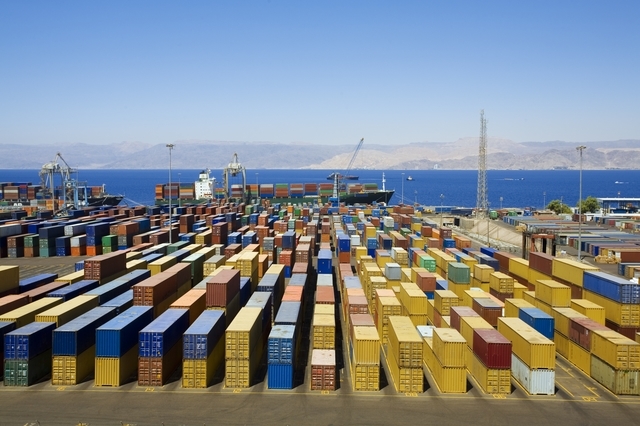
Containerization, which has been developing for several decades, has placed high demands on specialized maritime terminals, which serve as a kind of buffer and storage place for cargo in supply chains, as well as performing a number of other functions. Modern terminals must also meet the complex requirements of supply chain participants. It is expected that value-added services will be created here. Maritime container terminals must follow the role assigned to them in the changing distribution structures of many products. There are, among other things, many arguments in favor of deconsolidating containerized cargo at the seaport (destination) to avoid unnecessary inland transport of empty containers. However, container terminals themselves often do not have sufficient surface resources to perform this range of additional functions. Referring to new trends related to distribution structures, it is worth mentioning that, on the other hand, many manufacturers and distributors prefer solutions where products are stored inland, close to their consumption points. Terminal operators and logistics operators active in the modern TSL market must also take this condition into account. Responding to this range of sometimes contradictory requirements and trends, the literature points to the validity of implementing the “port-centric logistics” concept. (…)
The article contains 39,281 characters.
Source: Logistyka Magazine 5/2012
The port-centric logistics concept – selected issues – PDF file for download